


Quick Answer: What Was Western Xia?
Western Xia (西夏, Xī Xià) was a state founded by the Tanguts (党项, Dǎngxiàng) in 1038. It ruled parts of what is now northwestern China and dealt with several neighboring states until the Mongol conquest of 1227.[1][2][3]
- A Tangut state: The court ruled from the area of present-day Yinchuan and negotiated with the Song over war, payments and frontier markets.[1][2][3]
- Writing and books: The Tanguts used a distinctive character script for Buddhist texts, translations, dictionaries and other records.[5][6][7][10]
- Surviving heritage: Imperial tombs near the Helan Mountains and texts from a former frontier city preserve different kinds of evidence.[1][7][9]
Tangut writing remained in use after the Mongol conquest.[1][7][10]
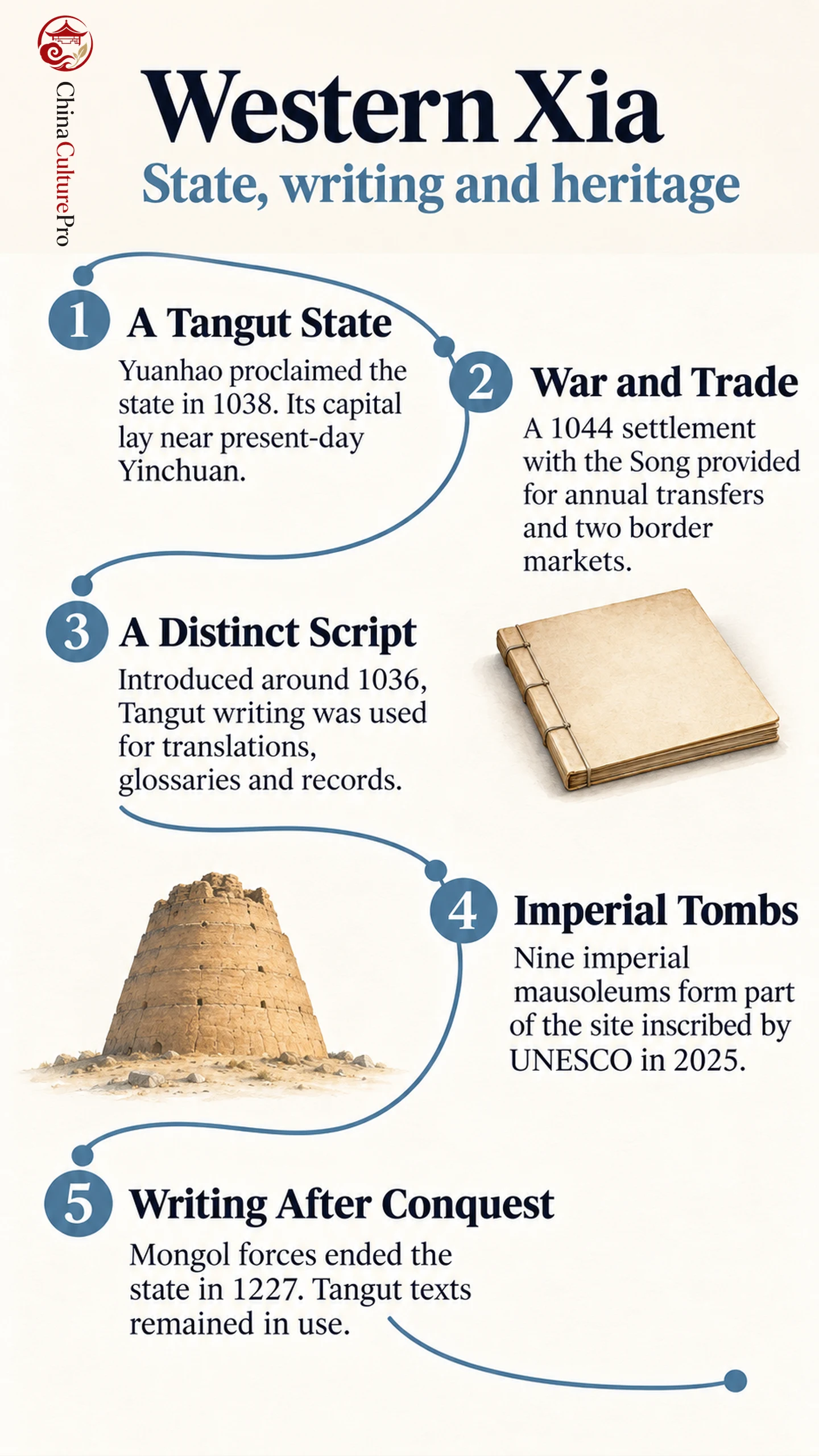
A contract, a bilingual glossary and a rammed-earth tomb preserve different aspects of a state that often appears in histories through its wars.[1][4][5][11]
The Tangut State and Its Capital
Tangut rulers had established power in the northwest before their leader Yuanhao (元昊, Yuánhào) proclaimed an imperial state in 1038. Its capital, Xingqing (兴庆, Xīngqìng), was in the area of present-day Yinchuan in Ningxia. Its territory extended west into the Gansu corridor, where routes linked towns and oases across the northwest.[1][2][3]
Western Xia governed communities in a varied landscape. The capital lay near agricultural land along the Yellow River, while other areas supported pastoral activity or trade. Surviving contracts record transactions over land and other property. Accounts and administrative records also show how the state tracked economic activity. These sources preserve details of exchange and obligations alongside the diplomatic record.[2][4][7]
War, Trade and the Song Frontier
The new state challenged the Song dynasty on its northwestern frontier. War from 1040 to 1044 ended in a negotiated settlement. The Song recognized Yuanhao under a royal title and agreed to annual transfers of silk, silver and tea. The arrangement also permitted two official border markets.[2][3]
The two sides could describe the settlement in different terms. Song documents placed Yuanhao within a hierarchy of titles, while the Tangut court retained control of its territory and institutions. The market provisions created specific places for regulated trade across a frontier that had been fought over. Renewed conflict later put pressure on those arrangements.[2][3][4]
The Tanguts also dealt with the Khitan Liao dynasty and, after its fall, the Jurchen Jin dynasty. Fighting with the Liao in the mid-eleventh century shows that peace on the Song border left other disputes open.[2][3]
Tangut Writing and Translation
The Tangut script (西夏文, Xīxiàwén) was introduced under Yuanhao around 1036, shortly before the imperial proclamation. Its characters can look similar to Chinese characters at a glance because of their square form and use of strokes. They form a distinct writing system for the Tangut language, with their own components and conventions.[5][6][10]
A bilingual glossary known as Pearl in the Palm (番汉合时掌中珠, Fānhàn Héshí Zhǎngzhōngzhū) pairs Tangut and Chinese material. For readers who knew one of the languages, the parallel entries provided a way to study the other. Modern researchers have used the same correspondences to identify character meanings and work out aspects of historical pronunciation.[5][10]
Surviving books include handwritten manuscripts and prints made from carved wooden blocks. Translations from Chinese and Tibetan sit alongside works written in Tangut. The manuscripts preserve handwriting and copying practices. Woodblock editions show how printers could reproduce the same pages for more than one reader.[5][6][7][8]
Buddhism and the Imperial Tombs
Tangut patrons supported Buddhist translation and book production. The surviving texts and images reflect religious connections with neighboring societies. Printed texts, silk paintings and votive objects give physical evidence of different ways people supported Buddhist practice.[6][7][8]
The Xixia Imperial Tombs (西夏陵, Xīxià Líng) lie in the foothills of the Helan Mountains. The World Heritage property includes nine imperial mausoleums, 271 subordinate tombs and structures that controlled floodwater. Some of the most visible remains are rammed-earth cores. Tomb structures could have a tiered, stupa-like form. Finds of tiles and architectural ornaments help reconstruct features that have weathered away.[1][9][11]
The concentration of imperial and subsidiary tombs marks differences in rank. Stupa forms and surviving ornaments also show how Buddhist imagery entered the imperial burial landscape. UNESCO inscribed the property on the World Heritage List in 2025.[1][9][11]
The Mongol Conquest and What Survived
Mongol campaigns ended the Tangut state in 1227. This was part of the expansion that preceded the establishment of the Yuan dynasty. Tangut writing continued in use after the conquest, and some of the places once controlled by Western Xia remained active.[1][2][7][10]
The ruined city of Khara-Khoto (黑水城, Hēishuǐchéng), in present-day Inner Mongolia, preserved texts in Tangut, Chinese, Tibetan and other languages. It continued to be occupied after 1227 and was attacked by Ming forces in 1372. Its collections therefore reflect a long-lived settlement. The imperial cemetery preserves evidence of the dynasty’s institutions, and the city’s texts preserve uses of languages and books across more than one period.[1][5][7]
FAQs About Western Xia
When did Western Xia exist?
Yuanhao proclaimed the state in 1038, and Mongol forces ended it in 1227. Tangut rule in the region had earlier roots, and Tangut texts continued to be used after the conquest.[1][2][10]
Was Tangut writing the same as Chinese writing?
Tangut was a distinct character script used to write the Tangut language. Its characters resemble Chinese characters in their overall appearance, and bilingual works connect the two systems.[5][10]
What survives from Western Xia?
Surviving evidence includes the imperial tombs, printed Buddhist texts, manuscripts, dictionaries and administrative documents. Finds from Khara-Khoto also preserve material from later periods of occupation.[1][4][5][6][7][9]
出典
[1] UNESCO World Heritage Centre. Xixia Imperial Tombs
[2] Cambridge University Press. Inner Asian Rule: Liao, Xi Xia, Jin and Yuan
[3] Journal of Chinese History. The Fragility of Peace on the Song Northwestern Frontier
[4] Brill. The Economy of Western Xia
[5] Imre Galambos. Translating Chinese Tradition and Teaching Tangut Culture
[6] Brill. Manuscript and Print in the Tangut State
[7] International Dunhuang Programme. Kharakhoto Collections
[8] International Dunhuang Programme. Late Buddhism on the Silk Roads
[9] UNESCO World Heritage Committee. Decision to Inscribe Xixia Imperial Tombs
[10] Unicode Consortium. Tangut Ideographs and Script
[11] ICOMOS. Evaluation of Xixia Imperial Tombs