
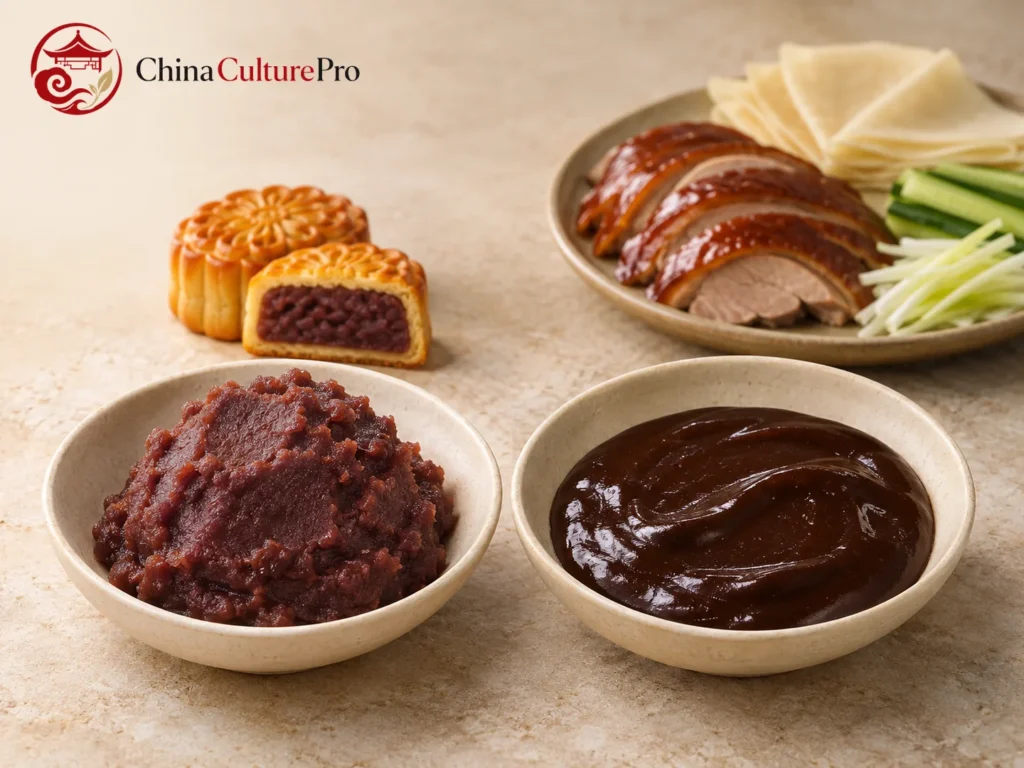

Quick Answer: Are Red Bean Paste and Sweet Bean Sauce the Same?
No. Sweet red bean paste, Hong Dou Sha (红豆沙, hóng dòu shā), is a cooked, sweetened red-bean filling. Sweet bean sauce, Tian Mian Jiang (甜面酱, tián miàn jiàng), is a sweet-savory fermented seasoning for savory dishes.[1][3]
- For a sweet pastry filling, look for a suitable red bean paste.
- For a dark savory noodle or dipping sauce, check for tian mian jiang.
- Read the Chinese name and ingredients when the English label says only “sweet bean paste.”[4][5]
They are not one-for-one substitutes. Similar brown color and the word “sweet” do not give them the same flavor or cooking role.

Start with the dish you plan to make. A sweet bun needs a filling that supplies body and sweetness; a savory noodle sauce needs a condiment that supplies seasoning.
Compare the Two Products at a Glance
| 製品 | Main identity | Flavor and usual role |
|---|---|---|
| Sweet red bean paste | Cooked red beans, usually adzuki, combined with sugar and sometimes other filling ingredients. | Sweet bean flavor; used as a dessert or bakery filling.[1][8] |
| Sweet bean sauce | A dark fermented sauce, often wheat-based, with formulations that may include soybeans and other seasonings. | Sweetness balanced with salt and savory depth; used as a condiment or cooking sauce.[2][3] |
Consistency varies within each category. A red bean filling for shaped pastries may be cooked quite firm and contain added fat or maltose. That is a different requirement from a smooth sauce intended to coat noodles or spread inside a savory wrap.[2][5]
Why Sweet Bean Sauce Is a Savory Seasoning
The “sweet” in sweet bean sauce describes one part of its taste. Salt and fermented savory flavor are also central, so it belongs with cooking condiments rather than dessert fillings.[3][4]
The name can be translated as sweet flour sauce or sweet wheat paste. However, do not turn that translation into a promise that every brand is bean-free: actual commercial versions can contain fermented soybean paste, wheat flour, sugar, sesame paste and soy sauce.[2][3]
For ingredient restrictions, inspect the full label. Wheat, soy and sesame can all appear in a product sold as sweet bean sauce. The category name alone is not an ingredient declaration.[2]
Match the Paste to the Chinese Dish
- Sweet buns and breads: choose red bean paste for the sweet filling. It needs the sweetness and body of a bean filling, not a fermented savory sauce.[1]
- Mooncakes (月饼, yuè bǐng): use a red bean filling with the firmness required by the recipe. The guide to what mooncakes are made of gives the wider filling-and-crust context.[5]
- Zha Jiang Mian (炸酱面, zhá jiàng miàn): sweet bean sauce can be one component of the fried savory sauce, often combined with another bean paste. It is one preparation within the broad family of Chinese noodles.[6]
- Peking Duck (北京烤鸭, běi jīng kǎo yā): sweet bean sauce accompanies the sliced duck, pancakes and vegetables. This serving sauce is different from the syrup used to coat the duck’s skin before roasting; see the Peking duck guide for the dish as a whole.[7]
Read the Label Before You Buy
Use three checks when a translated name is unclear:
- Match the Chinese name: 红豆沙 identifies the red-bean dessert paste in this comparison; 甜面酱 identifies tian mian jiang.
- Read the ingredients: look for sweetened red beans versus the fermented flour or soybean ingredients of a savory sauce.[2][8]
- Match the recipe’s function: filling, topping, dipping condiment and cooked sauce can require different textures even within the right category.
Do not rely only on the words “bean paste.” They are used across several products, and a short English label may not explain which one the recipe means.[3][4]
Substitution Means Staying in the Right Category
For red bean sweets, use another red bean filling that suits the recipe’s moisture and firmness requirements. A soft topping and a paste that must hold its shape inside a molded pastry are not necessarily interchangeable.[5][8]
Hoisin Sauce (海鲜酱, hǎi xiān jiàng) is a different savory condiment that some recipes accept in place of sweet bean sauce. It can change the sweetness and seasoning, so use a recipe-supported substitution rather than assuming an identical result.[3][4]
Storing Opened Products and Homemade Filling
Refrigerate opened sweet bean sauce as its label directs, keep it covered and use clean utensils. If it comes in packaging that cannot be resealed, transfer the remainder to a clean suitable container.[3]
Cool homemade red bean filling and refrigerate it in a clean, covered container according to the recipe. For purchased paste, follow the package instructions for storage after opening.[1][8]
FAQs About Red Bean Paste and Sweet Bean Sauce
Can I swap red bean paste for sweet bean sauce?
No. The sweet dessert filling and the sweet-savory fermented condiment perform different jobs. Choose a substitute from the category the recipe actually needs.
Is sweet bean sauce the same as hoisin?
No. They have overlapping savory uses, but their formulation and seasoning differ. Some recipes accept a swap, with a change in taste.[3][4]
Does red bean paste contain added sugar?
Sweet dessert versions generally do. Check the ingredients and the recipe, since the amount and any additional syrup or fat vary.[1][8]
Can color alone tell me which paste I have?
No. Both may look brown. Identify the Chinese name, ingredients and intended use instead of choosing by color.
出典
[1] The Woks of Life. Sweet Red Bean Paste
[2] Lee Kum Kee. Sweet Bean Sauce: Ingredients and Uses
[3] The Woks of Life. Sweet Bean Sauce: Tian Mian Jiang
[4] Maggie Zhu. Sweet Bean Sauce
[5] The Woks of Life. Classic Mooncakes with Red Bean Paste
[6] The Woks of Life. Beijing Fried Sauce Noodles
[7] Wei Guo. Peking Duck: An Easy Home Version