


Quick Answer: What Is Yunnan Pea Jelly?
Wandoufen (豌豆粉, wāndòufěn) can mean a cooked pea preparation in Yunnan, including a smooth, set jelly cut for savory dishes. It does not necessarily mean a dry powder to sprinkle over food.
- Cold: The cooked mixture sets before it is cut and dressed.
- Fried: Set pieces are cooked again for a contrasting golden surface.
- Hot: A related, softer preparation is served as a thick pea porridge, sometimes over noodles.
The form, locality and toppings matter: “pea jelly” is not one identical recipe across the province.
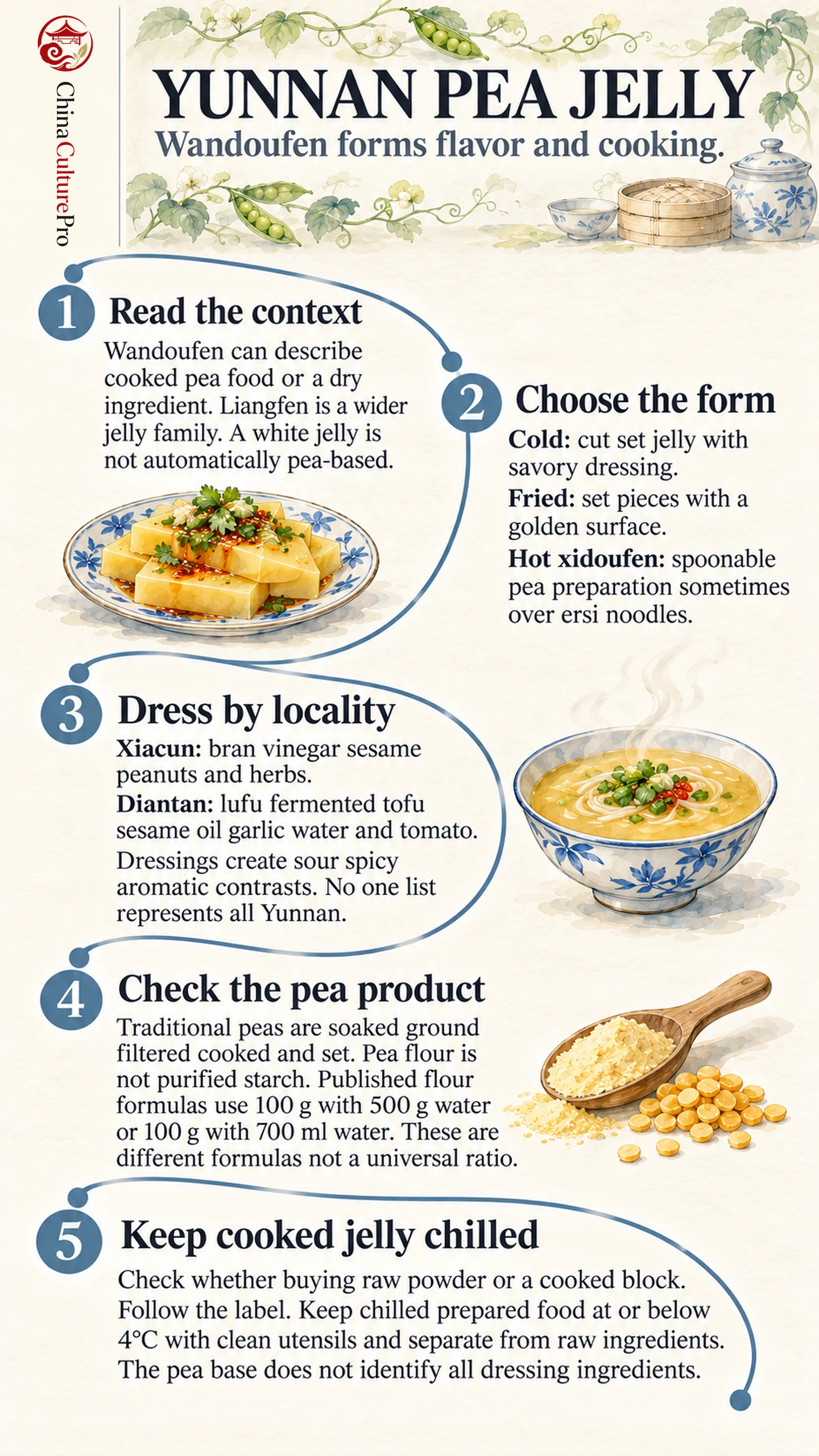
A yellow block on a market tray and a steaming breakfast bowl can belong to the same broad pea-food tradition while offering very different eating experiences. This is a useful way into the variety of Yunnan cuisine.
What Wandoufen Means on a Menu
Liangfen (凉粉, liángfěn) is a broader family of savory jellies; the name alone does not identify the raw material. Wandou liangfen (豌豆凉粉, wāndòu liángfěn) specifies a pea-based version. In one Tengchong market account, white rice jelly and amber-colored pea jelly appear separately on the same stall.[2]
Context also separates a finished food from a raw ingredient. Yellow pea flour is sold as flour milled from split peas; that dry product still needs a suitable cooking method. A bowl of prepared wandoufen is something you can order and eat, not the same thing as a bag of flour.[6]
Cold, Fried and Hot: Three Serving Forms
The following forms explain the main difference a diner or cook needs to establish before choosing a preparation.
| 表現形式 | Texture and preparation | Typical serving role |
|---|---|---|
| Cold pea jelly | A cooked mixture cooled until firm enough to slice | Cut pieces with a savory dressing.[1] |
| Fried pea jelly | Set pieces fried until golden outside | A warm snack with a contrasting surface.[5] |
| Hot xidoufen (稀豆粉, xīdòufěn) | A thick, spoonable pea preparation rather than a sliceable block | A hot bowl, or a topping for noodles.[4] |
Nanhua’s local food descriptions include cold, hot and pan-fried ways of eating the ingredient.[3]
In Tengchong, hot xidoufen can coat ersi (饵丝, ěrsī), rice-based noodle strands. That is a different experience from eating a plate of cut jelly; the distinction between rice and wheat noodles is useful when reading the menu.[2]
The Pea Base and Regional Dressings
Flour-based versions can retain a clear pea flavor; the dressing adds acidity, heat and aroma to the smooth set food.[5] Two local examples show the range.
In Baoshan’s Xiacun preparation, sesame, peanuts, bran vinegar, chives, coriander and other seasonings accompany the golden, smooth jelly. The vinegar and nutty toppings create layers beyond simply adding chili oil.[1]
In Diantan, Tengchong, cut pea jelly can receive a dressing made with lufu (卤腐, lǔfǔ), a fermented condiment made from tofu (豆腐, dòufu), alongside sesame oil, garlic water and chopped tomato.[2]
These are place-specific serving examples within Yunnan’s regional culture. Ask what is in the dressing instead of assuming every bowl has the same level of chili, sweetness or sourness.
From Peas or Flour to Set Jelly
A traditional Xiacun method begins with soaked peas, which are ground into a slurry and filtered through cloth. The liquid is heated and stirred until thick, then poured into trays to set. The cooking and setting turn the prepared liquid into something that can be cut.[1]
Flour-based home preparations are another route, but flour and isolated pea starch are not interchangeable names. Read the ingredient list and choose a recipe written for that product. A flour labeled as milled split yellow peas is not a packet of purified starch.[6]
Even published flour recipes use different proportions. One preparation for fried jelly uses 100 g pea flour with 500 g water; a separate hot-or-cold version uses 100 g flour with 700 ml water. These are examples of different formulas, not one universal ratio for all pea products.[4][5]
Decide whether you want a spoonable bowl or a block for cutting and frying before selecting the method. The overview of Chinese cooking methods provides broader technique context.
Buying and Serving Prepared Pea Jelly
Establish whether you are buying dry flour, a ready-made cooked block or a prepared snack with toppings. A package’s product name alone may not explain which handling stage has already been completed.
For fresh ready-made jelly, follow its storage and use-by instructions. Keep chilled prepared food at or below 4°C, use clean utensils and separate it from raw ingredients. A cold serving style does not mean the food should remain unrefrigerated for hours.[7]
Check the dressing separately when ingredients matter to you: the pea base does not tell you whether a finished bowl contains soy-based condiments, peanuts, sesame or other additions. For a purchased product, read the complete label rather than relying on its yellow color.
FAQs About Yunnan Pea Jelly
Is wandoufen the same as tofu?
No. The pea preparation described here is different from soybean tofu, even when both foods are cut into soft blocks.
Can Yunnan pea jelly be eaten hot?
Yes. Set jelly can be fried, and related hot xidoufen is served as a soft pea preparation rather than a cold block.
Can pea starch replace pea flour?
Do not assume a one-for-one swap. Use a recipe designed for the ingredient and the texture you want.
Is wandoufen always spicy?
No fixed chili level follows from the name. The dressing and serving style determine much of the finished flavor.
出典
[1] Longyang District Culture and Tourism Bureau. 保山隆阳下村豆粉
[2] Tengchong Diantan Town Government. 来尝尝滇滩的“粉色”记忆
[3] Nanhua County Government. 楚雄南华县:在市井小吃中品味南华
[4] Cara Bleiman. What is Wāndòufěn and what should we call it in English?
[5] Simple Chinese Food. Crispy Pea Jelly
[6] Hodmedod’s. Yellow Pea Flour: ingredients and product details
[7] Hong Kong Centre for Food Safety. Prepared Dishes: Food Safety Advice for Food Businesses and Consumers