
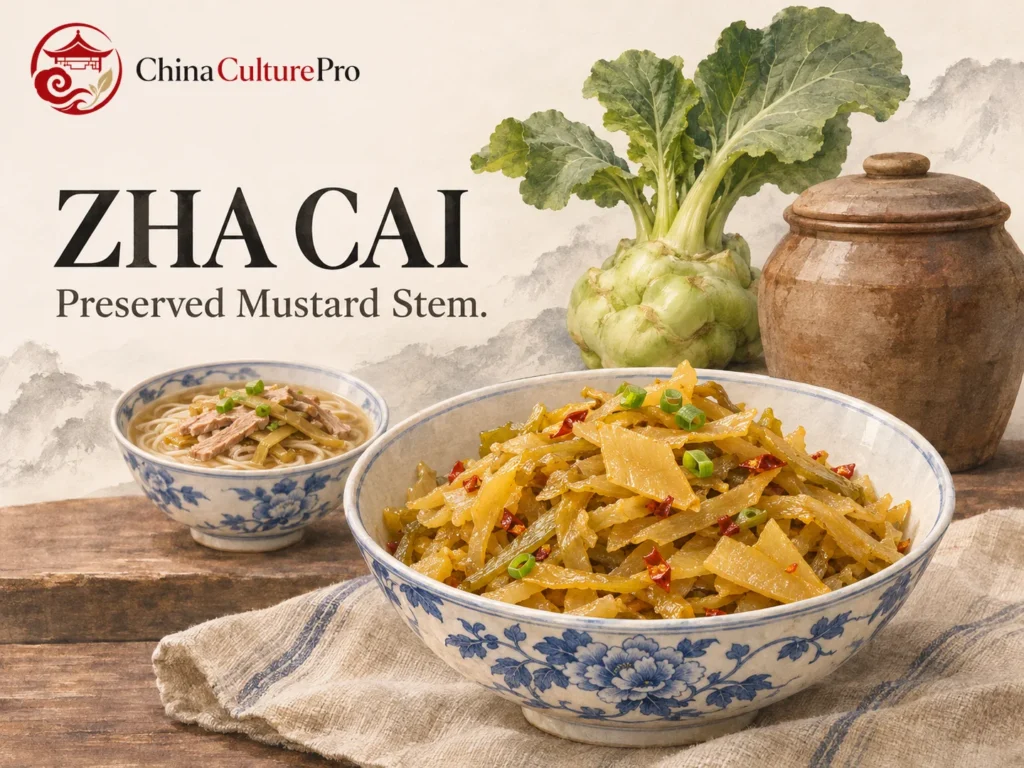

Quick Answer: What Is Zha Cai?
Zha cai (榨菜, zhàcài) is a preserved mustard-stem ingredient known for its crisp bite and concentrated seasoning. The edible part is a swollen stem, not a mustard root.
- Form: Whole pieces, shreds, slices and finer preparations offer different ways to use it.
- Flavor: Some products are mild; others include chili or a sweet-sour seasoning.
- Handling: A salty whole piece and a ready-to-eat packet do not necessarily need the same rinsing.
Read the product’s preparation instructions rather than treating every preserved mustard vegetable as identical.

English labels such as “Sichuan preserved vegetable” can make shopping confusing. The ingredient is familiar in Sichuan cooking, but its best-known place name belongs to present-day Chongqing.[4]
The Swollen Stem Behind the Name
Fuling (涪陵, Fúlíng) is the Chongqing district closely associated with this pickle. Its raw vegetable is qingcaitou (青菜头, qīngcàitóu), the enlarged, knobbly stem of a stem-mustard plant. The stem thickens as it develops and supplies the firm flesh used for preservation.[1]
The distinction matters when a translation says “mustard tuber” or even “preserved radish.” Look for the Chinese name and the ingredient description; a similar package or English category is not botanical identification.
Local leaf-mustard varieties are selected for Yibin ya cai (宜宾芽菜, Yíbīn yácài). That different raw material and preparation make ya cai a separate ingredient, even when both products are chopped small.[7]
How Preservation Changes Its Flavor
Traditional Fuling processing combines dehydration, salting, trimming, seasoning and maturation. Pressing out brine is associated with the name: the first character refers to pressing or squeezing. This is more than putting a fresh mustard vegetable into a stir-fry.[1]
The cured material and the finished packaged product are also different stages. A documented commercial finishing process includes cleaning, cutting, desalting, seasoning, packaging and sterilization. That helps explain why a finished snack packet may be ready to use while another preserved piece needs preparation.[2]
For the broader preservation context, see Chinese fermented foods. The label on the product in your hand remains more useful for cooking than assuming every producer uses one unchanged household method.
Choosing Whole, Shredded or Finely Cut Zha Cai
Fuling product descriptions include whole forms, shreds, slices, dice, granules and paste. The following groups organize those forms by the cook’s practical task.[2]
| Form group | Why choose it? | 確認したい点 |
|---|---|---|
| Whole pieces | Cut the ingredient to the size your dish needs | Preparation and desalting instructions |
| Shreds and slices | Convenient for noodle toppings or a pork stir-fry | Whether seasoning is already added |
| Dice, granules and paste | Smaller pieces or a spreadable format for fine distribution | Texture and intended use; paste is not a crunchy slice |
Cut and flavor are separate choices. A manufacturer’s own range includes mild original shreds and sweet-sour diced pieces; a different ready-to-eat listing offers mildly spicy shreds. “Original” does not automatically mean unsalted or unseasoned.[3][4]
Cooking with Zha Cai
Choose the role you want: a topping that stays distinct, a seasoning mixed through a dish, or a small partner to a plain staple.
- Noodle soup: Zha cai rousi mian (榨菜肉丝面, zhàcài ròusī miàn) pairs shredded pork and preserved mustard stem with noodles and broth. A cooked pork-and-pickle topping adds both texture and seasoning to the bowl.[5]
- A pork stir-fry: Shredded zha cai can be briefly cooked with pork, garlic and scallions. Think about the pickle’s saltiness before increasing the salty sauces elsewhere in the dish.[6]
- A plain staple: Ready-to-eat zha cai can accompany rice or congee, where a small, strongly flavored portion contrasts with the mild base.[6]
For another local noodle tradition, explore Chongqing xiaomian. Both belong to everyday Chinese home cooking, but they are different dishes.
Rinsing and Storage Depend on the Product
A ready-to-eat, pre-seasoned packet may be used directly. Older-style whole preserved pieces can carry more surface salt and need rinsing and cutting. Neither observation establishes one rule for every packet or can.[4]
Follow the manufacturer’s instructions first. Rinsing a ready-to-eat product can also remove its added seasoning; drain afterwards and adjust the dish before adding salt.
Refrigerate opened products in a sealed container as directed, and follow the label’s use-after-opening guidance. Fermentation is not a guarantee of indefinite storage.[4]
FAQs About Zha Cai
Is zha cai a mustard root?
No. Its characteristic flesh comes from a swollen mustard stem, even when an English label calls it a tuber.
Must I rinse packaged zha cai?
Not automatically. Check whether it is already prepared and seasoned, then follow the packet and recipe instructions.
Is zha cai always spicy?
No. Mild, chili-seasoned and sweet-sour products exist; the name alone does not identify the flavor.
Can I use ya cai instead of zha cai?
You can adapt a dish, but the texture and flavor will change. They are different preserved mustard ingredients.
出典
[1] Fuling District Archives, published by Chongqing Archives. 档案里的重庆特产:涪陵榨菜
[2] China National Intellectual Property Administration. Geographical indication protection requirements, section 1221: Fuling zha cai
[3] Chongqing Fuling Zhacai Group. Seasoning vegetable product descriptions
[4] The Mala Market. Wujiang Zhacai: product description and storage information
[5] Sarah Leung, The Woks of Life. Zha Cai Rousi Mian
[6] Elaine, China Sichuan Food. Zha Cai: The Preserved Vegetable
[7] Sichuan Department of Agriculture and Rural Affairs. 2022年度农业主推技术推介汇总表:宜宾芽菜专用青菜标准化栽培技术