


Quick Answer: Who Was Empress Lü Zhi?
Empress Lü Zhi (吕雉, Lǚ Zhì, died 180 BCE) was the wife of Liu Bang (刘邦, Liú Bāng), founder of the Han dynasty. She exercised the powers of government as empress dowager and ruled on behalf of two young emperors after the death of her son Emperor Hui (惠帝, Huìdì).[3]
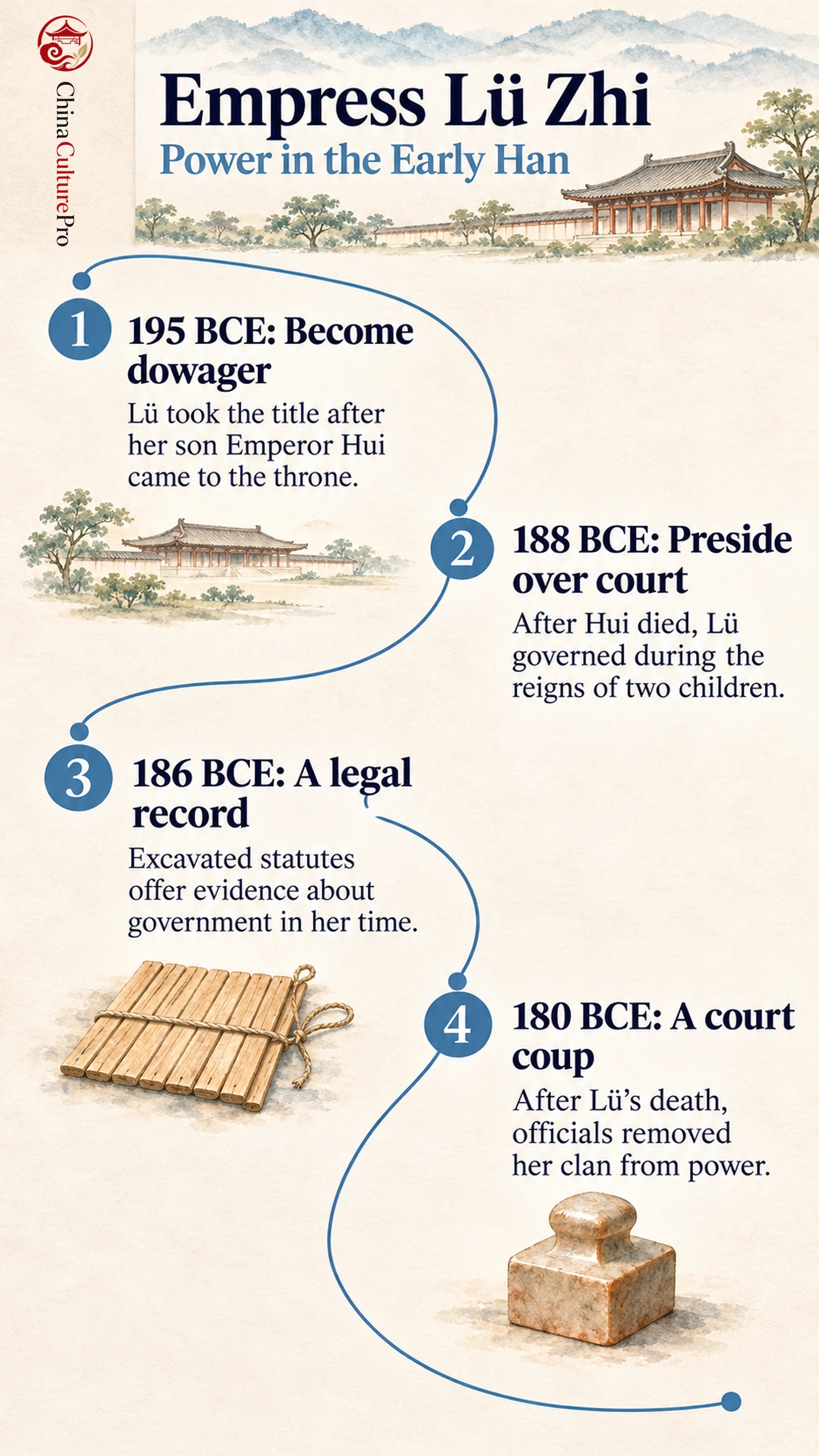
- 195 BCE: When Liu Bang died, Emperor Hui took the throne and Lü became empress dowager.[1]
- 188 BCE: After Emperor Hui died, Lü presided over court and issued commands in her own authority.[2]
- 180 BCE: Senior officials moved against her relatives after her death.[4]
Her years in power are recorded in the annals of two major histories. Excavated laws offer a separate view of how the early Han state operated during her rule.[3]
Lü’s formal title changed before the full extent of her authority did. While her son held the throne, she was already influential. After his death, the court continued to have an emperor in name, but important decisions came from the dowager.
How Lü Zhi Rose From Consort to Ruler
During Liu Bang’s reign, a dispute arose over whether to replace the crown prince with a younger son. In Sima Qian’s account, Lü’s son retained his position with support from senior advisers and became Emperor Hui in 195 BCE. Lü became known as Lü Taihou (吕太后, Lǚ Tàihòu), or Empress Dowager Lü.[1]
When Hui died in 188 BCE, a child took the throne. The Book of Han describes Lü presiding over court and issuing orders of the kind normally reserved for emperors. A second child succeeded the first. Sima Qian records that the court did not restart its year count because the dowager remained in charge.[1][2]
What the Early Han Sources Show About Her Rule
The histories record Lü granting ranks and territorial titles to members of her family. The Book of Han also records an early order that carried out Emperor Hui’s proposal to abolish certain penalties that extended to relatives and a law against ominous speech.[2] Sima Qian and Ban Gu wrote from within the Han historical tradition, and their portrayals shaped how later readers understood a woman holding imperial power.[3]
A legal collection from a tomb at Zhangjiashan (张家山, Zhāngjiāshān) is dated to 186 BCE. Its statutes and ordinances give historians evidence for the workings of the early Han state. The collection’s date places it in Lü’s period of rule, and the texts were copied and compiled over time.[3][5]
What Happened to the Lü Family in 180 BCE
After Lü died, senior officials, including Chen Ping, took action against her family. The coup ended the dominance of Lü’s relatives. The officials installed Liu Heng (刘恒, Liú Héng), a son of Liu Bang who became Emperor Wen.[1][4] His wife Dou became empress during his reign.
The traditional case against the Lü family rested on a claim that its leading members intended to seize the throne. Historians have debated what the surviving accounts establish about their intentions.[4]
FAQs About Empress Lü Zhi
Was Lü Zhi an Empress Regnant?
Her title was empress dowager. During the child emperors’ reigns, she exercised authority normally held by the emperor.[2]
How Long Did Lü Zhi Govern After Emperor Hui Died?
She governed from 188 BCE until her death in 180 BCE, an eight-year period.[4]
Who Took the Throne After Lü Zhi Died?
Liu Heng, previously King of Dai, became Emperor Wen after the coup against the Lü family.[1]
出典
[1] Sima Qian. Records of the Grand Historian, Annals of Empress Dowager Lü
[2] Ban Gu. Book of Han, Annals of Empress Gao
[3] Sharon Sanderovitch. Empress Lü, The Encyclopedia of Ancient History
[4] Hsiao-shih Cheng. Anatomy of the Coup Annihilating the Empress Lü’s Clan During the Early Han Period
[5] Anthony Barbieri-Low. Copyists, Compilers, and Commentators