


Quick Answer: Who Was Liu Bang?
Liu Bang (刘邦, Liú Bāng), later known as Gaozu (汉高祖, Hàn Gāozǔ), founded the Han dynasty. He became King of Han in 206 BCE and took the imperial throne in 202 BCE after defeating his main rival in the wars that followed Qin rule.[1][2][3][4]
- Origins: He held a minor local post under Qin before emerging as a rebel leader.
- Rival: A commander from the former state of Chu became his main opponent after Qin fell.
- Dates: The year 206 BCE marks Liu’s rule as King of Han. The year 202 BCE marks his imperial accession.
- Government: His court kept parts of Qin administration while granting regional authority and rewards to allies.[1][2][3][4][5][6]
The two founding dates refer to different stages in the creation of the dynasty.
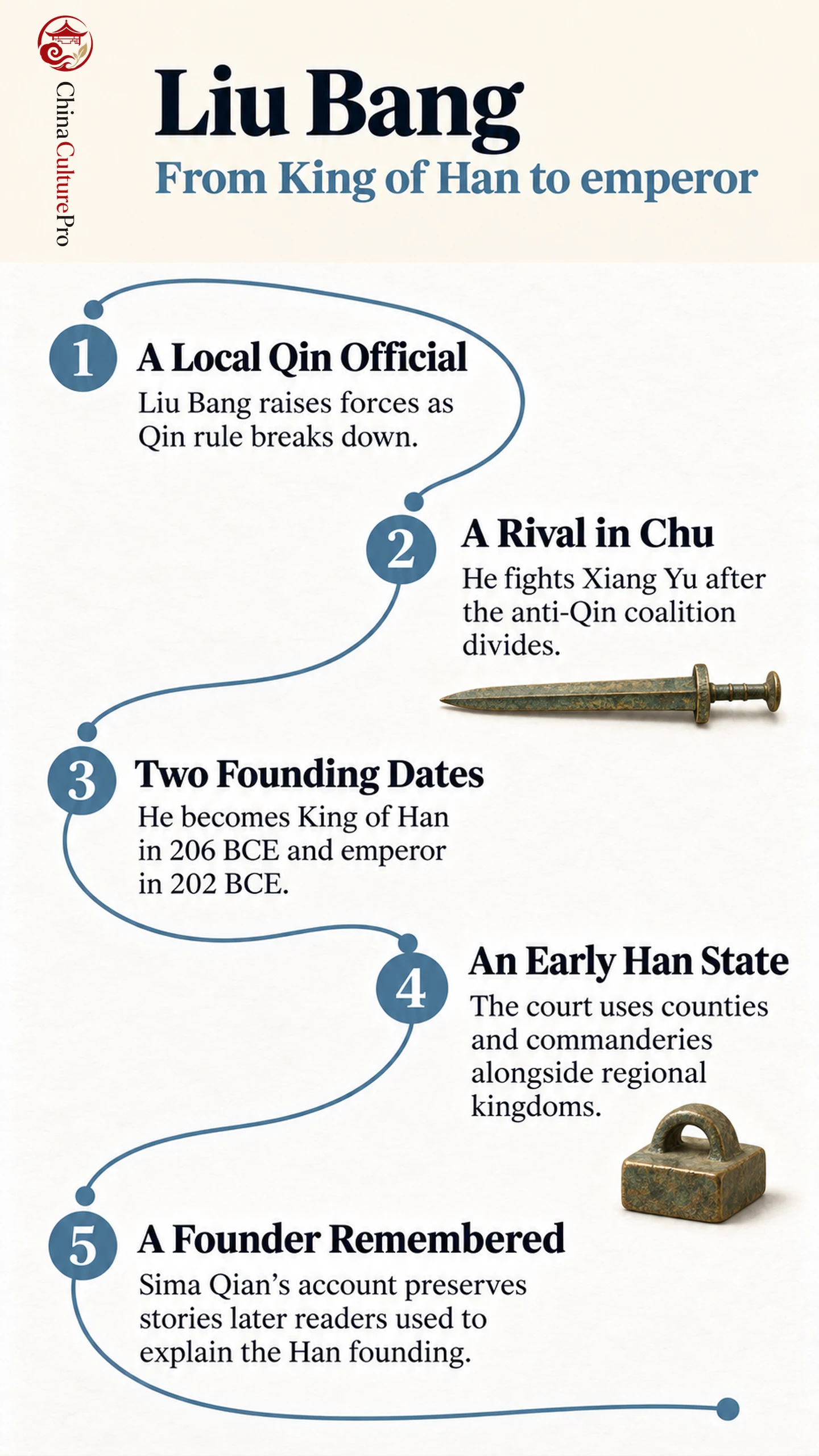
Liu Bang’s rise involved two problems. The first was how to gain control in a civil war. The second was how to turn a coalition of commanders into a government. Victories help explain the move from king to emperor. Grants, offices and written laws help explain what happened after he won.[1][3][5][6][7]
From a Qin Local Official to Rebel Leader
Liu came from the area of Pei, in what is now Jiangsu. Before the fall of the Qin dynasty, he held a low-ranking post at a local station. That background differed from the aristocratic military families from which some of his rivals came. The accounts of his rise follow him through a network of people he knew in the county. Some later helped him organize forces and take control in the area.[1][3][4]
Rebellion spread after the First Emperor’s death, and several armed groups competed to overthrow Qin. Liu raised forces in his home region and joined the struggle. His army entered the Qin heartland and accepted the surrender of the last Qin ruler. The surrender opened another contest over who would govern the former empire.[1][3][4]
The Rivalry with Xiang Yu
Xiang Yu (项羽, Xiàng Yǔ), a commander from a prominent Chu family, emerged as the strongest figure in the coalition against Qin. Accounts of the Hongmen Banquet (鸿门宴, Hóngmén Yàn) describe Liu meeting Xiang when the balance of power was against him. The story became famous because its outcome turns on a dangerous meeting and a narrow escape. Its dialogue reaches readers through later historical writing.[1][3][4]
Xiang redistributed territories among competing leaders and made Liu King of Han. The resulting Chu–Han contention (楚汉之争, Chǔ Hàn Zhī Zhēng) lasted several years. Liu’s forces and allies eventually defeated Xiang’s side. In the final phase, Liu’s coalition cornered Xiang at Gaixia. The campaign depended on keeping allied armies in the field and bringing them together against a common rival.[1][3][5][6]
Why the Han Has Two Founding Dates
In 206 BCE Liu became King of Han. The title referred to one kingdom in the divided political order that followed Qin. It gave him a territorial base from which to compete. The start of that kingdom is the reason many accounts date the Han dynasty from 206 BCE.[2][3][4]
In 202 BCE, after his victory over Xiang Yu, Liu took the imperial title. The year marks a different claim to authority over the former rival territories. When consulting a Chinese dynasties timeline, read 206 as the start of the Han political base and 202 as Liu Bang’s accession as emperor.[1][2][3][5]
Building the Early Han Government
The Han governed some territory directly through commanderies and counties, while regional kings controlled other areas. Liu rewarded military and political supporters with titles and grants. These were practical ways to recognize the people whose resources and forces had helped him win. They also left the court with the question of how much autonomy its allies would retain. Liu’s government subsequently reduced the power of several founding allies and placed members of his own family in regional kingdoms.[3][5][6]
The new court established its capital at Chang’an (长安, Cháng’ān). It adapted institutions already used under Qin. Early Han manuscripts from a tomb at Zhangjiashan preserve a collection of written statutes. The manuscripts date from after Liu’s reign. They contain provisions on a range of subjects and show that the early dynasty continued to use detailed written law.[2][5][7]
How Sima Qian Remembered the Founder
Much of the narrative of Liu Bang’s life comes from the history of Sima Qian (司马迁, Sīmǎ Qiān), written under the Han long after its founding. In the account of Liu’s arrival in the Qin heartland, he announces three basic rules to the local population. The episode presents him as offering relief from Qin punishment. The announcement helps explain how the founder was remembered. A collection of statutes serves another purpose and shows the range of matters that required written rules after the new court was established.[3][7]
Liu died in 195 BCE. Emperor Wu of Han inherited a state with different resources and priorities several generations later. Among Chinese historical figures, Liu is especially useful for understanding the moment when a coalition became a new ruling house.[2][3][5]
FAQs About Liu Bang
When did Liu Bang found the Han dynasty?
The Han is commonly dated from 206 BCE, when Liu Bang became King of Han. He took the imperial title in 202 BCE after defeating Xiang Yu.[1][2][3]
Who was Liu Bang’s main rival?
Xiang Yu was his principal rival after the fall of Qin. Xiang had helped lead the anti-Qin coalition and controlled the initial division of territories.[1][3][4]
What did Liu Bang keep from the Qin government?
The early Han retained administrative units such as commanderies and counties in areas it ruled directly. The new dynasty adapted these alongside regional kingdoms and continued using written law.[5][7]
出典
[1] Origins at Ohio State University and Miami University. Liu Bang, from Peasant Rebel to Emperor
[2] The Metropolitan Museum of Art. Han Dynasty
[3] Sima Qian. Records of the Grand Historian: Basic Annals of Gaozu
[4] China Culture. Han Gaozu
[5] Routledge. Handbook of Imperial Chinese History
[6] Shigaku Zasshi. The Political Significance of the Ranks Granted by Liu Bang
[7] Bulletin of the School of Oriental and African Studies. The Nature and Function of the Ernian Lüling Manuscript