
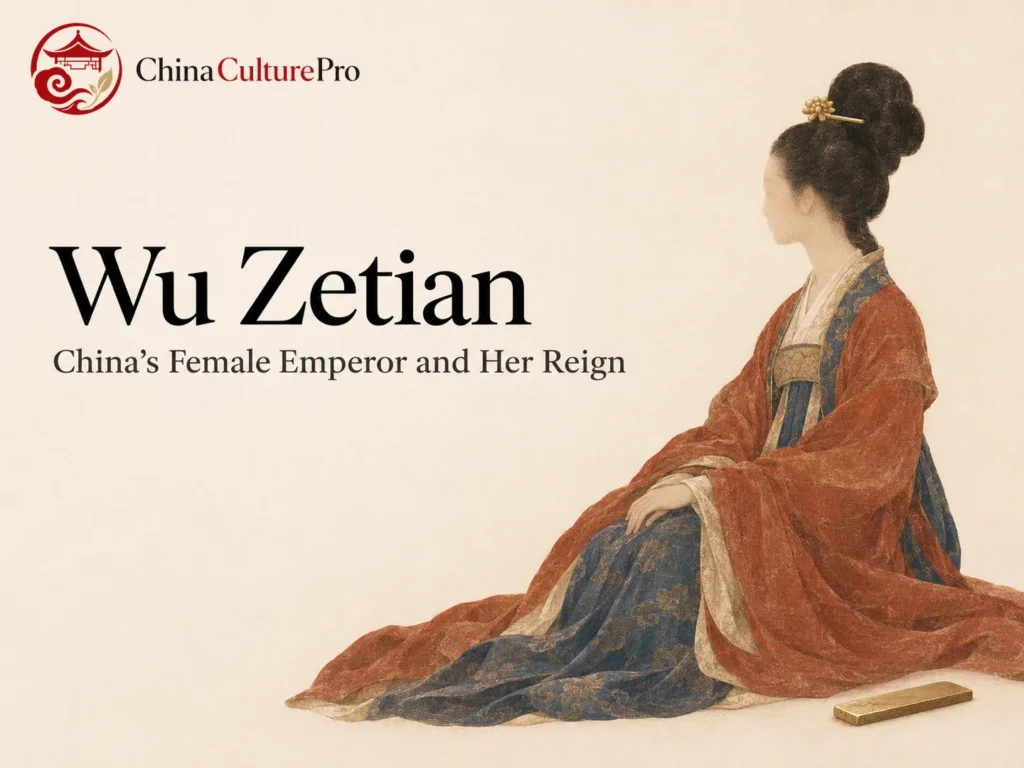

Quick Answer: Who Was Wu Zetian?
Wu Zetian (武则天, Wǔ Zétiān), also known as Wu Zhao (武曌, Wǔ Zhào), was the only woman to reign with the title of emperor in imperial China. She founded her own Zhou dynasty in 690 CE and ruled until 705.[1][2][4]
- Titles: She rose from consort to empress, held power as empress dowager, and finally took the title of emperor.
- Reign: Her Zhou interrupted Tang dynastic rule from 690 to 705.
- Government: She recruited officials through examinations and used religious patronage to strengthen her authority.
- Succession: A court coup ended her reign and restored the Tang in 705.[2][3][5][6][8]
The distinction between her years in power and her formal reign explains why accounts give different spans for her rule.
In 700 CE, Wu sent an inscribed gold slip to a sacred mountain. The object survives, and its inscription names her as the ruler of the Great Zhou. That small piece of gold preserves how she styled herself a decade into her reign. To understand the significance of the title, start with her earlier roles in the Tang court.[7]
From Tang Consort to Empress Dowager
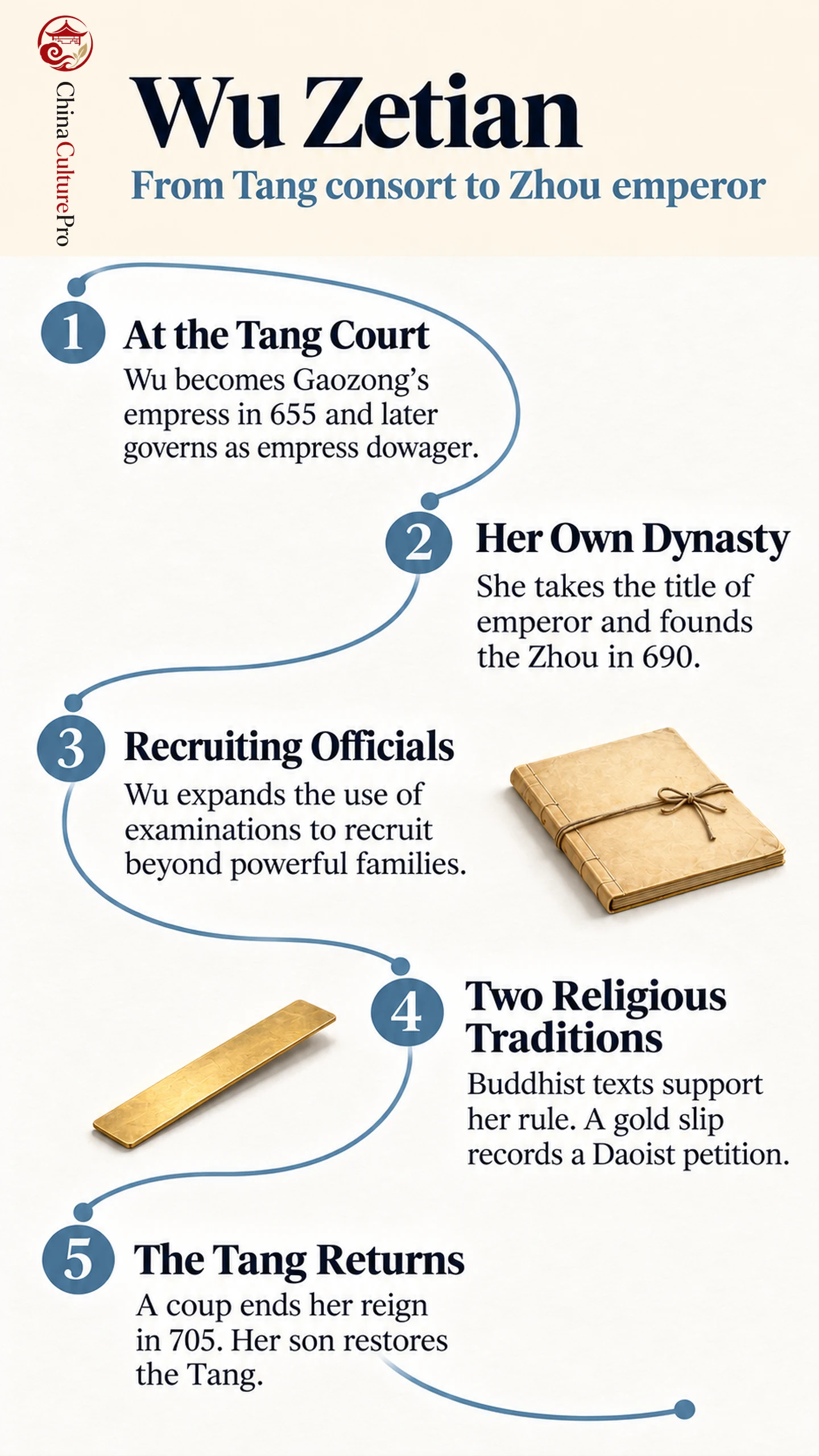
Wu entered the court of Taizong (唐太宗, Táng Tàizōng) as a junior consort. After his death in 649, she spent time in a Buddhist convent. She returned to the palace during the reign of his son Gaozong (唐高宗, Táng Gāozōng) and became Gaozong’s empress in 655. She now had an official position from which to intervene in palace and government affairs.[1][2][3]
As Gaozong’s health declined, Wu exercised increasing influence over government. After his death in 683, her sons succeeded to the Tang throne in turn, while she wielded power as empress dowager. The reigning sons still held the Tang title. Wu’s position as their mother and as dowager gave her the means to direct the court before her own accession.[1][2][3]
Why She Took the Title of Emperor
In 690 Wu assumed the title huangdi (皇帝, huángdì), the title of the reigning emperor. As Gaozong’s empress, she derived her formal position from marriage to a sovereign. As emperor, she became the sovereign and established a dynasty with its own name. The difference is easy to miss in English because many accounts continue to call her Empress Wu when discussing her entire career. Zhao was the given name she adopted as a ruler. The familiar name Wu Zetian comes from a title associated with her later.[2][4]
Her Zhou belongs inside the broader history of the Tang dynasty because it displaced Tang rule for 15 years. It was a seventh-century dynasty distinct from the much earlier Zhou on the timeline of Chinese dynasties. Her court continued to use existing institutions, including the examinations for entry into government service.[1][4][5]
How She Staffed and Controlled the Court
Wu used the existing examination system to recruit more officials. This provided a way to find candidates outside established aristocratic networks and to reduce reliance on the great families that traditionally dominated high office. Historian N. Harry Rothschild describes measures such as concealing examinees’ names from graders, limiting a family’s ability to influence assessment directly.[5]
Recruitment was only one part of how she maintained power. She promoted men she judged able and loyal, and dismissed or punished officials she regarded as unreliable. The same court could offer a new route to advancement for one official and expose another to a campaign of accusation. Accounts of her government record both the talent she brought into office and coercion against perceived opponents. They describe investigations that led to the exile or death of rivals.[3][5]
Some of the people who helped Wu govern worked through palace appointments. Shangguan Wan’er (上官婉儿, Shàngguān Wǎn’ér) drafted imperial edicts under Wu, giving her a role in turning court decisions into written orders. Her position shows how authority could also flow through work performed inside the palace.[3]
Buddhist Patronage and the Gold Slip
Wu’s supporters drew on the Great Cloud Sutra (大云经, Dàyún Jīng) to present a woman’s rule as compatible with Buddhist ideas of sovereignty. In the sutra, the Buddha predicts that a female divinity will obtain sovereignty. A commentary circulated before Wu founded her dynasty identified her with that figure, making the text part of the court’s public case for her accession. The episode is one example of the role of Chinese Buddhism in political life.[6][8]
The gold slip from Mount Song (嵩山, Sōngshān) records another kind of religious action. Wu sent an envoy to deliver it in 700. The gold tablet is 36.2 centimeters long and 8 centimeters wide. Its 63 characters name her as the ruler of the Great Zhou and ask Daoist powers to absolve her of wrongdoing. It also expresses a wish for longevity. The gold slip gives us a contemporary ritual petition in her name. The Buddhist commentary addressed the legitimacy of her rule, while the slip made a request about her own life and conduct.[6][7]
The Tang Restoration and Her Legacy
A coup in 705 forced Wu to abdicate. Her son Zhongzong (唐中宗, Táng Zhōngzōng) returned to the throne and restored the Tang. Wu died that year and was buried with Gaozong at Qianling (乾陵, Qiánlíng). The monument associated with her there originally lacked a commemorative inscription. Its absence leaves room for interpretation, and the monument by itself gives little basis for assigning a personal motive.[3][8]
Among Chinese historical figures, Wu presents an unusual case because later writers had to account for a woman who held the imperial title. The gold slip records how she styled herself while she was alive. Stories about the court preserve claims about how she won and kept power. Read them with attention to what each can establish, especially when a story assigns motives to people who left little evidence of their own.[3][5][7]
FAQs About Wu Zetian
Was Wu Zetian an empress or an emperor?
She held both roles at different stages. She became Gaozong’s empress in 655, exercised power as empress dowager after his death, and held the title of emperor in her own right from 690 to 705.[1][2]
Did Wu Zetian rule the Tang dynasty?
She exercised authority during the Tang as Gaozong’s empress and later as empress dowager. Her formal reign as emperor, from 690 to 705, belonged to her own Zhou dynasty. The Tang returned after her abdication.[1][2][8]
Where was Wu Zetian buried?
She was buried with Emperor Gaozong at Qianling, a joint imperial mausoleum in what is now Shaanxi province.[8]
出典
[1] Smithsonian National Museum of Asian Art. Timeline of Chinese History, Art, and Culture
[2] Columbia University Press. Wu Zhao’s Titles at Different Stages of Her Career
[3] Origins at Ohio State University and Miami University. Wu Zetian: The Only Woman Emperor in Chinese History
[4] A Companion to Global Queenship. When the Emperor Is a Woman: The Case of Wu Zetian
[5] The World of Wu Zhao. The Culture of the Court
[6] Columbia University Press. Bodhisattva with a Female Body: Wu Zhao and Devi Jingguang
[7] Henan Museum. Wu Zetian Gold Strip
[8] University of California Press. China: Dictionaries of Civilization