

Quick Answer: Who Was Empress Dowager Cixi?
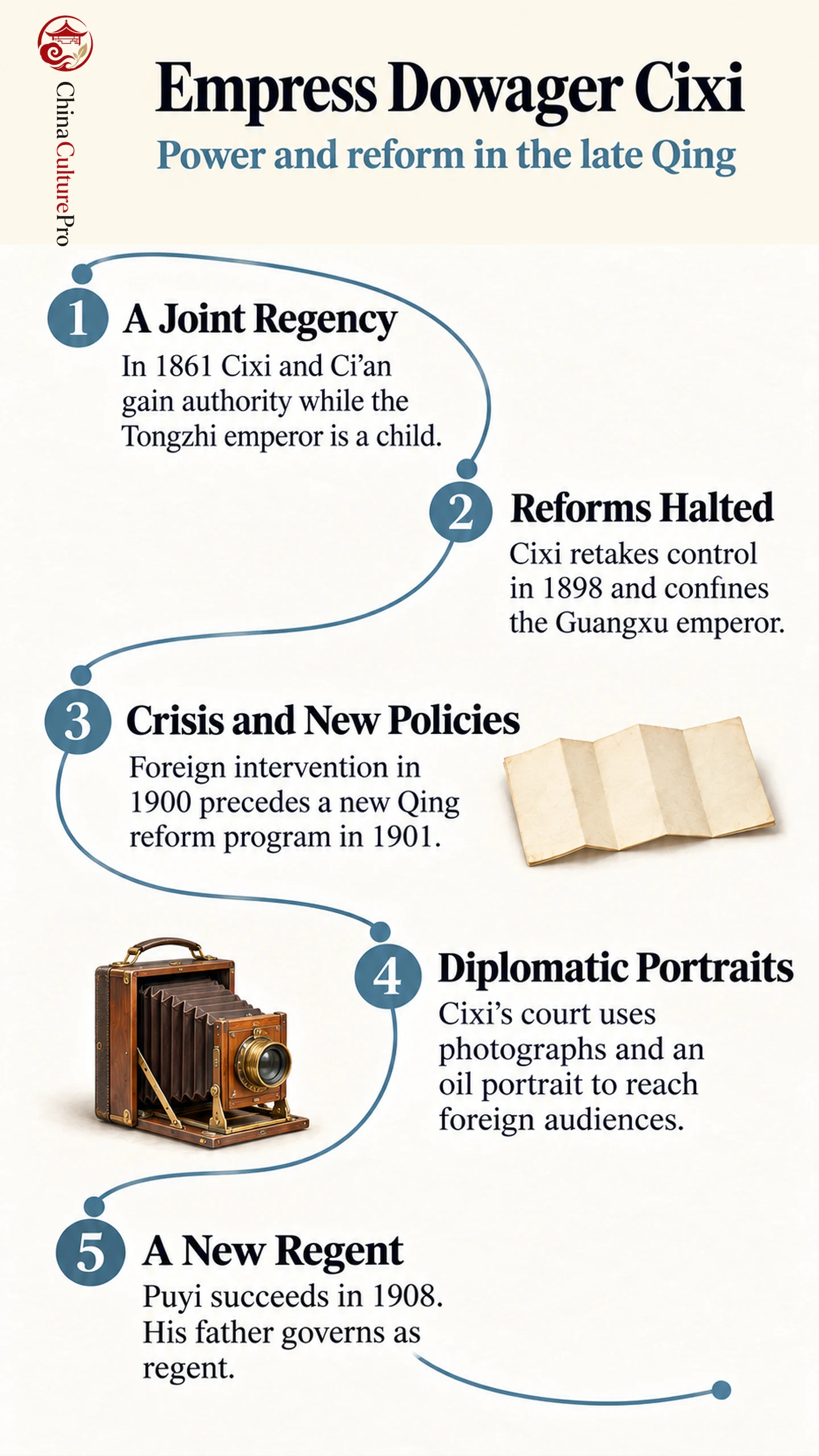
Empress Dowager Cixi (慈禧太后, Cíxǐ Tàihòu) was a central figure in Qing government from the regency crisis of 1861 until her death in 1908. She gained authority through her position as an emperor’s mother and exercised it as dowager across two reigns.[1][2][9]
- Position: She shared the early regency with another dowager and worked with senior princes and officials.
- Reform: She ended the 1898 reform drive and later backed a different program of institutional change.
- Crisis: Her court supported the Boxer movement in 1900. Foreign intervention and defeat followed.
- Public image: She used photographs and a commissioned oil portrait to cultivate ties with foreign audiences.[1][2][3][4][5][6][8]
Her influence varied over time. An emperor formally occupied the throne throughout the period.
An edict and a portrait capture a change in Cixi’s dealings with the outside world. A reform edict of 1901 called for officials to consider what the Qing could learn from abroad. A portrait shown at the 1904 St. Louis World’s Fair presented her to a foreign public in the regalia of a Qing dowager. Each addressed a different audience in the years after the Boxer crisis.[1][6]
How Cixi Gained Power at the Qing Court
Cixi entered the imperial household as a consort of the Xianfeng emperor (咸丰, Xiánfēng). Her son became the Tongzhi emperor (同治, Tóngzhì) in 1861 while still a child. Xianfeng had named senior advisers to run the government in the event of his death. Cixi, fellow dowager Ci’an (慈安, Cí’ān) and Prince Gong worked together to remove those advisers and establish a new regency.[1][2]
That alliance mattered because Cixi held her position in the imperial household while princes and officials carried out government business. The two dowagers received court business on behalf of the young emperor. When Tongzhi died without an heir in 1875, the court placed Cixi’s young nephew on the throne as the Guangxu emperor (光绪, Guāngxù). Guangxu belonged to the same generation of the imperial clan as his predecessor, a departure from the usual succession pattern. His youth enabled Cixi to resume acting as regent at the center of the Qing dynasty.[1][2][9]
Why She Stopped the Hundred Days’ Reform
After Qing defeat in the war with Japan in 1894–95, reformers pressed for changes in schools, examinations and government. Guangxu issued a series of edicts in the summer of 1898. The proposals became known as the Hundred Days’ Reform (百日维新, Bǎirì Wéixīn). They would have changed how the court trained, recruited and organized the people who served it.[3]
Cixi moved against the reformers in September. She resumed control of court affairs, Guangxu was confined, and six reform advocates were executed. The confrontation concerned who could direct the court as well as which proposals would go ahead. The dowager shelved a plan affecting the hereditary banner system but continued to support some military modernization. That difference shows why the fate of individual proposals matters when assessing the coup.[3][4]
The Boxer Crisis and the Turn to New Policies
The Boxers (义和团, Yìhétuán) were an anti-foreign movement whose members attacked missionaries and Chinese Christians. Qing officials disagreed over how to respond. In 1900 Cixi’s court backed the Boxers as the confrontation with foreign powers escalated. A multinational force took Beijing and the court fled. The settlement reached the following year imposed a large indemnity on the Qing.[4][5][6]
The defeat changed the political setting for reform. A January 1901 edict invited officials to submit proposals for strengthening the government. The measures that followed became known as the New Policies (新政, Xīnzhèng). They included changes to schooling, the military and government administration. In 1905 the court ordered the end of the traditional civil service examinations. Schools and new credentials took on roles that had once belonged to the examination system, though the transition continued for years.[4][6][7]
The contrast with 1898 concerns who authorized the measures and what problems the court faced. In 1898 the program came through Guangxu and his reform allies during a struggle for power. In 1901 Cixi’s own court sought policies it could direct in the wake of military defeat.[3][4][6]
What Cixi’s Portraits Were Designed to Do
Xunling (勋龄, Xūnlíng) made carefully staged photographs of the dowager. The Qing court used prints as diplomatic gifts. Alice Roosevelt received one after meeting Cixi in 1905. She later recalled that the print reached the foreign legations in a yellow chair under military escort, extending the ceremony of the encounter to the delivery of an image.[8]
Cixi also sat for the American painter Katharine Carl. The formal oil portrait was shown at the 1904 World’s Fair and subsequently presented to President Theodore Roosevelt. It projected authority through the dowager’s regalia and court setting. American newspaper caricatures and the court’s commissioned image addressed different audiences and give different kinds of evidence about her reputation.[1][8][10]
Succession and the Debate over Her Legacy
In 1908 Cixi approved a nine-year timetable for constitutional preparation. She died before it could be carried out. Guangxu died in November that year, followed by Cixi the next day. She had arranged for the young Puyi (溥仪, Pǔyí) to succeed him. Puyi’s father served as regent. The Xinhai Revolution brought the dynasty to an end within a few years of her death.[9]
Comparisons with Wu Zetian help clarify the kind of power Cixi held. Wu took the title of emperor and founded a dynasty in her own name. Cixi governed through her standing in the Qing imperial family and her influence over appointments and court decisions. Among Chinese historical figures, Cixi has been remembered through sharply different images. The reports and caricatures that fixed her reputation abroad and the portraits that her court commissioned were made for different audiences. The strongest judgments about her government start with decisions that can be dated and traced, such as the suppression of the 1898 reform drive and the new program announced in 1901.[1][2][4][6][10]
FAQs About Empress Dowager Cixi
Was Cixi the emperor of China?
Cixi held the title of empress dowager. She exercised power through the regency and remained influential under the Tongzhi and Guangxu emperors, who held the imperial title.[1][2]
Why did Cixi oppose the reforms of 1898 but support later reforms?
The 1898 reforms were tied to Guangxu’s effort to direct the court and ended when Cixi regained control. After defeat in the Boxer crisis, her court sponsored a reform program of its own. It adopted some changes related to proposals from the earlier period.[3][4][6]
Who succeeded after Cixi and the Guangxu emperor died?
Puyi became emperor, and his father governed as regent. Puyi was the last emperor of the Qing dynasty.[9]
出典
[1] Smithsonian Institution. Cixi, the Last Empress Dowager of China
[2] Modern Asian Studies. Imperial Authority in Crisis: An Interpretation of the Coup D’état
[3] Library of Congress Federal Research Division. China: A Country Study
[4] University of Washington Press. Cixi and the Peculiar Institution
[5] United States Department of State Office of the Historian. Secretary of State John Hay and the Open Door in China
[6] Columbia University Asia for Educators. Reform Edict of the Qing Imperial Government
[7] International Journal of Asian Studies. The Longer Abolition of the Chinese Imperial Examination System
[8] Smithsonian National Museum of Asian Art. Diplomacy
[9] University of Washington Press. Zaifeng and the Manchu Ascendency
[10] Smithsonian National Museum of Asian Art. Cixi’s Popular Legacy