

Quick Answer: Who Was Empress Liu of Song?
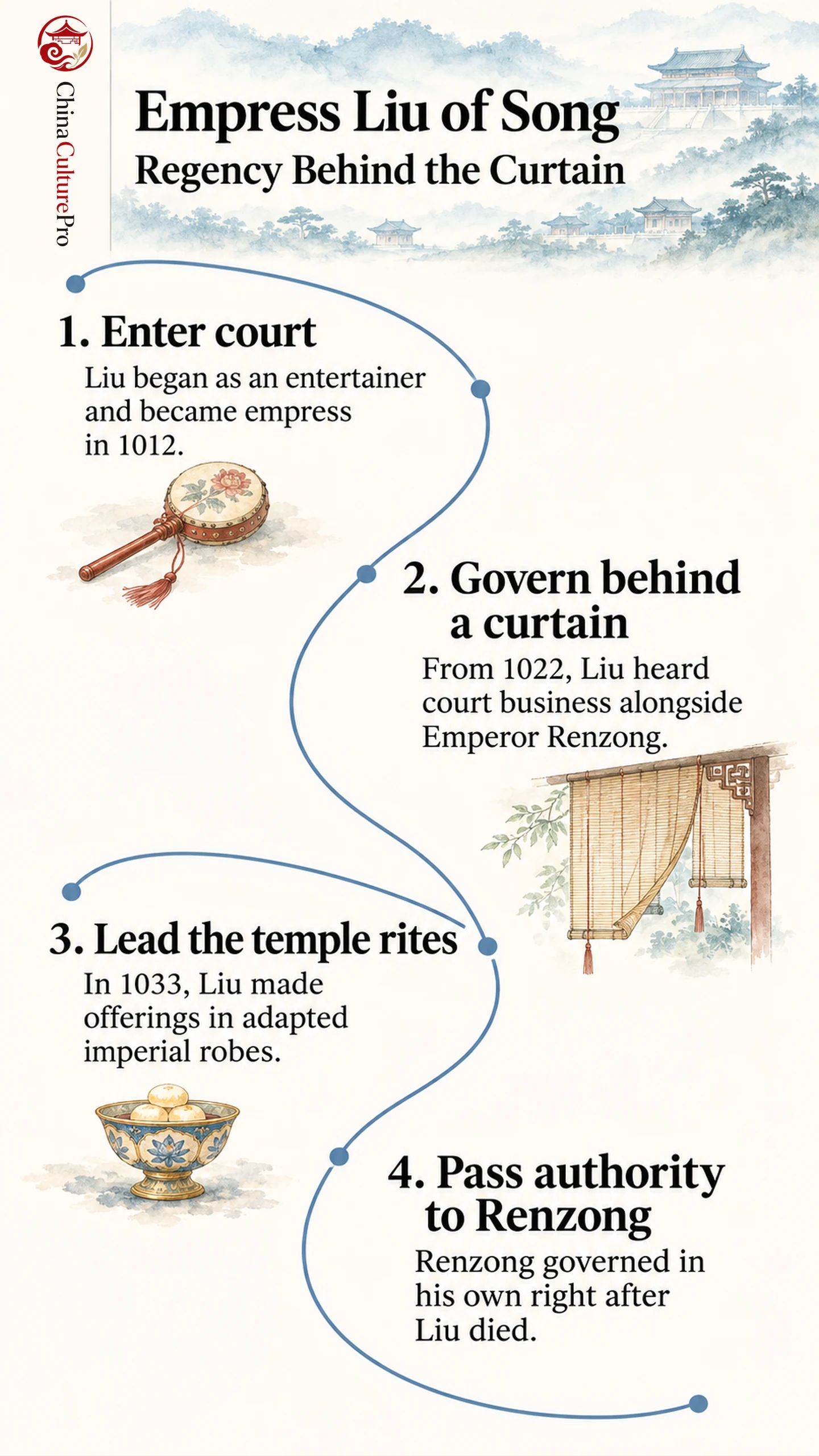
Liu E (刘娥, Liú É, 969–1033) was the consort of Emperor Zhenzong (真宗, Zhēnzōng).[3] She became the first empress dowager to serve as regent of the 北宋 (北宋, Běi Sòng). She governed under the young Emperor Renzong (仁宗, Rénzōng) from 1022 until her death.[7]
- Before the regency: She was already handling court business when Zhenzong fell ill in 1020.[5]
- Court audiences: She heard officials alongside Renzong, seated behind a curtain.[5]
- Imperial rites: In 1033 she made offerings in adapted imperial dress at the dynasty’s ancestral shrine.[2]
Her power came from the regency. The Song throne remained with Renzong.
After Zhenzong’s death, the court had to decide whether his widow and his young successor would hear officials in the same room. Where Liu could sit and when officials could address her became questions of government.
From Palace Entertainer to Empress
Liu met the future emperor through her work as an entertainer. That gave her access to the palace through a different route from the marriages that tied established families to the throne.[4] The History of Song (宋史, Sòngshǐ) credits her with skill at playing a small drum.[2]
Zhenzong appointed her empress in 1012 despite objections from his advisers.[1] During his prolonged illness in 1020, she took charge of much of the court’s business. His death in 1022 made her a formal regent for Renzong.[5]
What Ruling Behind the Curtain Meant
The late emperor’s decree gave Liu temporary authority over major military and state affairs. The status of that authority was a matter of debate. A proposal to omit the term indicating that her powers were temporary was turned down.[3]
In Chengming Hall (承明殿, Chéngmíng Diàn), Renzong sat on the left and Liu sat on the right behind a curtain. The court agreed to hold joint audiences there every five days.[2]
Liu relied on alliances with palace women, court officials and eunuchs. That pattern was a precedent for later Song regents and a distinct chapter in the history of women in China.[1]
In 1032, the government established a separate Bureau of Policy Criticism. Its officials could raise policy objections directly with the throne.[1]
Imperial Robes and the Limits of the Regency
In 1033, Liu made offerings in the Imperial Ancestral Temple (太庙, Tàimiào). The official history describes an imperial-style robe with ten emblems, omitting two of the customary twelve, and no sword.[2] Leading the offerings put her in a role normally reserved for the emperor.[3]
The historian Keith McMahon places this ceremony alongside the example of Wu Zetian (武则天, Wǔ Zétiān). Liu used some of the ruler’s ceremonial forms. She rejected a proposal to establish an ancestral temple for her own lineage.[3]
Renzong’s Birth and the Civet Cat Story
Lady Li (李宸妃, Lǐ Chénfēi) gave birth to Renzong, and Liu took him as her son. According to the official history, Renzong learned his birth mother’s identity only after Liu died.[2]
The opera Swapping a Civet Cat for a Prince (狸猫换太子, Límāo Huàn Tàizǐ) imagines a substitution at birth. In the story, the official Bao Zheng (包拯, Bāo Zhěng) exposes the plot.[6] The birth secret links the court account to the opera. The animal substitution and courtroom rescue belong to the later legend.
FAQs About Empress Liu of Song
What was Empress Liu’s posthumous title?
Her posthumous title was Zhangxian Mingsu (章献明肃, Zhāngxiàn Míngsù).[2]
Who helped raise Emperor Renzong?
Consort Yang (杨淑妃, Yáng Shūfēi) cared for him in Liu’s household from infancy.[2]
Who governed after Empress Liu died?
Renzong took personal control in 1033. Liu’s final decree had proposed giving Yang a role in government, but the court removed that provision.[3]
出典
[1] Charles Hartman. Sung Government and Politics, The Cambridge History of China
[2] Toqto’a and others. History of Song, chapter 242, biographies of Empress Liu and Consorts Li and Yang
[3] Keith McMahon. Women Rulers in Imperial China, Nan Nü 15, pp. 203–206
[4] Beverly Bossler. Gender and Entertainment at the Song Court, Servants of the Dynasty
[5] Yee Ling Lau. A Study of Dowager Empress Liu in the Reign of Emperor Song Renzong, University of Hong Kong
[6] Ministry of Education, Taiwan. Revised Mandarin Chinese Dictionary, Swapping a Civet Cat for a Prince
[7] Zike Ren. Chronicles of Changes, The Transforming Image of Empress Liu in the Northern Song, University of Virginia