

Quick Answer: What Shapes Chinese Culture in Indonesia?
Chinese culture in Indonesia develops through the lives of Chinese Indonesians (印度尼西亚华人, Yìndùníxīyà huárén) and their connections with local communities. It includes regional family histories, changing languages, religious and festive practices, food and creative traditions shaped within Indonesian society.[1]
- History: Settlement and cultural exchange interact with periods of restriction and renewed public expression.
- Community: Language, family experience and local institutions vary across people and places.
- Culture: Festive food, batik and performance connect inherited forms with Indonesian settings.
No single language, religion or family custom represents everyone. These cultural connections are part of Indonesian life, rather than a uniform copy of traditions elsewhere.

A family’s everyday language, a festive rice-cake meal and a puppet troupe’s new repertoire reveal different forms of Chinese Indonesian experience. Following these examples within Chinese diaspora histories shows how people retain, reinterpret and create cultural practices in local settings.
Settlement, Local Identity and Cultural Restrictions
Chinese community life developed across the Indonesian archipelago through settlement and contact with local societies. Peranakan traditions are one result of that interaction. In Indonesia, the label can describe locally rooted Chinese descendants whose culture incorporates local influences; it does not require every person to have mixed ancestry.[1]
Peranakan cultural histories in places such as Tangerang and Semarang therefore need to be understood through local relationships, language and customs as well as ancestry.[1]
Public cultural expression also changed under state policy. A 1967 presidential instruction restricted activities connected with Chinese religion, belief and customs. On January 17, 2000, Presidential Decree No. 6 revoked that instruction and its implementing provisions, and removed the special-permit requirement for those activities.[2]
This change helps explain the renewed visibility of Chinese cultural expression. It should be understood as a specific historical policy change, not evidence that every social barrier disappeared at once. Family practices and public performances also followed different paths through that history.
Languages, Family Life and Community Memory
Language heritage includes Hakka (客家话, Kèjiāhuà), Teochew (潮州话, Cháozhōuhuà) and Hokkien (福建话, Fújiànhuà). These Chinese names have Mandarin readings; the familiar local labels do not mean different accents of Mandarin.[3]
A study published in 2023 surveyed 100 respondents in West and North Jakarta and included interviews. Most respondents had shifted toward Indonesian; English also appeared in language mixing. Family background, contact with extended relatives and attitudes toward heritage languages helped explain differences in use.[3]
The findings concern those participants, not a national language census. They help explain why heritage-language use can differ within the same city. Learning Mandarin and maintaining a family’s older variety involve different language choices.
Material heritage offers another view. The Hakka Museum at Taman Mini Indonesia Indah presents both broader Chinese Indonesian history and Hakka community (客家, Kèjiā) histories. Its displays include household and agricultural objects, wedding-room settings and pharmacy equipment associated with Yongding Hakka livelihoods. These collections show selected experiences, not occupations or lifestyles shared by everyone.[4]
Imlek, Cap Go Meh and Different Kinds of Participation
Imlek is the Indonesian name for Chinese New Year (春节, Chūnjié). Family meals and visiting have a different setting from large public events. Cap Go Meh marks the fifteenth day of the first lunar month, corresponding to the Lantern Festival (元宵节, Yuánxiāo Jié) that closes the New Year period.[5][6]
Alongside household New Year traditions, public celebrations can bring together food stalls, contemporary performances and barongsai, or lion dance (舞狮, wǔshī). A March 2026 Cap Go Meh celebration in Jakarta’s Glodok area included these forms of public participation.[5]
Other local traditions have a more specific religious role. In Singkawang, West Kalimantan, Cap Go Meh is associated with a procession involving tatung, or spirit mediums. Its ritual role gives this procession a different setting from a food fair or stage performance. Taking part in temple festivals can involve different relationships with belief, community and spectatorship.[6]
Food Adapted to Indonesian Ingredients and Occasions
Lontong Cap Go Meh shows how a festival meal can take a locally distinctive form. Associated particularly with Central and East Java, including Semarang, it combines slices of lontong, a compact rice cake, with accompanying dishes drawn from Javanese cooking. Chicken in coconut milk, vegetables and seasoned eggs can form part of the spread.[7]
The result differs in form from a bowl of sweet rice balls: it is a savory assembled meal built around a local rice staple. Its name links the dish with a festive occasion, while ingredients and accompaniments vary. This is one regional example within the larger range of rice-based meals.
The meal illustrates Chinese food developing across communities through the connection between a New Year occasion and local ingredients. Its recognizable form is more securely documented than the colorful stories told about its invention.
Lasem Batik: Textile, Craft and Cultural Memory
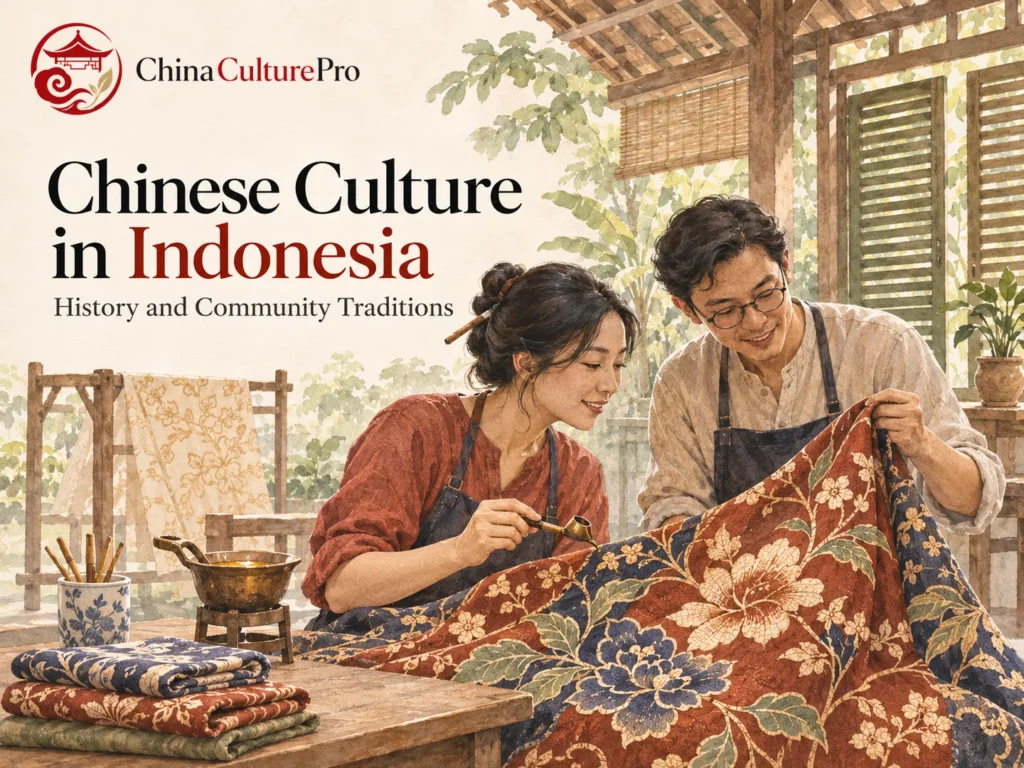
Lasem, on Java’s northern coast, is associated with hand-drawn batik combining Chinese and Javanese cultural influences. A 2025 study at the Kidang Mas batik center documented artisans and entrepreneurs through observation, interviews and visual records. The research examined canting tools used to apply wax, nature-based designs and Chinese mythological imagery. Dragons, phoenixes and peonies appear in this visual vocabulary.[8]
A separate 2019 study explored how batik entrepreneurs used repeated motifs, reproductions of older cloths and Chinese characters to carry cultural memory. Repeating a motif can maintain its visible form even when later makers or wearers no longer recognize all its earlier meanings.[9]
Lasem batik belongs to an Indonesian textile tradition shaped through local cultural exchange. The separate guide to wax-resist textiles in China provides a technique comparison; it should not be taken to classify Indonesian batik as a branch of one exclusively Chinese craft.
Wayang Potehi and Living Performance Traditions
Wayang potehi is glove puppetry, related to the Chinese form called budaixi (布袋戏, bùdàixì). A puppeteer manipulates small figures with a hand inside the puppet’s cloth body. In Chinese Indonesian communities, performances have served entertainment and temple-related ritual purposes.[10]
A 2022 study examined Rumah Cinwa, a troupe with young Indonesian practitioners. Their work adapted puppet appearances, repertoire and musical accompaniment, while using digital platforms to share performance information. The case shows cultural transmission through active creative choices, not only the repetition of inherited material.[10]
Chinese Indonesian performance also includes forms such as the gambang kromong ensembles associated with Batavia, now Jakarta. These differ from East Java’s glove-puppet traditions even though both reflect histories of cultural contact. Their local development is one reason to examine each art on its own terms.[11]
The guide to Chinese puppetry distinguishes glove, shadow and other puppet forms. Shared Chinese connections do not make all Indonesian wayang performances the same genre.
FAQs About Chinese Culture in Indonesia
Is Chinese Indonesian culture the same as culture in China?
No. It has developed through Indonesian local histories, language choices, community relationships and creative practices, while retaining varied connections with Chinese heritage.
Does Peranakan mean every person has mixed ancestry?
No. In this context, Peranakan can describe locally rooted descendants whose culture incorporates local influences, without requiring mixed ancestry in every family.
Do all Chinese Indonesians speak Mandarin?
No. Indonesian and different heritage varieties have distinct roles. Research on particular Jakarta participants shows language change, not one language pattern for everyone.
Is Cap Go Meh celebrated in the same way everywhere?
No. Jakarta’s public performances and Singkawang’s spirit-medium procession illustrate different local settings. A festival name alone does not establish a person’s religious participation.
Is wayang potehi the same as shadow puppetry?
No. Potehi uses glove puppets manipulated by hand. Shadow puppetry uses figures whose silhouettes are projected on a screen; these are different performance forms.
出典
[1] Inspectorate General, Ministry of Primary and Secondary Education, Indonesia. Menelusuri Budaya Peranakan di Indonesia dan Sejarahnya
[2] Government of Indonesia, BPK Legal Documentation. Presidential Decree No. 6 of 2000
[3] Linguistik Indonesia. Language Attitudes, Shift, Maintenance: A Case Study of Jakartan Chinese Indonesians
[4] Taman Mini Indonesia Indah. Museum Hakka
[5] Ministry of Creative Economy, Indonesia. Kementerian Ekraf Apresiasi Perayaan Cap Go Meh Jakarta Simbol Keberagaman dan Semangat Kreativitas
[6] Ministry of Tourism, Indonesia. Best Places to Enjoy Festive Chinese New Year Celebrations in Indonesia
[7] Ministry of Tourism, Indonesia. The Scrumptious Story of Lontong Cap Go Meh
[8] Dewa Ruci: Jurnal Pengkajian dan Penciptaan Seni. Visual Narrative of Ethnic Identity: Preserving Chinese Culture through Traditional Hand-Drawn Batik Lasem
[9] Maranatha Christian University Repository. Lasem Batik as Visual Documentation of Tionghoa Peranakan Society’s Cultural Memory
[10] The International Journal of Traditional Arts. Revitalizing Potehi Practice: Preservation, Innovation, and Transmission by Rumah Cinwa in Contemporary Indonesia
[11] University of Melbourne, Indonesia at Melbourne. Talking Indonesia: Chinese Indonesian Performing Arts