

Quick Answer: What Is Chinese Lion Dance?
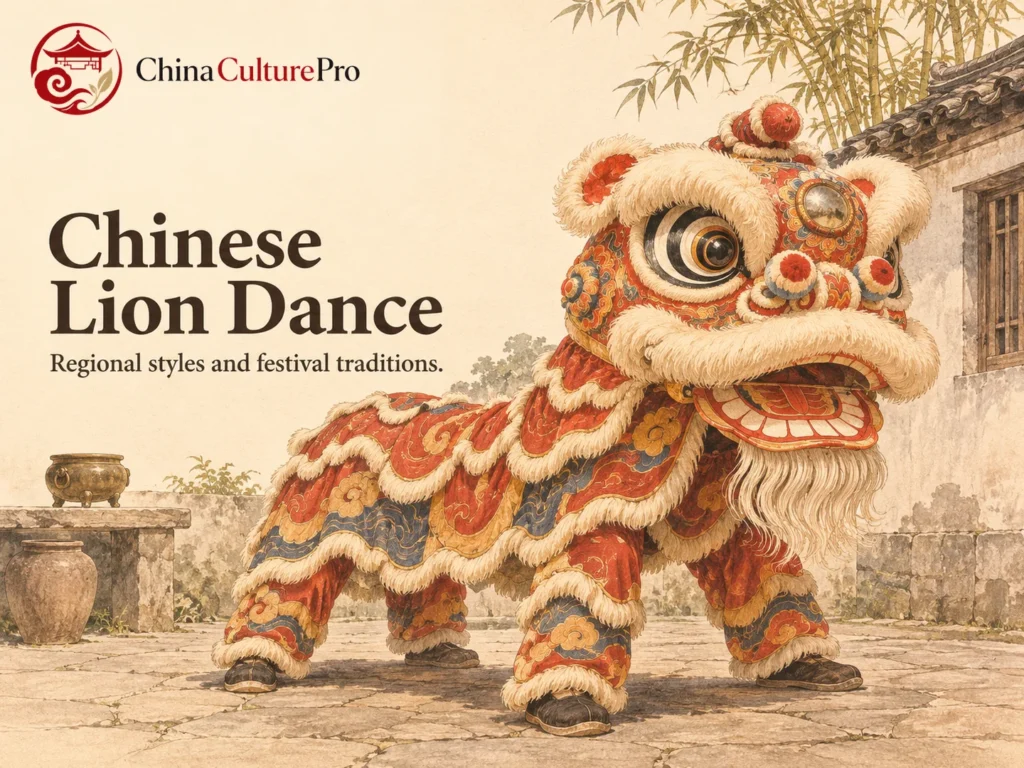
Chinese lion dance, or wushi(舞狮,wǔshī), is a performance in which dancers make a lion costume appear to move, look and react. A large lion typically has two performers, one at the head and one under the cloth body. Music helps coordinate the action.
Northern and southern styles include many local traditions. Some performances bring out a lion’s playful movements. Others center on a stylized encounter with an offering. Lion dances appear at festivals, community ceremonies and celebrations. The way a troupe performs depends on its training and the occasion.
A lion can seem to hesitate just before it pounces. The performer at the head changes its gaze, the partner shifts under the cloth and the drummer brings out the pause. Watch for moments like this to see how the costume becomes a character.
How Performers Bring the Lion to Life
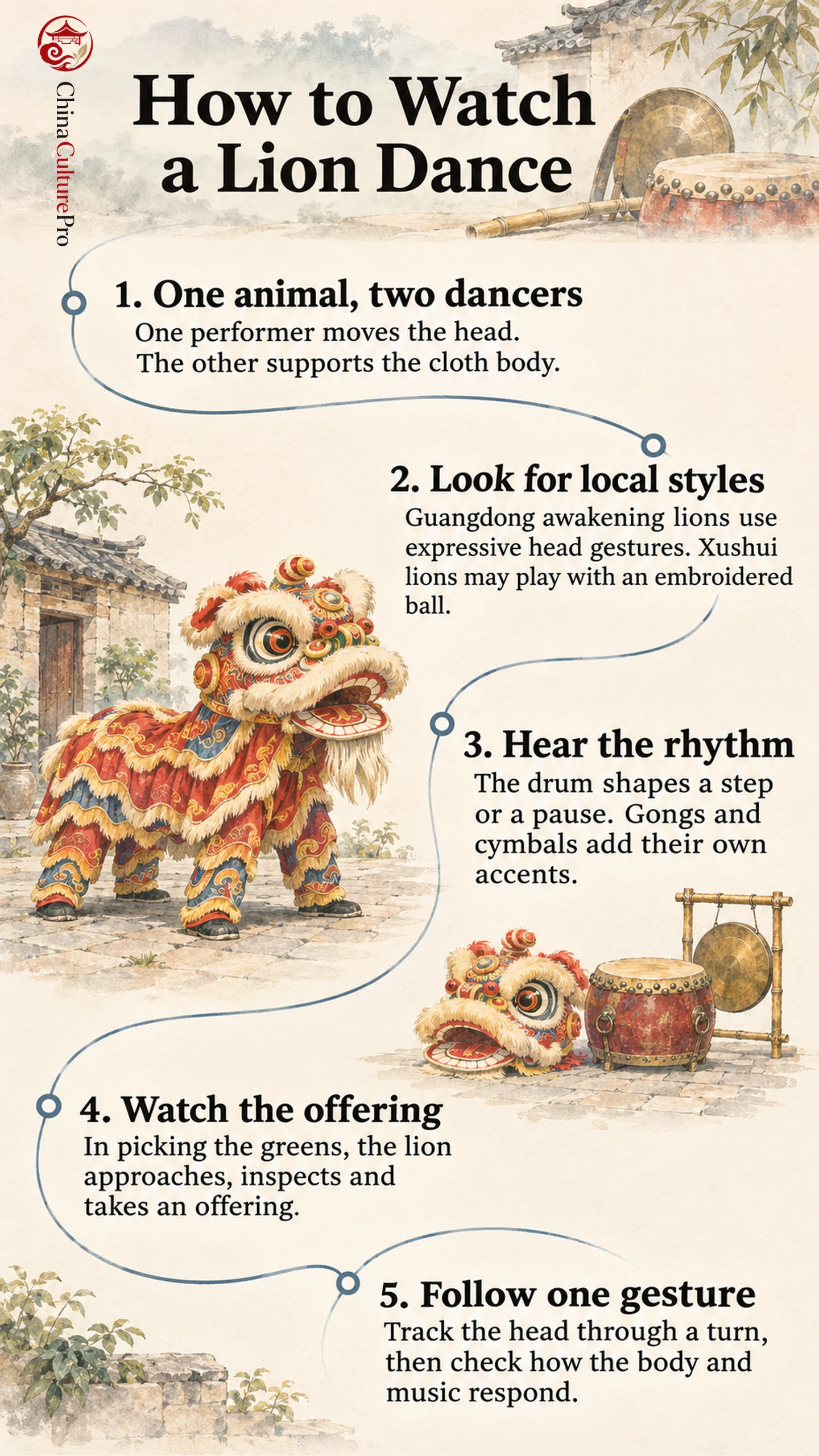
The head and cloth body do different jobs. One gives the animal a face, and the other lets two people create the shape of a single moving body. In a two-person lion, the front performer supports and turns the head. The rear performer supports the body cloth and matches the front performer’s changes of direction. Both have to shift weight together for a crouch or turn to look like one animal’s movement. [1]
Some heads have movable features that can make the animal seem to blink or open its mouth. The timing of these actions matters. A blink after a sudden drum accent can look like surprise, while a slow tilt can suggest that the lion is studying something. Guangdong heritage accounts describe movements such as opening the eyes, grooming and shaking the body. [2]
Southern and Northern Lion Dance
Guangdong xingshi(醒狮,xǐngshī), or awakening lion dance, is a southern tradition with strong links to martial-arts training. [2] Xushui in Hebei offers one northern example. Its troupe tradition includes a guide who can play with the lion using an embroidered ball. Each example gives the viewer a way to recognize a local style. [3]
| 記録のある例 | Costume and performance | What to watch |
|---|---|---|
| Guangdong awakening lion | A stylized head with expressive features, worn by a pair of performers | The lion may investigate an offering and react through head gestures and changes of stance. |
| Xushui lion dance | A rounded head and shaggy body on the large lion, with a small solo lion also documented | Watch the animal’s playful movements and interaction with the ball-carrying guide. |
Both traditions can involve athletic feats. Some Guangdong teams perform on elevated supports. [2] The Xushui repertoire also includes balancing and acrobatics. [3] A pole or platform can be part of either style. Compare how a team uses its head design, footwork and sequence of actions.
Drums, Gongs and the Lion’s Movements
Drum, gong and cymbal parts can give shape to a walk, bow or sudden movement. At Toronto’s Hong Luck Kung Fu Club, the walking phrase documented by Colin McGuire uses both rim clicks and strokes on the drumhead. Its length changes with the lion’s movement and the final stroke marks the end of the phrase. [4]
A sequence like that shows the connection between the percussionists and the dancers. Listen to the drum for the start and shape of a phrase, then hear what the cymbal and gong parts add. The patterns belong to a troupe’s performance practice, so a rhythm documented at one school may differ from another’s. The wider guide to Chinese drums and gongs explains the sounds behind those cues. [4]
Picking the Greens and Celebratory Settings
In southern lion dance, caiqing(采青,cǎiqīng), or picking the greens, can give the lion an object to approach. A troupe may let the lion pause, inspect the offering and then take it. The approach, pause and taking of the offering give the routine a short plot. Troupes have developed different ways to present and reach the offering. [2]
Lion dance is familiar at Chinese New Year celebrations. The Hong Kong heritage inventory also records performances at deity birthdays, weddings and other community ceremonies. [1] In these settings the lion can convey a wish for good fortune. China’s first national heritage list included several named lion dances in 2006, among them Guangdong awakening lion and Xushui lion dance. [5]
How to Watch a Lion Dance
Follow the head for a few seconds. When it stops, see whether the rear performer also lowers the body, shifts direction or holds still. Then replay the same moment and listen for the percussion. This makes it easier to separate the lion’s gestures from the broader festival activity.
At a procession, several teams or styles may appear. In a dragon dance, performers typically hold sections of a long body on poles. A lion’s head and body move over the people inside it. When the costume is hard to see from a distance, the way the performers support it is a better clue than its color. [1]
FAQs About Chinese Lion Dance
How many people are inside a lion costume?
A full-sized lion commonly has two performers. A small lion can have one, as in the Xushui tradition.
Do all lion dances use poles?
Many routines take place on the ground. Platforms or poles appear in particular repertoires and competition routines.
How can you tell lion dance from dragon dance?
Look at how the body is supported. Lion performers usually work underneath the costume. Dragon performers often lift a long, segmented figure on poles.
出典
[1] Hong Kong Intangible Cultural Heritage Office. Inventory of Intangible Cultural Heritage, Lion Dance and Dragon Dance
[2] China Intangible Cultural Heritage Digital Museum. Guangdong Awakening Lion
[3] China Intangible Cultural Heritage Digital Museum. Xushui Lion Dance
[4] Colin P. McGuire. Music in Performances of Traditional Chinese Martial Arts and Lion Dance
[5] State Council of China. First National Intangible Cultural Heritage List