


Quick Answer: What Is the Difference Between Lion Dance and Dragon Dance?
In a typical lion dance(舞狮,wǔshī), two people work under a compact costume. One moves the head and the other supports the body. In a typical dragon dance(舞龙,wǔlóng), a line of performers holds sections of a long figure on poles. A turn or wave travels along the figure.
Both can appear at festivals and community celebrations, and both can move to percussion. Look first at how the figure is supported. A costume over the dancers suggests a lion. A long figure raised above a line of carriers suggests a dragon.
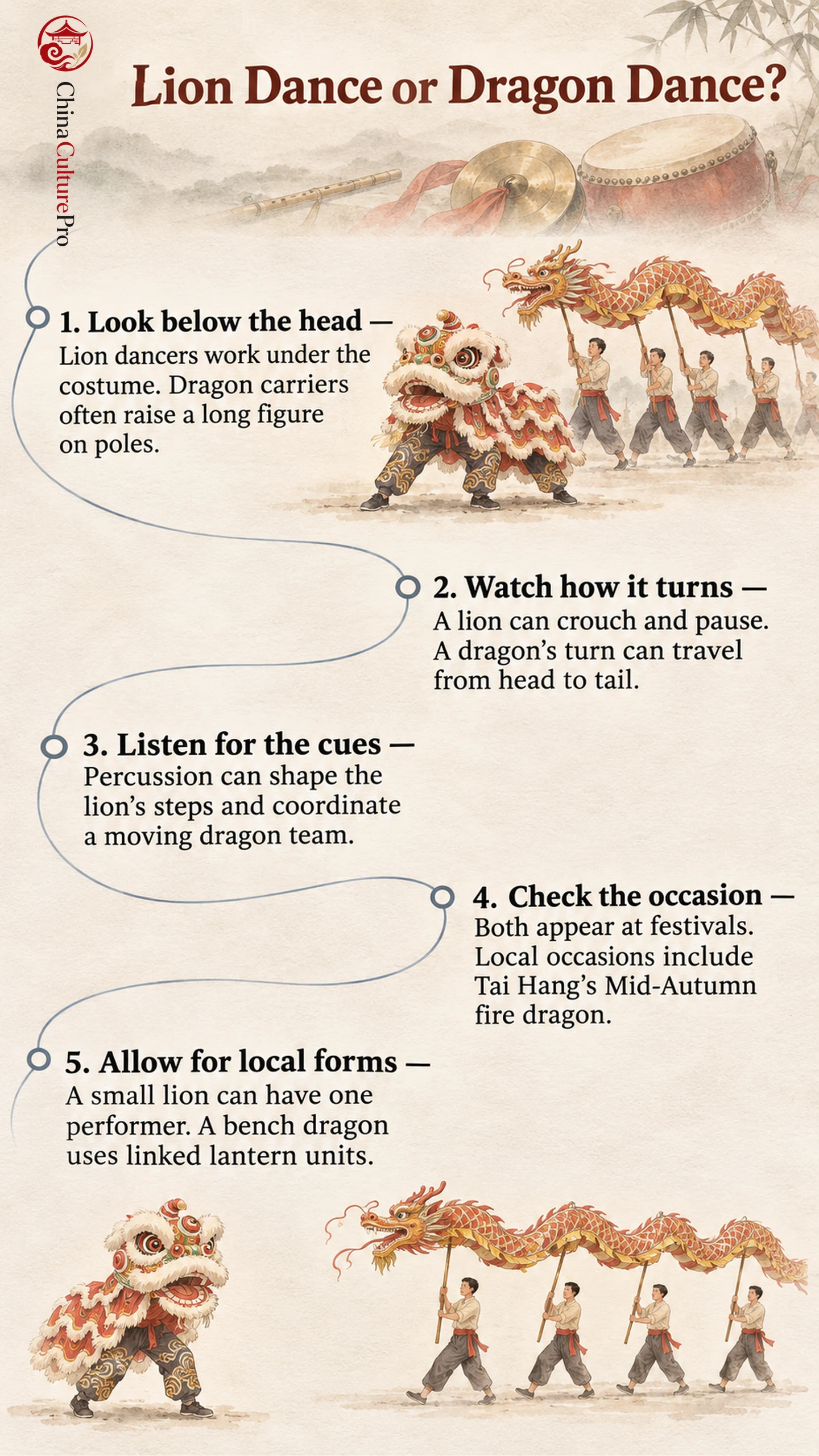
In a crowded parade, the two heads can look similar from a distance. Look below the head to see how the figure is held. The relation between the dancers and the costume is usually the quickest way to identify what is passing.
The Fastest Way to Tell Them Apart
In the familiar costume and pole-supported forms documented in Hong Kong, the first clue is where the performers stand relative to the figure. [1]
| Performance | Where the performers are | What usually gives it away |
|---|---|---|
| Lion dance | Under the head and cloth body | The animal’s compact body bends with its performers. Its head can seem to look, sniff or react. |
| Dragon dance | Below a long figure, holding its sections | The head can turn before the middle and tail follow. Several carriers keep the long shape in motion. |
A painted head, bright colors and a drum sound can appear in either performance. If the view is blocked, wait for the animal to turn sideways. You can often see a lion’s legs under a cloth body or see poles extending from the dragon’s underside.
How the Performers Make Each Figure Move
A pair of lion dancers can suggest an animal’s attention. When the head tilts, the person at the rear may lower the body or hold it still. A pause can be as important as a jump because it gives the lion a moment to seem curious or wary. The head and body movements belong to one character. [1]
In a pole-supported dragon dance, the group can send a rise or turn from one section to the next. A section near the tail may still be going straight after the head turns. The distance between the two shows when each carrier changes direction. The performers can make the body appear to coil or ripple by changing where and when they raise it. [1]
What Percussion Does in Each Dance
Both forms can use a rhythmic accompaniment. In one documented lion troupe, Toronto’s Hong Luck Kung Fu Club, the length of a walking phrase changes with the lion’s movement. The drummer can combine rim clicks and strokes on the head. The timing of the last stroke makes the end of the step sequence audible. [2]
In a dragon routine, listen for the rhythm as a whole group changes speed or begins a new figure. Hong Kong’s inventory describes carriers moving with music. The audible accents may help link the performers while the eye follows movement from head to tail. Both can use percussion. Use the shape and support of the figure to identify the dance. [1]
Where the Dances Appear and What They Mark
Lion and dragon dances can both be part of Chinese New Year traditions and other celebrations. The Hong Kong inventory documents both at festivals, ceremonies and deity birthdays. It also names weddings and picking-the-greens routines in its lion dance entry. In one routine the lion approaches an offering and takes it, giving the performance a short dramatic sequence. [1]
Other occasions have a particular local association. Tai Hang’s fire dragon is part of a Mid-Autumn Festival tradition in Hong Kong. The dragon and its route connect the performance with that neighborhood. The occasion explains why a performance is taking place. The figure and its local name help identify the dance. [3]
When the Usual Visual Clues Break Down
A large lion can be operated by two people while a small lion has only one. Both occur in Xushui’s northern lion tradition. A guide with an embroidered ball may also appear outside the costume. To count the people operating the figure, look underneath the cloth instead of counting everyone who moves with it. [4]
Some dragons use a different type of support. Pujiang’s bench dragon consists of connected units carrying lanterns. It has a different outline from the flexible cloth body, but a long joined figure still organizes the procession. If you see an unfamiliar design, look for the name of the troupe and the local tradition before deciding which dance it is. [5]
FAQs About Lion Dance vs Dragon Dance
Can lion dance and dragon dance appear at the same festival?
Yes. The occasion can include both forms, even though they use different figures and kinds of movement.
Do all lion dances have two performers?
Two is common for a large costume. Some traditions also use small lions with a single performer.
Is a long procession always a dragon dance?
A procession can include several kinds of dance. Look for the shape of each figure and how the performers support it.
出典
[1] Hong Kong Intangible Cultural Heritage Office. Inventory of Intangible Cultural Heritage, Lion Dance and Dragon Dance
[2] Colin P. McGuire. Music in Performances of Traditional Chinese Martial Arts and Lion Dance
[3] Tai Hang Fire Dragon Heritage Centre. Cultural Heritage of Tai Hang Fire Dragon Dance
[4] China Intangible Cultural Heritage Digital Museum. Xushui Lion Dance
[5] China Intangible Cultural Heritage Digital Museum. Pujiang Bench Dragon