

Quick Answer: What Are Chinese Drums and Gongs?
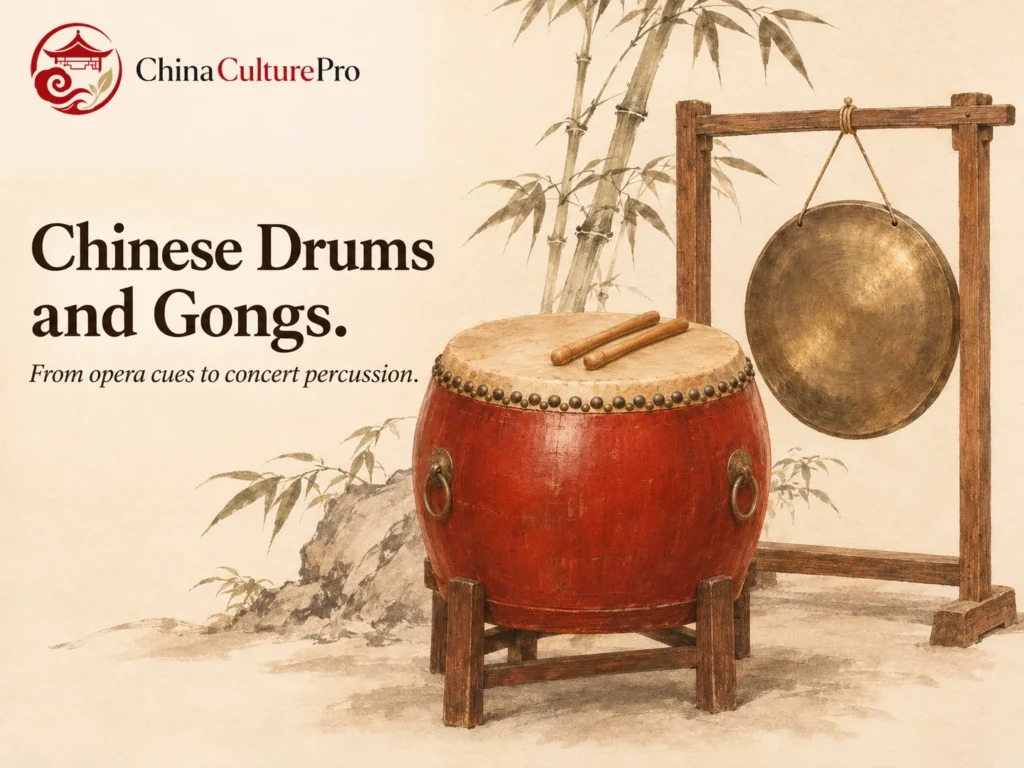
Chinese drums sound when a stretched head vibrates. Gongs sound when a struck metal disc vibrates. A large drum can give a piece a deep pulse, a small drum can mark a stage cue, and a gong can add anything from a short punctuation to a wash of sound.
The instruments often play alongside cymbals and clappers. In opera and dance, their patterns can help coordinate movement. In regional and concert ensembles, they also shape the rhythm and color of the music. Musicians can also play across a set of tuned drums or gongs.
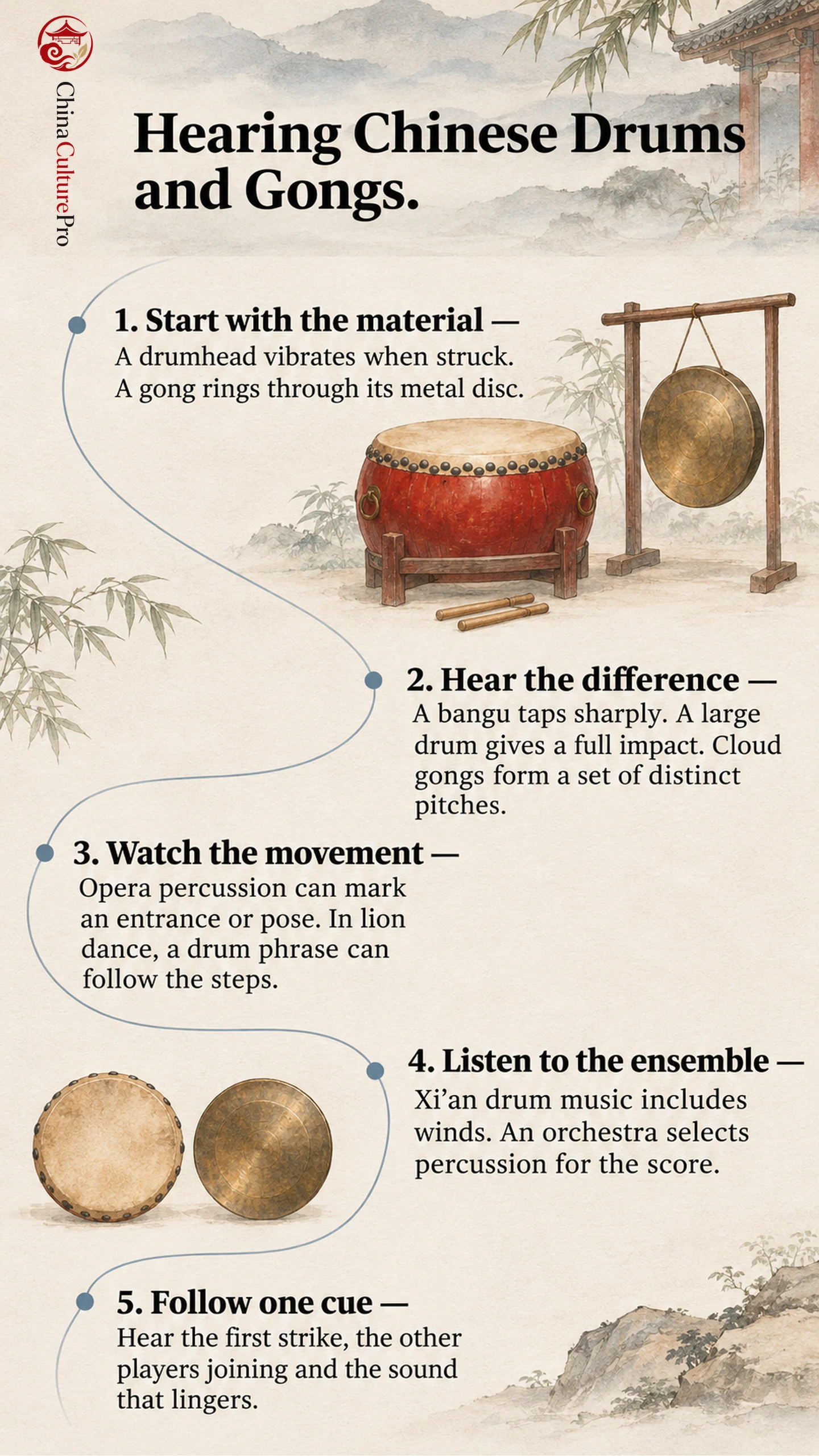
A dry click can mark an actor’s entrance. A few seconds later, a gong rings out as the actor stops and strikes a pose. To make sense of sounds like these, start by identifying what makes them, then watch what happens around the strike.
What Vibrates in a Drum or Gong?
A drum, or gu(鼓,gǔ), has a head stretched over a body or frame. The head vibrates when struck. The head’s tension, the amount of material free to move and the shell all affect the sound. A broad head can give a deep, full attack. A tightly supported head can produce a much shorter tap, as the opera drum below illustrates.
A gong, or luo(锣,luó), gets its sound from the metal itself. The shape and thickness of the disc affect how it responds. A stroke may sound bright at first and then spread into a lower, noisier resonance. Some gongs have a clear pitch. In others, the pitch can shift audibly as the metal rings. The Hong Kong Chinese Orchestra groups gongs and cymbals with metal percussion and drums with skin percussion. [1]
Common Drums and Gongs by Sound and Use
Instrument names often indicate size or configuration. The same label can cover instruments with different dimensions, and the gong that appears in an opera pit may differ from one mounted behind a modern orchestra.
| Instrument | 見分けるポイント | What to listen for |
|---|---|---|
| dagu(大鼓,dàgǔ), large drum | Broad head on a deep body | A full low impact that can carry an accent or pulse |
| bangu(板鼓,bǎngǔ), opera drum | Small exposed striking area on a head held tightly over a rigid body | A high, dry tap that can articulate a cue |
| paigu(排鼓,páigǔ), tuned drum set | Several drums arranged together | A phrase moving between distinct drum pitches |
| Large and small opera gongs | Individual suspended or held metal discs | Contrasting attacks and resonance in the same cue |
| yunluo(云锣,yúnluó), cloud gongs | Small gongs mounted together in a frame | A succession of separate pitches rather than one sustained wash |
The Hong Kong Music Office illustrates the large drum, the tuned drum set and the cloud gongs. [2] Grinnell College’s instrument collection shows how a bangu’s wooden body supports most of its head, leaving a small central area free to vibrate. [3]
How Percussion Cues Opera and Dance
In Peking opera, the percussion leader can play a bangu and wooden clappers. The drum and clappers can mark the beat under singing. A sequence of drums, gongs and cymbals can underline a turn, entrance or mock fight. Musicians use named patterns called luogudianzi(锣鼓点子,luógǔ diǎnzi). The dramatic effect comes from how the pattern meets the action onstage. [3]
In Chinese lion dance, the musicians can give the lion’s movements an audible shape. Ethnomusicologist Colin McGuire documented drum, gong and cymbal parts at Toronto’s Hong Luck Kung Fu Club. In the club’s walking rhythm, the drummer switches between clicks on the rim and strokes on the head. The phrase changes length with the steps and lands on an emphatic final beat. This is a documented example from one troupe, and other groups have their own patterns. [4]
Regional Ensembles and the Concert Stage
The Xi’an wind and percussion ensemble brings drums and gongs together with wind instruments. Its UNESCO listing describes seated and walking forms, illustrating how an ensemble can adapt to settings as different as a fixed performance space and a moving procession. The name “drum music” points to percussion’s prominence within the ensemble. [5]
A Chinese orchestra can draw on instruments from several performance traditions. The Hong Kong Chinese Orchestra lists large and small gongs, cloud gongs and several kinds of drums alongside wood percussion and Western concert percussion. A composer can choose particular sounds for a score, while a regional ensemble’s mix often reflects the pieces and occasions it serves. [1]
How to Hear the Parts in a Performance
Watch percussionist Wu Baofu’s bangu demonstration in the Grinnell collection and listen for how fast the sound ends. Then try a clip that shows both percussionists and performers. Follow one movement such as a turn or landing. Hear which sound begins the phrase, which instruments join it and what is still ringing when the body comes to a stop. [3]
If the musicians are outside the frame, focus on the beginning and end of each sound. A drum stroke or clapper can create a precise point in time, and the ringing sound after a gong strike can overlap the next gesture. Repeated viewings make it easier to distinguish a recurring pulse from a cue tied to one action.
FAQs About Chinese Drums and Gongs
Are all Chinese gongs tuned?
No. Cloud gongs form a set of distinct pitches. Many individual gongs are chosen for their attack, resonance or pitch movement.
What is the small drum used in Peking opera?
The bangu gives a short, high sound. The percussion leader often plays it in coordination with wooden clappers.
Why are cymbals used with drums and gongs?
Cymbals add a bright attack that can reinforce or answer another instrument’s stroke. The parts work together in patterns suited to the performance.
出典
[1] Hong Kong Chinese Orchestra. Percussion Instruments
[2] Leisure and Cultural Services Department, Music Office. Chinese Musical Instruments
[3] Grinnell College Musical Instrument Collection. Bangu
[4] Colin P. McGuire. Music in Performances of Traditional Chinese Martial Arts and Lion Dance
[5] UNESCO. Xi’an Wind and Percussion Ensemble