


Quick Answer: What Is the Hakka Language?
Hakka (客家话, kèjiāhuà) is a Chinese language with related regional varieties in southern China, Taiwan and overseas communities. It has its own sound patterns and linguistic conventions. Hakka cultural identity and the ability to speak a particular Hakka variety are connected questions, but they are not interchangeable.[1][2][4]
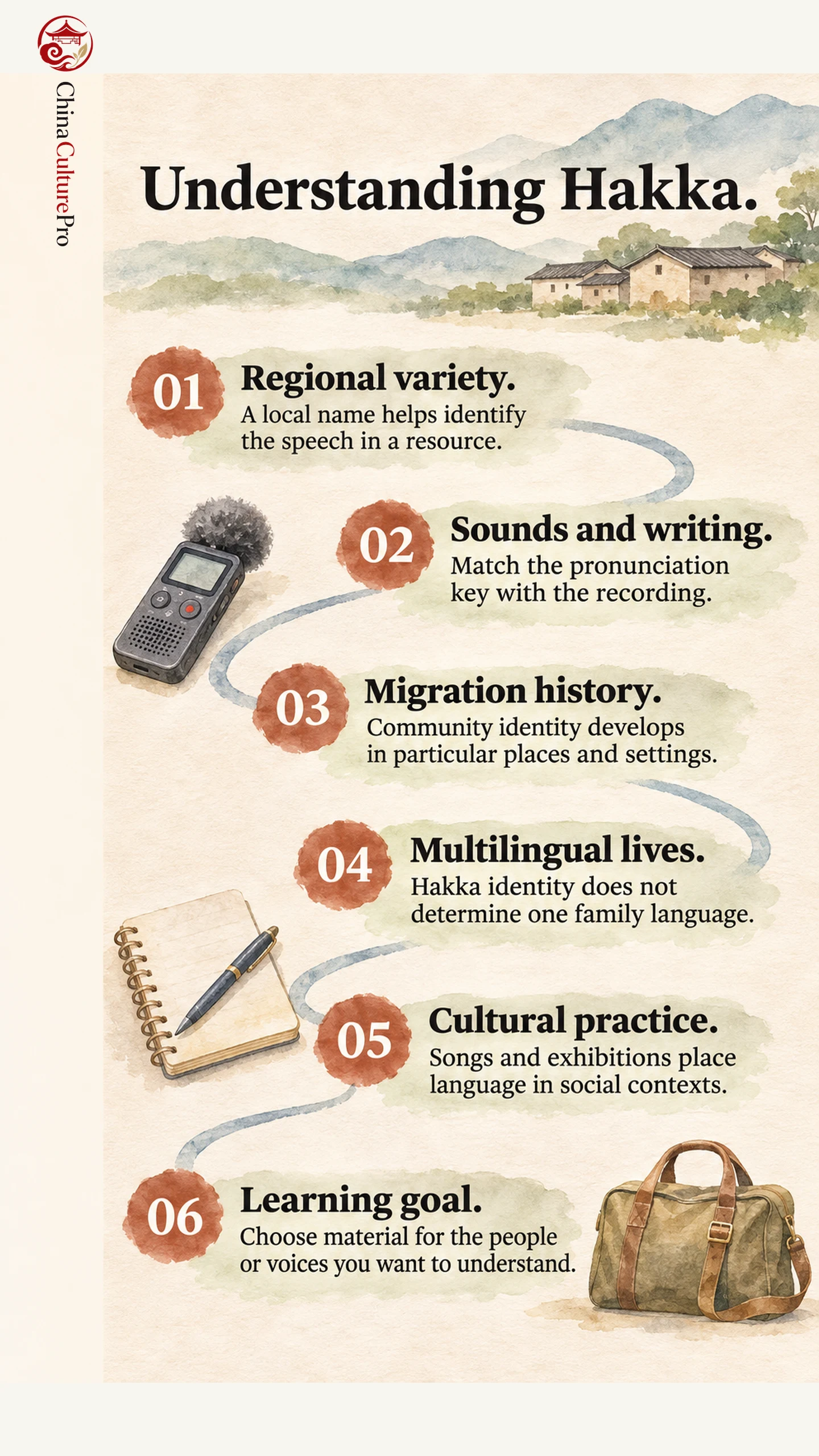
- Region: A local label matters when comparing pronunciation or choosing lessons.
- Sound: Tone descriptions apply to specified varieties, not automatically to every Hakka speaker.
- Migration: Community histories involve different places and social settings.
- Identity: A person can identify as Hakka while using several languages in daily life.
The pinyin here identifies Chinese names. It is not a guide to their pronunciation in Hakka; use a resource’s own romanization and audio for that task.[1][3]
A family name, a hometown and a language label can preserve different parts of someone’s history. If a relative says “we are Hakka,” a useful next question is which languages they grew up hearing and speaking. That distinction places Hakka within the broader diversity of Chinese languages and dialects without reducing identity to a vocabulary test.
Where Hakka Is Spoken and What Regional Labels Mean
Hakka-speaking areas include parts of Guangdong, southwestern Fujian and southern Jiangxi, with further communities elsewhere in southern China, in Taiwan and overseas. The distribution does not form one uniform block with identical speech throughout it.[2]
A phonetic study of Meixian (梅县, Méixiàn) Hakka in northeastern Guangdong makes its reference explicit. Its fieldwork in 2007 focused on younger speakers from the Meijiang area, and its accompanying recording featured a 22-year-old male college student. This is a documented sample, not every possible Hakka voice.[1]
Official Taiwan learning materials also distinguish varieties by name. Sixian (四縣, Sìxiàn) and Hailu (海陸, Hǎilù), for example, appear as separate labels. A resource’s regional focus is therefore part of its content, not an optional footnote.[3]
| ラベル | What it helps identify | Boundary to keep |
|---|---|---|
| Meixian | A reference variety in northeastern Guangdong | One research description does not cover all Hakka speech. |
| Sixian | A named variety in Taiwan learning resources | Check the resource’s own regional and pronunciation notes. |
| Hailu | Another named variety in Taiwan learning resources | Do not assume its sound conventions match another variety’s. |
This table illustrates how labels work; it is not a complete classification or a ranking of better and worse Hakka.
Sounds, Writing and the Importance of a Named Variety
Hakka is tonal. An acoustic study identified six citation tones in Meixian Hakka while also discussing differences among earlier scholars’ transcriptions. That result describes a particular variety and analytical setting. It is not a universal tone chart for every community.[2]
The practical lesson is to compare like with like. Check whether an audio example is an isolated word or part of connected speech, and whether a number labels a tone category or describes its pitch. The broader introduction to Chinese tones explains the underlying distinction.
Written teaching resources can combine characters, pronunciation notation and audio or video. Taiwan’s official digital-materials listing includes sentence patterns, new words, e-books, animations and teaching videos across named varieties. These different components help connect a written entry with actual speech.[3]
Do not read a Hakka romanization automatically as English or Mandarin pinyin. Romanization systems use letters according to their own conventions. When using a dictionary, check its variety and pronunciation key before comparing an entry with a family recording.
Migration Histories and Community Identity
Migration is central to many Hakka histories, but one journey or fixed cultural essence cannot explain every community. Anthropological research has examined how Hakka identity acquires different meanings in particular historical, social and economic settings.[4]
This approach treats family origin stories as material to investigate. Ask which places, migrations and institutions a record describes, rather than assuming that a shared label supplies a complete biography. The wider guides to Chinese migration および Hakka culture place those questions in context.
Ancestral records can help establish particular connections, but a surname alone does not reveal current language use. Clan and ancestral identity are therefore related to, but distinct from, the question “what do you speak at home?”
A Diaspora Case: Hakka Identity and Language Choice
A study published in 2023 examined Hakka language use in the Netherlands through 115 questionnaires and 21 qualitative interviews. Participants came from different migration backgrounds while connecting through a shared Hakka identity.[5]
The study found differences in language use: some participants with Hong Kong and Guangdong connections tended toward Cantonese, while Hakka remained a family language among participants from Suriname. Mandarin and Dutch also figured in the multilingual setting.[5]
These findings demonstrate why identity cannot be read directly from a single language label. They do not establish the language habits of every Hakka person in Europe or elsewhere. The broader overview of diaspora languages includes related situations, and the Cantonese guide helps distinguish the languages involved.
Songs and Cultural Transmission
Mountain songs, or shange (山歌, shāngē), provide one setting in which Hakka speech participates in cultural life. Research on women’s accounts of singing and listening in northern Taiwan between 1930 and 1955 examines how song connected work and leisure. It describes particular experiences, not a requirement that every Hakka person sing.[6]
Local exhibitions can also preserve a more specific community story. A 2022 museum exhibition on Zhao’an (詔安, Zhào’ān) Hakka in Yunlin connected regional history with performance traditions and language learning. Such projects show why cultural transmission needs local detail rather than a single generic Hakka image.[7]
Folk songs および heritage practices offer useful contexts for language. They complement recordings of conversation; they do not replace the need to understand the words and conventions of a particular variety.
Choosing Material for a Family or Local Context
Start with the people or recordings you want to understand. Ask for a hometown or variety name, and find material that identifies its own target clearly. If family speech differs from the lesson, keep both examples rather than deciding immediately that a relative’s form must be wrong.
Match the transcript, pronunciation key and recording. A written word without its local reading gives less information than that combination. Keep place, speaker and date with a family recording so that future comparisons have a context.
For general cultural reading, begin with the relationship among language, community and migration. For conversation, prioritize a specific local model. Those are different learning tasks, and a resource that serves one well may need supplementation for the other.
FAQs About the Hakka Language
Does Hakka always have six tones?
No universal total should be assumed. Six citation tones are reported for Meixian in the acoustic study cited here; use a description of the particular variety you are learning.[2]
Does Hakka ancestry guarantee Hakka fluency?
No. The Netherlands study documents people connecting through Hakka identity while using different family and community languages. Ask about a person’s language experience rather than treating ancestry as a proficiency statement.[5]
Which Hakka variety should a beginner choose?
Choose according to the people or speech you want to understand. A clearly labelled regional course with matching text, pronunciation guidance and audio is more useful for that goal than an unspecified “universal Hakka” word list.[1][3]
出典
[1] Lee and Zee. Hakka Chinese
[2] Cheung, City University of Hong Kong. Vowels and Tones in Meixian Hakka: An Acoustic and Perceptual Study
[3] Taiwan Government Open Data Platform. Hakka Digital Learning Materials
[4] Constable, University of Washington Press. Guest People: Introduction
[5] Vollmann and Soon. Language Use Among the Hakkas in the Netherlands
[6] National Yang Ming Chiao Tung University Research Repository. Leisure, Work, and Constituted Everydayness: Mountain Songs of Hakka Women
[7] Taiwan Hakka Culture Development Center. Exhibition on Zhao’an Hakka Culture