

Quick Answer: What Are Chinese Folk Songs?
Chinese folk songs(民歌,míngē)are vocal traditions passed on and reshaped within communities. They include songs for shared work, courtship, storytelling, ceremonies and entertainment. The language, setting and use of the voice help identify a song tradition.
A work call can help coordinate movement, while a lyrical tune might be sung to a small audience. Some traditions feature a single singer, while others combine several vocal parts. Local names and ways of grouping songs vary.
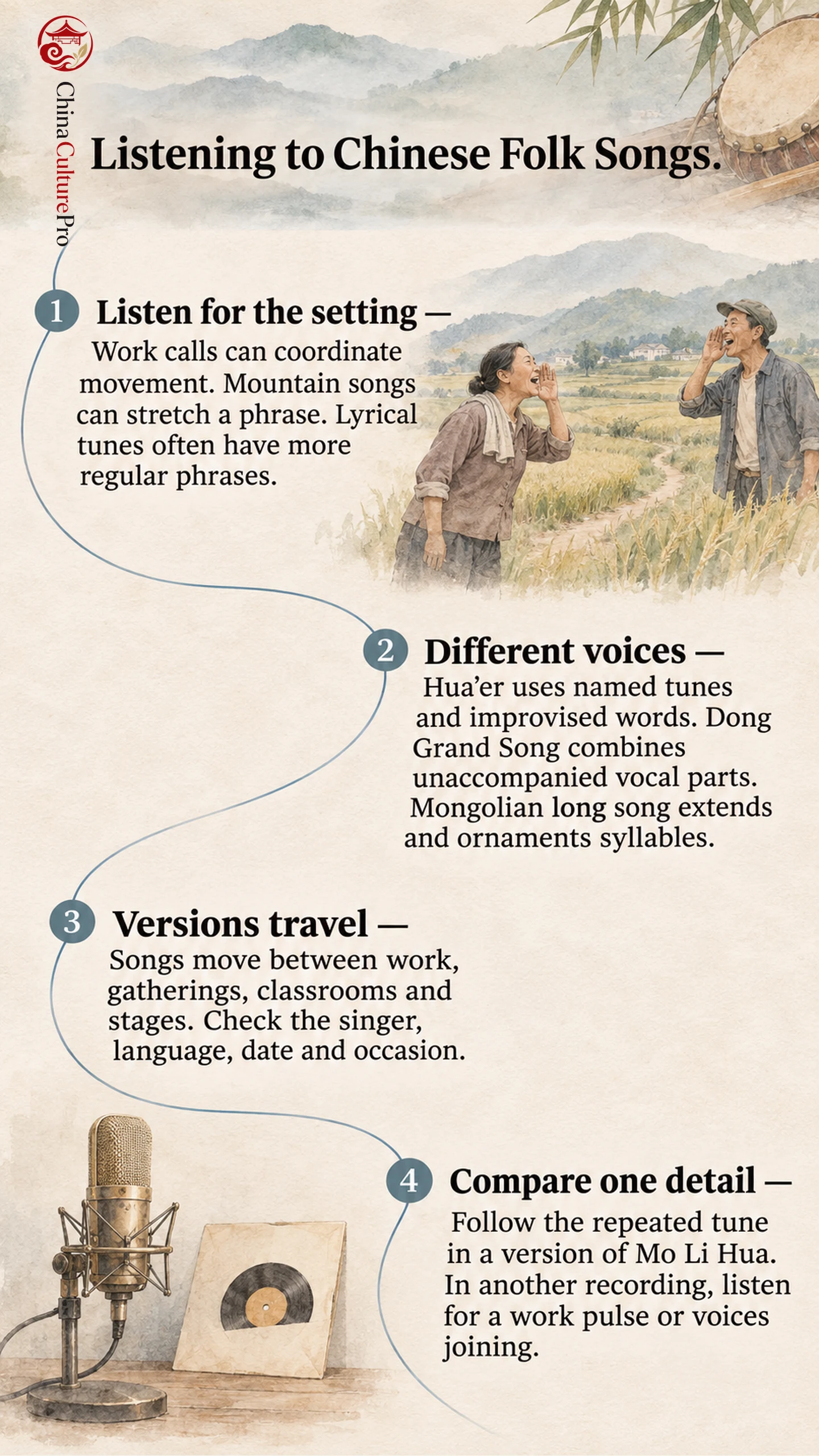
A boat crew matching its effort to a sung response and a choir trading melodic parts in a village have different reasons to sing. Those settings can shape what you hear, from the pulse of a repeated call to a phrase that stretches over several breaths. The timing and the number of voices are two clues you can listen for.
Work Songs, Mountain Songs and Lyrical Tunes
A common starting point groups Han Chinese folk songs into work songs, mountain songs and smaller lyrical tunes. A field study in Zhenba and Ziyang in southern Shaanxi identified those three alongside a fourth group tied to local customs. These labels help describe how a song works in a setting.[1]
| 種類 | Typical setting or function | What to listen for |
|---|---|---|
| Haozi(号子,hàozi) | Work that benefits from a coordinated rhythm, such as hauling or pounding. | A repeated pulse and, in some forms, a leader answered by a group. |
| Shange(山歌,shāngē) | Mountain or outdoor singing, with themes that can include courtship and daily life. | Longer calls and flexible pacing in many examples. |
| Xiaodiao(小调,xiǎodiào) | Lyrical tunes sung in homes, gatherings and entertainment settings. | Regular phrases and a clearly shaped tune, with ornament varying by singer. |
| Custom songs | Songs associated with a specific custom or ritual, as in the southern Shaanxi study. | Words and timing tied to an occasion, such as a marriage or incense offering. |
The Hanjiang boatmen’s songs cited in that study show how the work can give a sung phrase its timing. A singer performing one onstage may preserve a recognizable pulse after the original task has been removed. Ask what the song originally accompanied and what the recorded performance is doing now.
Regional Traditions and Languages
Across parts of Gansu and Qinghai, Hua’er (花儿,huā’ér)brings together singers from several ethnic communities. Singers work with named tune types and improvise words within conventions. This means a familiar melody can carry a response to a particular person or event. The tradition includes singing in fields and at festivals.[2]
Grand Song of the Dong(侗族大歌,Dòngzú Dàgē)is a different way of organizing voices. The UNESCO nomination describes unaccompanied singing in multiple parts, passed on by experienced singers to choirs. A village drum tower can be a formal setting, alongside singing in homes and public spaces. The repertoire includes greeting songs, ballads and imitations of sounds from the natural world.[3]
Mongolian long song, called urtiin duu, stretches syllables into extended, ornamented phrases. Its regional styles are associated with community celebrations and pastoral life in Mongolia and parts of China, including Inner Mongolia. Its long vocal lines can unfold at a flexible pace. The repeated responses of some work songs serve the different task of coordinating movement.[4]
How Folk Songs Change Between Settings
A song can travel between a work site, a family gathering, a lesson and a concert. Each setting changes who joins in and what the audience hears. A lead singer’s repeated line can become a solo verse in an arrangement. Instruments can supply an introduction or answer the voice where another singer would have responded in a group.
Language is another clue. The 1994 release Flower Drum and Other Chinese Folk Songs by Stephen Cheng draws on multiple song types and includes Mandarin and Cantonese performances. Its track listing preserves such pairings as Purple Bamboo with Cantonese Lullaby. The album offers a named artist’s presentation of songs, which gives listeners a different kind of evidence from an account of a working group or ritual setting.[5]
A familiar title can also travel between versions. For any recording, check its performer, language, date and occasion. Those details explain how a song was presented and help you compare versions without assuming that one arrangement represents every community.
Where to Start Listening
Begin with Mo Li Hua(茉莉花,Mòlìhuā), or Jasmine Flower. The version taught by singer Qian Yi in a Carnegie Hall lesson uses five pitches in a D-based collection. Follow the repeated tune and listen for where the lines come to rest. The example connects a specific performance with the Chinese pentatonic scale.[6]
Then choose a contrasting entry, such as Cheng’s Song of the Hoe, listed on a track alongside Su-Wu Tending the Sheep. The catalog gives you the song and performer, and the southern Shaanxi research offers a question to bring to the recording. Does a regular pulse seem central to the phrasing? With a Dong Grand Song example, shift your attention to how voices overlap and join. Comparing the tasks voices perform helps you hear more than melody alone.
FAQs About Chinese Folk Songs
What are the main types of Chinese folk songs?
Work songs, mountain songs and lyrical tunes are common categories. Local classifications can also distinguish songs for customs, rituals or other specific settings.
Are Chinese folk songs always sung in Mandarin?
They are sung in many languages and regional varieties. Mandarin and Cantonese both occur on some recorded collections, and other traditions use their own community languages.
Is every Chinese folk song pentatonic?
Five-tone melodies are widespread, but particular songs and versions can use other pitches. Listen to the specific performance before assigning it a scale.
出典
[1] Yang Wang and Awirut Thotham. Ethnomusicological Insights into the Sociocultural Dynamics of Folk Songs in Southern Shaanxi, China
[2] UNESCO Intangible Cultural Heritage. Hua’er
[3] UNESCO Intangible Cultural Heritage. Decision 4.COM 13.15, Grand Song of the Dong Ethnic Group
[4] UNESCO Intangible Cultural Heritage. Urtiin Duu, Traditional Folk Long Song
[5] Smithsonian Folkways Recordings. Flower Drum and Other Chinese Folk Songs
[6] Carnegie Hall. Learning Mo Li Hua