
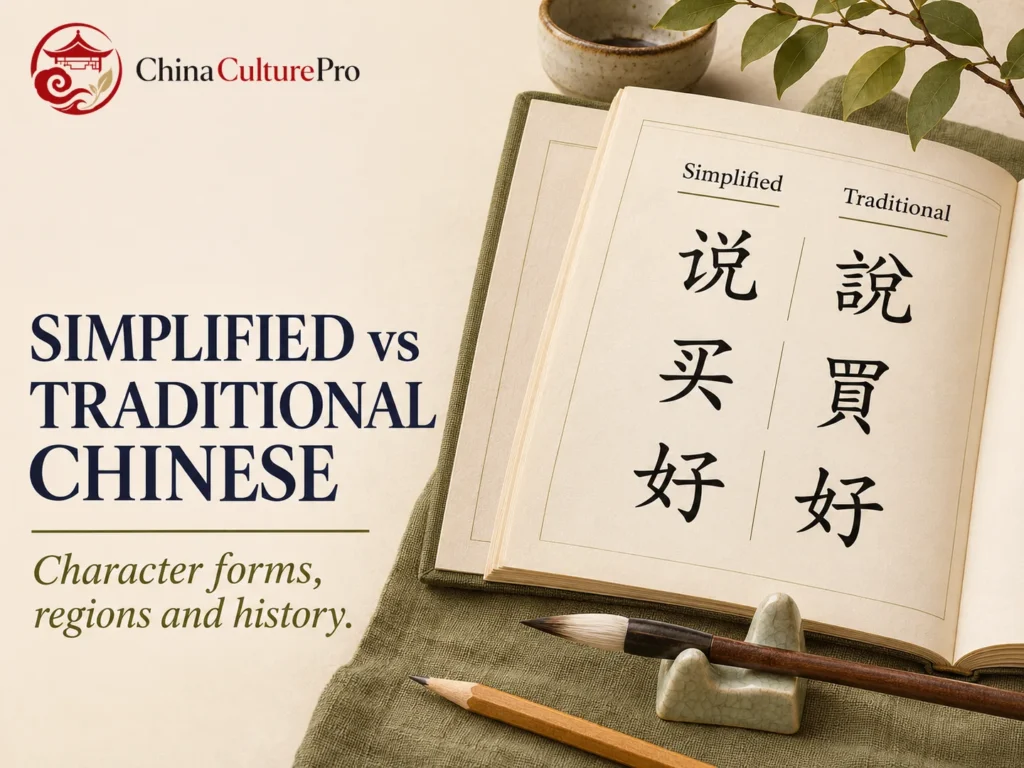

Quick Answer: What Is the Difference Between Simplified and Traditional Chinese?
Simplified characters (简体字, jiǎntǐzì) and traditional characters (繁体字, fántǐzì) are forms within the Chinese writing system. Many characters are identical; others have different shapes, and a single simplified form can correspond to more than one traditional character.[1]
- Regional use: Simplified forms are common in mainland China and Singapore; traditional forms are common in Taiwan, Hong Kong and Macao.[1]
- Written meaning: Conversion sometimes requires the whole word, not a one-character replacement.[5]
- Learning choice: Start with the form used in your main reading or study setting, then learn frequent counterparts.
These labels do not name two spoken languages, and neither form is a guarantee that a text uses classical rather than modern Chinese.
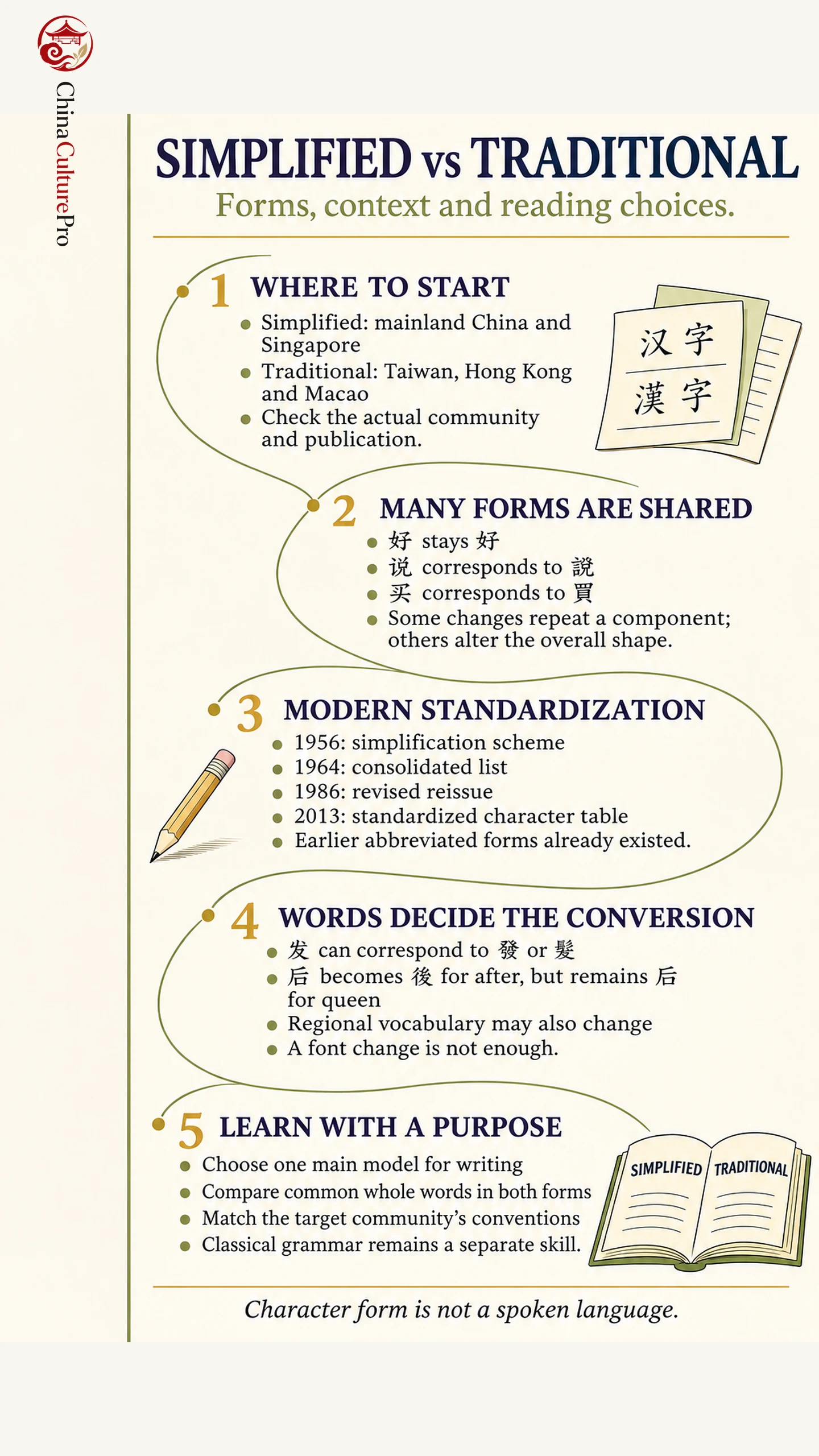
Two editions can present the same modern Chinese sentence with different character forms. Two other editions may differ in vocabulary as well. A useful comparison therefore asks both “Which characters are used?” and “Whose wording and conventions does this text follow?”
Where Each Form Is Commonly Used
Use this as a guide to ordinary publishing and learning materials, rather than a claim that every sign, book or individual in a place follows one pattern.[1]
| Reading setting | Common starting point | What else to check |
|---|---|---|
| Mainland China | Simplified forms | The particular publication, names and special uses |
| Singapore | Simplified forms | Local wording and the intended readership |
| 台湾 | Traditional forms | Taiwan character conventions and vocabulary |
| Hong Kong and Macao | Traditional forms | Local wording, register and character conventions |
Standard Mandarin (普通话, pǔtōnghuà) can be written in either form: Taiwan provides a clear traditional-character example. Cantonese (粤语, Yuèyǔ) does not require traditional forms, as ordinary publication in Cantonese-speaking Guangdong shows. The Mandarin versus Cantonese comparison explains the spoken-language distinction.[8]
“Traditional” also does not mean one completely uniform regional standard. Taiwan provides its own standard-form learning resources. Hong Kong’s reference glyph resources discuss local shapes that differ from those associated with older Taiwan-based computer fonts. These Hong Kong resources are reference guidance, not a mandatory rule governing every person’s daily handwriting.[6][7]
For an overseas family or community, look at the actual books, newspapers and messages you want to read. A country label alone may not predict the form preferred by a particular reader.
What Changes in the Characters
Some differences involve a recurring component; others change the overall shape more noticeably. Many familiar characters remain unchanged. This makes learning the second form partly a task of recognizing patterns rather than starting with an entirely unrelated script.[9]
| Meaning and Mandarin reading | 簡体字 | 繁体字 | 注目する点 |
|---|---|---|---|
| Speak, shuō | 说 | 說 | The speech component changes |
| Meal or cooked rice, fàn | 饭 | 飯 | The food component changes |
| This, zhè | 这 | 這 | The central component looks substantially different |
| Buy, mǎi | 买 | 買 | A conspicuous overall shape change |
| Good, hǎo | 好 | 好 | No change in form.[2] |
The Chinese characters guide explains how components fit within a character. A font may change stroke appearance, but a different font is not a reliable way to convert distinct characters: the underlying text may also need to change.[1]
Fewer strokes can reduce the work of handwriting a particular simplified form. That observation does not establish a universal ranking for reading, memory or cultural value. Recognizing words fluently also depends on familiarity with the form you actually encounter.[9]
How the Modern Standards Developed
Abbreviated and alternative forms existed before modern reform. The mainland reforms selected and standardized many earlier forms while also using new graphs; they did not invent the idea of simplified handwriting from nothing.[2]
- 1956: The State Council announced a character simplification scheme.
- 1964 and 1986: A consolidated simplified-character list was compiled in 1964 and reissued with adjustments in 1986.[3]
- 2013: A standardized character table was released for general mainland use, replacing the earlier related tables as the applicable reference.[4]
These dates describe modern standardization, not the beginning of Chinese writing. Traditional forms also have a history of change and regional selection. Neither label means every character has remained unchanged since antiquity. For artistic script styles, the Chinese calligraphy guide addresses a different question from simplified-versus-traditional form choice.
Why Conversion Needs the Whole Word
The simplified 发 covers traditional 發, associated with sending or emitting, and 髮, hair. Likewise, 后 becomes 後 in the sense “after,” but remains 后 in a word for a queen. Context determines the counterpart. Another useful pair is 面: traditional 面 means face, while 麵 is used for noodles.[5]
The issue extends beyond character shapes. For “software,” mainland 软件 corresponds to Taiwan 軟體 in a common regional usage; changing only the first character’s form produces 軟件 instead. That is a vocabulary choice, so a character converter and a regional-language revision are doing related but different jobs.[5]
Check a simplified or traditional conversion with four separate actions:
- Set the target community: Choose mainland, Taiwan, Hong Kong or another audience convention before converting the text.
- Convert phrases in context: Use a phrase-aware conversion process and check characters with several possible counterparts against their whole words.
- Review names and local wording: Preserve verified personal and place names, and check whether vocabulary suits the intended readers.
- Inspect the displayed result: Read the complete text with an appropriate font, checking character forms, punctuation and meaning rather than only individual substitutions.
Choose One Starting Point, Then Read Across
Choose the form that supports your main activity: reading Taiwan publications, studying with a mainland textbook, following Hong Kong material or exchanging family messages. Pair it with the pronunciation system and spoken variety your course actually teaches. The Chinese languages guide および pinyin guide explain those separate choices.
For writing practice, use one consistent model initially. For reading, compare common whole words in both forms, noticing recurring component changes alongside exceptional pairs. You can build recognition of the second form without immediately expecting equal handwriting recall in both.[2]
If the goal is older literature, choose an annotated edition suited to your level. Traditional characters alone do not teach older vocabulary, grammar or allusions, while a simplified-character edition can still present an ancient text. The Chinese classics reading guide helps you judge the edition and its notes as well as its character forms.
FAQs About Simplified and Traditional Chinese
Are simplified and traditional Chinese different languages?
No. The distinction concerns written forms and associated publishing conventions. It should be kept separate from spoken varieties such as Mandarin and Cantonese.[1][8]
Can software convert them perfectly character by character?
Not reliably. One simplified character may have several traditional counterparts, and regional vocabulary can require more than a character substitution. Whole-word context and a final reading check matter.[5]
Should a beginner learn both at once?
You can begin with one form for active writing while gradually recognizing the other in frequent words. Let your main course and reading setting determine the initial model, rather than dividing every practice session equally.[2]
Does learning traditional characters make classical Chinese easy?
It helps you recognize the forms in many editions, but older grammar, vocabulary and textual references remain separate learning tasks. Check whether an edition includes explanations appropriate to your level.
出典
[1] Unicode Consortium. Unicode 17.0, Chapter 18: Simplified and Traditional Chinese
[2] Massachusetts Institute of Technology OpenCourseWare. Chinese I, Lesson 1: Characters
[3] China Ministry of Education. Background notes on the standardized character table
[4] China Ministry of Education. State Council releases the standardized character table
[5] Jack Halpern and Jouni Kerman, CJK Dictionary Institute. The Pitfalls and Complexities of Chinese to Chinese Conversion
[6] Hong Kong Government, Chinese Language Interface Advisory Committee. Hong Kong Reference Glyphs
[7] Taiwan Ministry of Education. Common standard character forms: downloads
[8] American Translators Association. Simplified versus Traditional Chinese: spoken and written choices
[9] The Open University, OpenLearn. Simplified and traditional forms of Chinese characters