

Quick Answer: What Is Chinese Culture in Vietnam?
Chinese culture in Vietnam includes the local traditions of Chinese Vietnamese (越南华人, Yuènán huárén), particularly communities known in Vietnam as Hoa. Their cultural lives connect Chinese heritage with Vietnamese places, languages and social relationships.[1]
- Communities: Migration and settlement produced different regional and family histories.
- Institutions: Community venues, religious places and neighborhood businesses support cultural life.
- Living traditions: Festivals, food, language choices and new forms of documentation connect generations.
Hoa identity does not establish someone’s citizenship, birthplace, home language or religious practice. This is a community-focused part of Chinese diaspora culture, rather than an explanation of every Chinese influence in Vietnam.
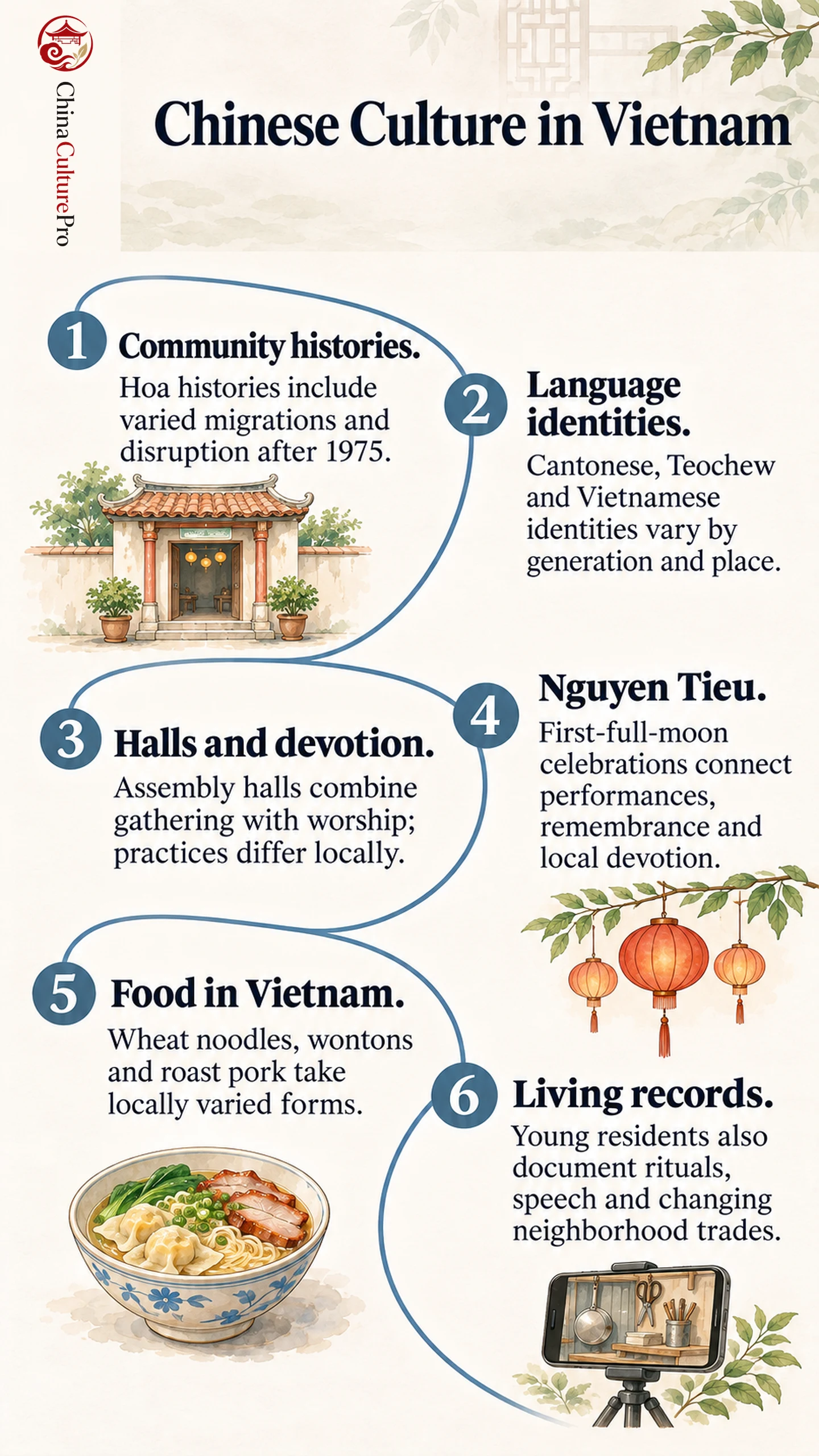
A meeting hall in Hội An, a noodle stall in Ho Chi Minh City and a young person recording neighborhood customs reveal different forms of cultural continuity. Following their local settings helps explain how Chinese Vietnamese heritage is maintained, shared and reshaped within Vietnam.
Hoa Communities, Migration and Historical Disruption
Hoa communities developed through different waves of migration and settlement, with histories in northern and southern Vietnam. Urban commerce is important, but it does not describe everyone: community accounts also record farming, fishing and craft work. These experiences belong within wider migration histories.[1]
Chợ Lớn (堤岸, Dī’àn; Mandarin name), commonly written Cholon in English, is an important historic Chinese Vietnamese area of Ho Chi Minh City. It is one local center, not a geographical definition of all Hoa communities. The historic neighborhood label, familiar from other Chinatown areas, does not define a current administrative district.[5]
After 1975, Chinese Vietnamese communities faced persecution, the loss of business positions and extensive refugee departures. A 2006 ethnography of Cholon examined how people rebuilt economic and social relationships afterward, connecting local lives with national change and relatives abroad. This disruption is part of the community’s history alongside its older trading connections.[2]
Languages, Generations and Mother-Tongue Identity
Chinese heritage does not mean everyone identifies Mandarin as a mother tongue. 広東語 (粤语, Yuèyǔ), Teochew (潮州话, Cháozhōuhuà) and Vietnamese can carry different roles across families and places. A person’s ancestry, preferred language and ability to use that language are separate questions.[3]
Research published in 2026 examined self-identified mother tongues among 2,745 Hoa participants across seven southern provinces and cities. Questionnaires were combined with interviews. Cantonese and Teochew remained important identifications in concentrated communities, while Vietnamese increasingly appeared among younger and student participants.[3]
The study concerns how people name a mother tongue, rather than a simple test of proficiency. Its participants do not stand for every Hoa household nationwide. Understanding diaspora language choices requires attention to school, family, neighborhood and generation, rather than assigning one language from a community label.
Assembly Halls, Worship and Local Community Life
Assembly halls (会馆, huìguǎn), called hội quán in Vietnamese, connect community association with places to gather. Some serve people linked to a particular region of origin; others bring together a wider membership. These roles overlap with the functions of Chinese community associations, without making every hall a single-surname organization.[4]
The Fujian Assembly Hall (福建会馆, Fújiàn Huìguǎn) in Hội An illustrates that combination. Established in 1697 and rebuilt in 1757, it includes a gathering vestibule and a main worship hall. This arrangement brings social and sacred uses into the same complex.[4]
The main altar honors Thiên Hậu (天后, Tiānhòu; Mandarin reading), a title associated with the sea goddess Mazu (妈祖, Māzǔ). Maritime devotion and community gathering share one site, while people’s reasons for participating can differ.[4][11]
A fieldwork-based study published in 2025 described both continuity and adaptation in folk religious practices around Cholon. This is evidence about particular local institutions and participants, not proof that all Hoa follow the same faith.[5]
Nguyên Tiêu: Shared Festivals in Different Places
Nguyên Tiêu corresponds to the Lantern Festival (元宵节, Yuánxiāo Jié), marking the first full moon of the traditional new year. In Ho Chi Minh City, a March 2026 cultural record describes lantern-decorated halls and shrines, lion and dragon performances, processions and Cantonese opera. The lanterns form part of a wider set of communal and devotional activities.[6]
Hội An’s 2026 program placed observances at Chinese assembly halls, communal houses and ancestral halls. It included remembrance of founding ancestors, alongside announced opera performances and local folk games. This wider local setting connects Chinese Vietnamese traditions with the town’s shared cultural life.[7]
These celebrations combine public performances with acts of remembrance and devotion. Their different settings explain why participation extends beyond one congregation or ancestry group.
Food Traditions in a Vietnamese Setting
Food makes these connections visible in everyday life. Cholon’s Chinese Vietnamese repertoire includes roast duck, dumplings and noodle dishes. These foods are part of the neighborhood’s daily eating habits.[9]
Vietnamese noodle terminology also shows why ingredients matter. Mì refers to thin wheat noodles, sometimes made with egg, rather than rice noodles. A Vietnamese wonton noodle soup called mì vằn thắn can combine them with aromatic broth, roast pork and sliced boiled eggs.[8]
Comparison with Chinese wonton noodles (云吞面, yúntūnmiàn) is useful for recognizing a related repertoire, without treating every bowl as an identical recipe. Such local combinations belong within the wider history of Chinese food abroad; they are also part of Vietnamese eating habits.
Young People, Digital Records and Living Heritage
Cultural preservation also happens through new media. A December 2025 report followed the Cholon Downtown social-media project, created by a third-generation Hoa resident to document neighborhood rituals, languages, customs and changing trades. Her mother connected this work with the need to pass memories to younger generations.[10]
The project treats streets, work and everyday speech as cultural records, alongside festivals and historic buildings. Its focus on changing trades makes everyday livelihoods part of the heritage record. This is one example of participation, rather than a measure of what all young Hoa people think.[10]
For the longer history of exchange across the two societies, Chinese–Vietnamese cultural connections provides a different frame. Hoa community life is related to that history, but deserves attention to its own people, institutions and lived experiences.
FAQs About Chinese Culture in Vietnam
Are Hoa communities the same as recent arrivals from China?
No. Hoa community histories include established families and different migration periods. An ethnic or cultural label does not by itself establish birthplace or nationality.
Do all Hoa people identify Mandarin as their mother tongue?
No. Cantonese, Teochew, Vietnamese and other languages can shape family life. Self-identifying a mother tongue also differs from demonstrating language proficiency.
Are all Chinese assembly halls simply temples?
No. Worship can share a site with meetings, association activities and community relationships. A hall’s social and religious roles can coexist.
Is Nguyên Tiêu celebrated only by Hoa communities?
No. Hội An’s program includes Chinese halls alongside communal houses, ancestral places and local arts. The festival also belongs to wider local cultural life.
Does Chinese Vietnamese food follow one unchanged recipe?
No. Ingredients, accompaniments and serving forms vary locally. Recognizing a related noodle or dumpling tradition does not mean every household uses an identical recipe.
出典
[1] Nhân Dân, drawing on the Committee on Ethnic Minority Affairs. Hoa Ethnic Group
[2] LiAnne Sandra Yu, University of California San Diego. The Reemergence of Vietnam’s Ethnic Chinese Community through Local, National, and Transnational Structures
[3] Lingua. Mother Tongue Identification in a Multilingual Context: The Case of the Hoa Ethnic Group in Southern Vietnam
[4] Hội An Center for the Conservation of World Cultural Heritage. Fujian Assembly Hall in Hội An
[5] Thuy Anh Mai, Journal of East Asian Religions and Cultures. The Continuity and Change of Chinese Traditions: Folk Religions in Ho Chi Minh City
[6] Ho Chi Minh City Department of Culture and Sports. Nguyên Tiêu Festival Programme, 2026
[7] Hội An Center for the Conservation of World Cultural Heritage. Information: Nguyên Tiêu Festival in Hội An, 2026
[8] Viet Nam National Authority of Tourism. A Foodie Guide to Vietnam’s Noodles
[9] Ho Chi Minh City Tourism Promotion Center. Ho Chi Minh City: Street Food Traditions
[10] TVB News. Vietnam Chinatown Young Generation Breathes New Life into Hoa Heritage
[11] Vietnam Airlines. Thiên Hậu Temple in Saigon’s Chinatown