

Quick Answer: What Shapes Chinese Culture in Malaysia?
Chinese culture in Malaysia is the changing cultural life of Chinese Malaysians (马来西亚华人, Mǎláixīyà huárén), shaped by local settlement, regional communities and contact within a multicultural country. Chinese heritage connects people across places, but Malaysian histories give languages, institutions and celebrations their own settings.[1]
- Communities: Peninsular port cities and Sarawak provide different regional histories.
- Transmission: Families, language choices, associations and schools carry and reshape traditions.
- 表現力: Local food, public gatherings, coastal rituals and Malaysian-created performance show distinct forms of participation.
These are overlapping aspects of cultural life, not a checklist every Chinese Malaysian must follow. A person’s language or festival participation alone does not define their identity.

A classroom in Penang, breakfast in Sibu and a drum performance in Johor Bahru reveal different Chinese Malaysian experiences. These local examples place Chinese diaspora histories in the daily work of learning, gathering and creating.
Regional Histories Across the Peninsula and Sarawak
Melaka and George Town developed through trading connections that brought Chinese, Malay, Indian and European influences into their urban life. Their multicultural heritage includes languages, religious buildings, food and festivals. Chinese community history belongs within that wider port setting rather than apart from it.[1]
The Baba & Nyonya Heritage Museum in Melaka offers one family’s perspective. Its three terrace lots were acquired by the Chan family in 1861; four generations lived there before the house became a museum in 1985. Furnishings and domestic spaces help explain that particular household’s history.[2]
These Peranakan traditions offer one family perspective within Malaysia’s wider range of Chinese community histories. Sarawak, on Borneo, adds other local histories, visible in Kuching’s community institutions and Sibu’s food traditions.
Mandarin, Heritage Languages and Family Choices
Mandarin can connect people across different Chinese language backgrounds while also changing the place of older heritage varieties. In a qualitative study published in 2022, six Chinese Malaysians aged 40 and over reported using Mandarin in home, work, religious and cultural settings formerly served by heritage languages.[4]
A separate 2022 study interviewed 29 people from nine urban Foochow families in Sarawak. Foochow (福州话, Fúzhōuhuà; Mandarin label) was more prominent in interactions involving older family members, while younger participants favored Mandarin and English. The pattern varied with generation and family relationships.[3]
These small studies show how language choices can change within families; they do not establish how all Chinese Malaysians speak. Some participants understood ethnic identity through descent, customs and food as well as language. Language change and cultural attachment did not always move in the same direction.[3]
The distinction between classroom learning and family conversation matters when considering Chinese diaspora languages. Using Mandarin to participate in cultural life and maintaining a particular heritage variety are related, but different, activities.
Associations, Schools and Community Memory
Chinese associations historically organized support around connections such as surname, regional origin and religion. Their work could include lodging, welfare, funerals and education. These practical functions help explain why a clan house could also become a place of learning and collective activity.[5]
In George Town, Leong San Tong Khoo Kongsi (龙山堂邱公司, Lóngshāntáng Qiū Gōngsī) provides a specific example. Its present clan house was completed in 1906, and a two-grade elementary school opened inside in 1907. The classroom connects an ornate heritage building with the everyday task of educating children.[5]
Kuching’s Chinese History Museum occupies a different kind of community building. Built in 1912, it first served as a court for the Chinese community and later housed the Chinese Chamber of Commerce. Its conversion into a museum in 1993 added a new role: presenting community history.[6]
The guide to Chinese associations explains these varied organizational forms. A surname-based clan association and a wider community institution should not be treated as identical, even when both support cultural continuity.
Food with Distinct Local Connections
Two regional dishes show why “Chinese Malaysian food” is a broad description. The Chinese names below have Mandarin readings; the familiar local names remain distinct from those readings.
| 料理 | Local connection | 見分けやすい姿 |
|---|---|---|
| Bak kut teh (肉骨茶, ròugǔchá) | Klang, Selangor | An herbal pork soup, often presented in a claypot. |
| Kampua mee (干盘面, gānpánmiàn) | Sibu, Sarawak | Foochow-associated noodles tossed with a light dressing rather than served in a full bowl of soup. |
The contrast is between a soup-centered dish and lightly dressed noodles, as well as two local community settings.[7][8]
Kampua mee belongs within the wider range of Chinese noodle dishes. Its regional identity also illustrates how Chinese food develops across communities: familiar categories gain local names, forms and associations.
New Year Gatherings and Coastal Ritual Traditions
Chinese New Year (春节, Chūnjié) includes both family celebration and public hospitality. Open-house events can bring people together through food and cultural performances. A documented 2015 open-house program in Teluk Intan brought guests together for performances and traditional foods.[9]
The guide to New Year in Singapore and Malaysia explores regional celebration patterns. Public participation and household practice have different settings, and neither requires every participant to share the same religious beliefs.
Wangkang (王船, wángchuán; Mandarin reading) has a more specific coastal religious context in Melaka. The ceremony centers on devotion to Ong Yah, with community processions, performances and a model barge made of wood or paper. Beliefs about caring for spirits of people lost at sea give the rite its maritime meaning.[10]
The related Ong Chun, Wangchuan and Wangkang traditions were inscribed on UNESCO’s Representative List in 2020 through a joint China–Malaysia nomination. This recognized shared heritage does not make the ceremony a practice of every Chinese Malaysian. Its folk-religious context concerns a particular community tradition.[10]
A Malaysian-Created Art: The 24 Festive Drums
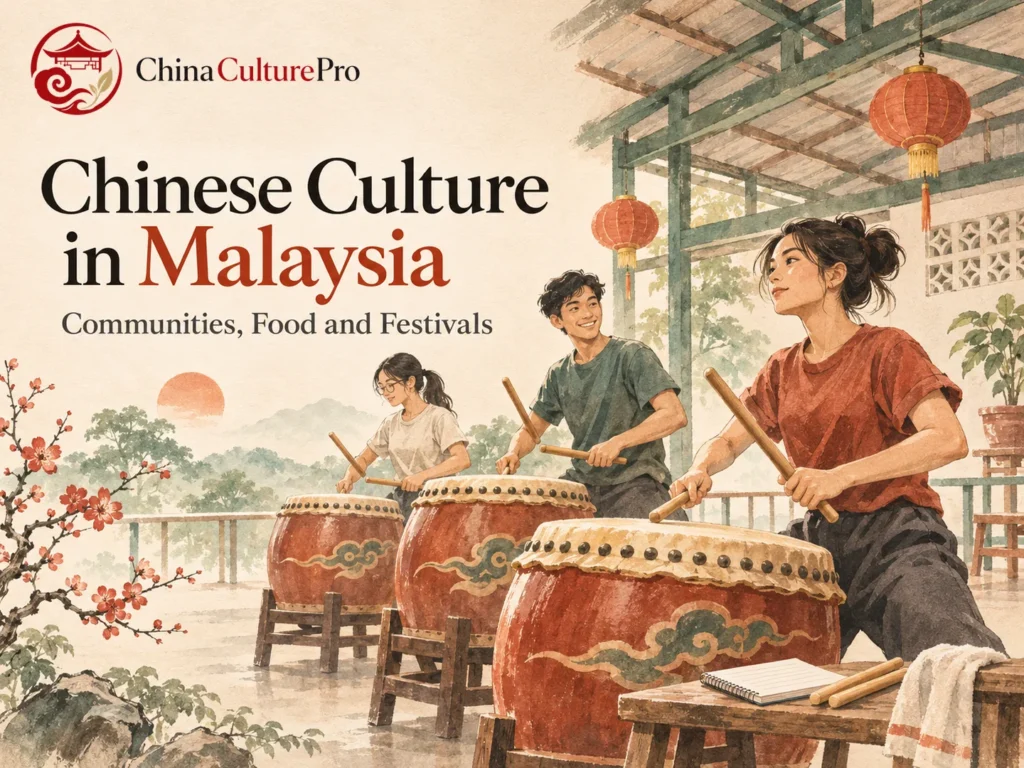
The 24 Festive Drums (二十四节令鼓, èrshísì jiélìnggǔ) were co-created in Johor Bahru in 1988 by Tan Chai Puan (陈再藩, Chén Zàifān) and Tan Hooi Song (陈徽崇, Chén Huīchóng; Mandarin readings). Their name draws on the 24 solar terms, turning a calendar framework into a form of ensemble performance developed in Malaysia.[11]
The art continues through school groups and professional troupes, supported by teaching, competitions, festivals, textbooks and a museum. This infrastructure makes cultural transmission visible: performers learn an established form while organizers create settings in which it can be practiced and presented.[11]
Connections with Chinese drums help explain its instruments, while its Malaysian creation gives it a particular modern history. It demonstrates that cultural inheritance can produce new local forms, alongside the maintenance of older customs.
FAQs About Chinese Culture in Malaysia
Is Chinese Malaysian culture the same as culture in China?
No. Chinese heritage is shaped through Malaysian local histories, regional communities, institutions and cultural exchange. Connections with China are one part of that setting.
Do all Chinese Malaysians speak Mandarin at home?
No. Mandarin use and family heritage varieties differ. Small studies in Malaysia show generational changes, but they do not establish one national home-language pattern.
Are Baba and Nyonya traditions shared by all Chinese Malaysians?
No. Baba and Nyonya traditions represent particular Peranakan histories. One preserved family home cannot describe the circumstances or practices of an entire community.
Is Chinese Malaysian food always halal?
No. The bak kut teh example contains pork. A dish’s cultural label does not establish halal suitability; ingredients and preparation need separate confirmation.
Were the 24 Festive Drums created in China?
No. This performance form was created in Johor Bahru in 1988. Its reference to the 24 solar terms connects Chinese heritage with Malaysian cultural creativity.
出典
[1] UNESCO World Heritage Centre. Melaka and George Town, Historic Cities of the Straits of Malacca
[2] Baba & Nyonya Heritage Museum. A House Museum
[3] Universiti Malaysia Sarawak Repository. Intergenerational Transmission of Chinese Foochow: Exploring the Role of Malaysian Chinese Family Members
[4] MANUSYA, Journal of Humanities. The Double-Edged Sword of Mandarin: Language Shift and Cultural Maintenance among Middle-Aged Chinese-Malaysians
[5] George Town World Heritage Incorporated. A Guide to Selected Chinese Clan Houses
[6] Sarawak Museum Department. Chinese History Museum
[7] Tourism Selangor. Splendid Selangor: Travel Itinerary and Packages
[8] Sarawak Trade and Tourism Office Singapore. Sarawak Food Trail
[9] Tourism Malaysia. Chinese New Year Open House (MRTM)
[10] Department of National Heritage, Malaysia. Ong Chun/Wangchuan/Wangkang Ceremony
[11] 24 Festive Drums Association (Malaysia). 24 Festive Drums on the Road to UNESCO