

Quick Answer: How Are Chinese Cooking Salts Classified?
Edible salt (食盐, shíyán) has overlapping descriptions of source, processing and added ingredients. The descriptions overlap; one product can meet several at once.[1][2]
- Source: Sea, salt lake, underground brine or rock-salt deposits.
- Physical form: Fine grains, coarse crystals or flakes affect handling.
- Formula: Plain, iodized and blended salts are separate label questions.
Read the actual product and its intended use.

Two bags labeled salt can behave differently in a kitchen without belonging to different regional cuisines. Separating origin, crystal structure and added ingredients explains what the Chinese names mean and why a cooking salt may not match another product spoon for spoon.
Sea Salt, Lake Salt and Well or Rock Salt
| Chinese source name | Material source |
|---|---|
| Sea salt (海盐, hǎiyán) | Seawater or related coastal brine. |
| Lake salt (湖盐, húyán) | Salt-lake deposits or salt-lake brine. |
| Well and rock salt (井矿盐, jǐngkuàngyán) | Underground natural brine or rock-salt deposits. |
These names describe the source, not the grain size, added iodine or finished seasoning formula.[1][2]
Refining, Crystal Size and Spoon Measurements
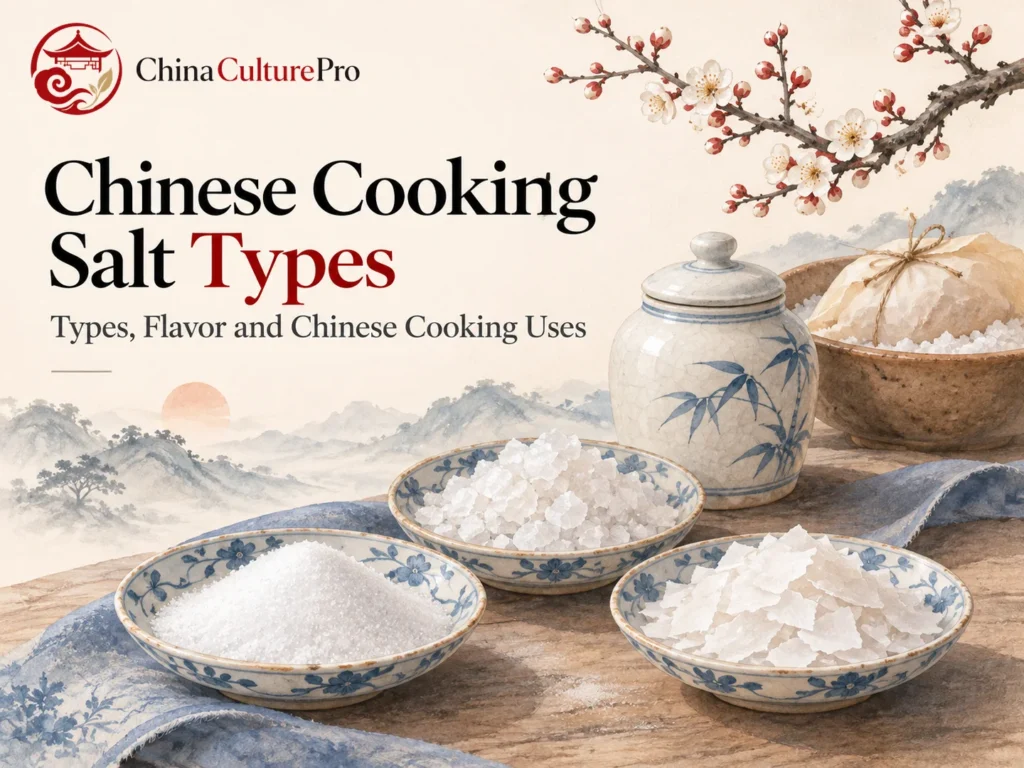
Refined salt (精制盐, jīngzhìyán) is processed from brine or raw salt. Sea, lake and underground sources can supply it. Fine salt (细盐, xìyán) and coarse salt (粗盐, cūyán) describe grain size instead.[1][7]
Fine grains dissolve readily in sauces and marinades. Crystal form also affects handling and the weight held in a spoon.[3][4]
An original comparison of eight commercial salts found different bulk densities. Crystal shape and packing mattered, not only particle size. Equal volumes need not contain equal masses; follow the preparation’s specified salt form.[3]
Iodized Salt, Reduced-Sodium Products and Seasoning Blends
Iodized salt (加碘盐, jiādiǎnyán) has added iodine. Lower-sodium salt (低钠盐, dīnàyán) can include potassium chloride; seasoned salt (调味盐, tiáowèiyán) has additional flavorings. These are composition differences.[1]
One plain table-salt product lists calcium silicate as an anti-caking agent. Check each ingredient statement; neither “fine” nor “sea” specifies every additive.[6]
Everyday Seasoning and Salt-Baked Dishes
Salt supplies salinity. 醤油 and other prepared sauces contribute saltiness alongside their own flavors, so visible salt crystals tell only part of the seasoning story.[4]
Salt-baked chicken (盐焗鸡, yánjújī) gives coarse salt another job: wrapped chicken sits in a salt bed. This cooking method differs from sprinkling seasoning. The dish guide explains versions whose preparation can differ.[5]
FAQs About Chinese Cooking Salt
Is sea salt always coarse?
No. Sea describes its source; a sea-salt product can be processed into fine grains.
Is there one special salt required for Chinese cooking?
No single source or grain is required for every dish. Follow the intended preparation and read the actual product.
Can equal spoonfuls of different salts weigh differently?
Yes. Crystal shape and packing density affect the mass in a spoon. Equal volume is not necessarily equal weight.
Is iodized salt the same as seasoned salt?
No. Iodized describes added iodine. Seasoned salt contains additional flavorings; the labels answer different questions.
出典
[1] Hami Market Regulation Administration. Cooking Salt: Source, Processing and Added Ingredients
[2] Chinese Center for Disease Control and Prevention. Salt Categories: Sea, Lake and Well or Rock Sources
[3] University of California Agriculture and Natural Resources. Salt Crystal Shapes and Bulk Density: An Original Comparison
[4] The Woks of Life. Chinese Seasoning Glossary: Fine Salt and Salty Sauces
[5] China Sichuan Food. Salt-Baked Chicken: Coarse Salt as a Cooking Bed
[6] Morton Salt. Table Salt: A Product Ingredient Statement
[7] Morton Salt. Salt Production: Evaporating Brine and Mining Rock Salt