


Quick Answer: Who Was Bing Xin?
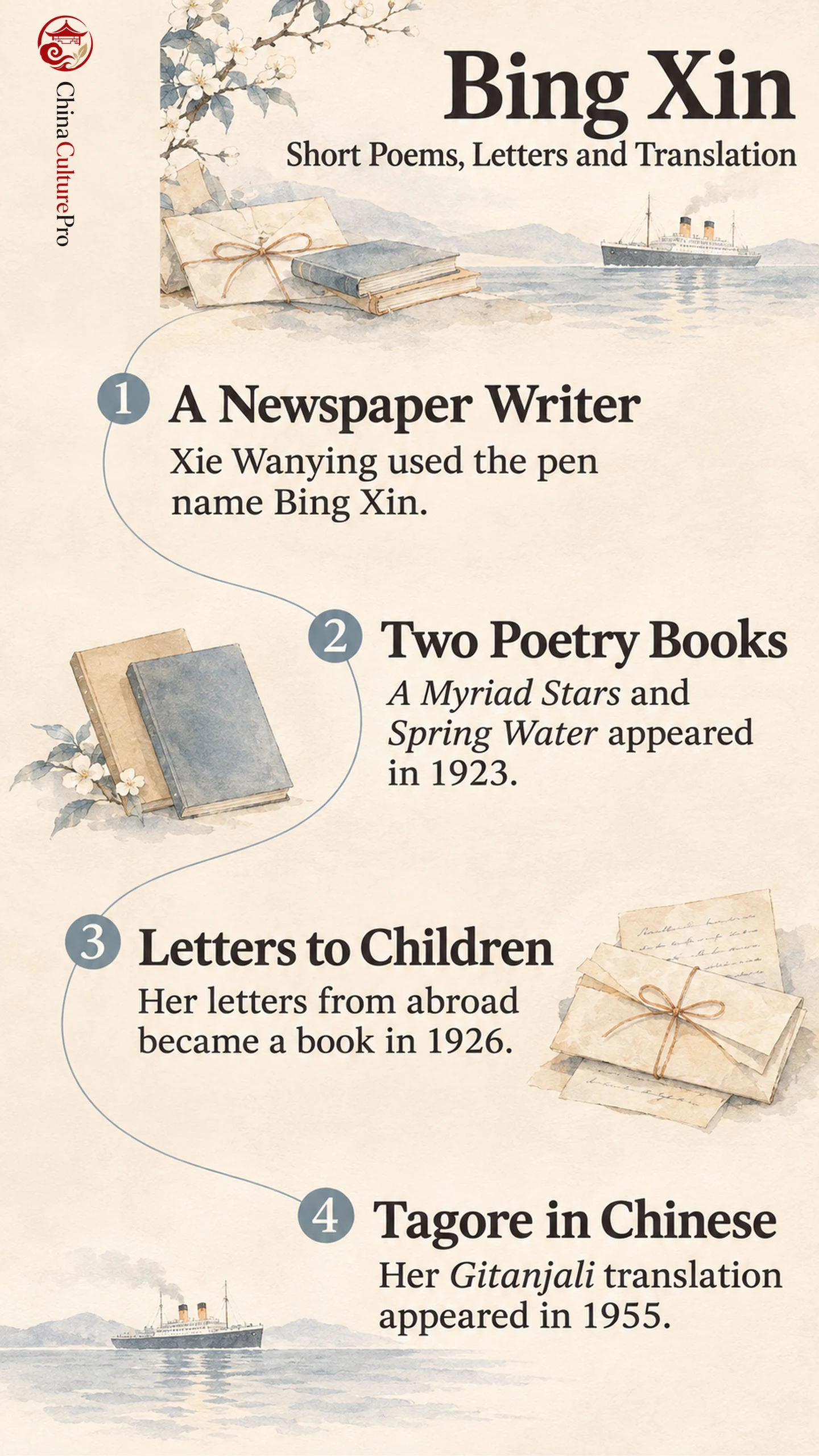
Bing Xin (冰心, Bīng Xīn) was the pen name of Xie Wanying (谢婉莹, Xiè Wǎnyíng, 1900–1999), a Chinese writer, poet and translator. She began publishing around the May Fourth era and became known for short poems, letters addressed to children and translations from English.[1][2][7]
- Poetry: A Myriad Stars (繁星, Fánxīng) and 泉中水 (春水, Chūnshuǐ) appeared as separate collections in 1923.[3]
- Letters: To Young Readers (寄小读者, Jì Xiǎo Dúzhě) grew out of newspaper correspondence during her studies in the United States.[4][5]
- Translation: Her 1955 Chinese version of Rabindranath Tagore’s Gitanjali became an important example of prose poetry in Chinese.[7]
The collections, letters and translations give three ways into her writing, each with its own audience and publication history.
A reader who first encounters Bing Xin in an anthology may know her for just a few lines about the natural world or the care of a parent. She also wrote to children about studying far from home and worked as a translator of literature from abroad. The link between these activities becomes clearer if you pay attention to whom she addresses and how much room each form gives her.
How Xie Wanying Became Bing Xin
Xie Wanying was born in Fuzhou and graduated from Yenching University (燕京大学, Yānjīng Dàxué) in Beijing. A Tsinghua University account dates her first use of Bing Xin as a published pen name to the 1919 appearance of Two Families (两个家庭, Liǎng Ge Jiātíng) in the Morning Post (晨报, Chénbào).[1][2]
The May Fourth Movement was both a moment of public protest and part of a wider argument about education, literature and society. Bing Xin entered that world through a newspaper. Lu Xun published his best-known early vernacular story in another venue, New Youth (新青年, Xīn Qīngnián). The journal associated with Chen Duxiu is one route into the period; Bing Xin’s newspaper work supplies another.[2]
The route a story takes to readers can shape what the author does next. The Morning Post later printed her poems and gave her letters a regular place on its children’s page. Those genres let her speak to different readers and make different kinds of claims on their attention.
How A Myriad Stars and Spring Water Took Shape
In the preface to A Myriad Stars, Bing Xin recalled reading Tagore’s Stray Birds with her younger brother in 1919. The example encouraged her to write down thoughts that seemed too brief to make into longer pieces. She later brought the notes together, and the poems appeared in serial form before the first book edition in 1923.[3][6]
The shape of a short poem is part of its effect. In a 泉中水 poem, the speaker asks the moving water to reflect a face, and the water answers. A small change in who is speaking turns a description into a conversation. This is one reason to read more than a single line lifted out of the poem.[6]
The two collections are often sold in one volume today. Their separate publication is worth remembering when comparing prefaces, numbered poems or English titles. A survey of modern Chinese literature can help place these brief experiments alongside other May Fourth forms.[3]
What She Wrote to Young Readers
Bing Xin left for the United States in 1923 and earned a master’s degree at Wellesley College in 1926.[1]
During her time abroad, her letters appeared in the children’s section of the Morning Post. They drew on the voyage, places she encountered and her memories of home. The letters were collected in book form in 1926.[4][5]
The form matters to a reader deciding where to begin. A child who read the newspaper regularly could follow the writer’s journey from one letter to the next. A reader of the later book can compare the places she describes and notice when her attention turns from what she sees to whom she misses.
The letters are often read alongside Chinese children’s stories, but their effect depends on her relationship to a particular readership. She writes to children as people capable of following a life beyond their own surroundings. Look for the points where the account of an unfamiliar place depends on a comparison the recipients might understand.
Why Her Translations Matter to Her Legacy
Bing Xin returned to China and taught at several institutions, including Yenching and Tsinghua. Her later career also included translation. The two Tagore connections belong to different moments. She read Stray Birds while developing her short-poem practice and translated Gitanjali decades later.[1][3][7]
Literary scholar Nick Admussen argues that her 1955 version of Gitanjali helped shape Chinese prose poetry. His point concerns what her rendering did in Chinese, including its choice of register, and gives a reason to look at her as a translator making decisions about form. You can set this next to the longer history of Chinese poetry to see how much the setting of publication and readership changes across periods.[7]
Read one short poem, one letter and the opening of the translation to see how her treatment of the reader changes with the form. Check the edition’s contents first, since English titles can vary. The history of Chinese literature offers context for tracing those different routes into print.
FAQs About Bing Xin
Was Bing Xin her birth name?
No. Bing Xin was the published pen name of Xie Wanying. Older English references can spell her name differently.[1][2]
When was To Young Readers first published as a book?
It was published as a book in 1926, after the letters appeared in the children’s section of the Morning Post.[4]
Which Bing Xin work should an English reader start with?
Start with one of her short poems for a brief introduction, or To Young Readers for a sustained prose voice. Check the translator and contents before choosing an edition.
出典
[1] Chinese University of Hong Kong, Renditions. Bing Xin
[2] Tsinghua University Archives. Bing Xin on the 120th Anniversary of Her Birth
[3] Wang Binggen, China Writers Network. A Century of A Myriad Stars and Spring Water
[4] Wang Jian, China Writers Network. Bing Xin’s Three Series for Young Readers
[5] China Association for Promoting Democracy. Bing Xin’s American Studies and To Young Readers
[6] China Association for Promoting Democracy. Bing Xin: A Myriad Stars and Spring Water
[7] Nick Admussen, Oxford University Press. Bing Xin, Tagore, and Prose Poetry