


Quick Answer: Where Does Modern Chinese Literature Begin?
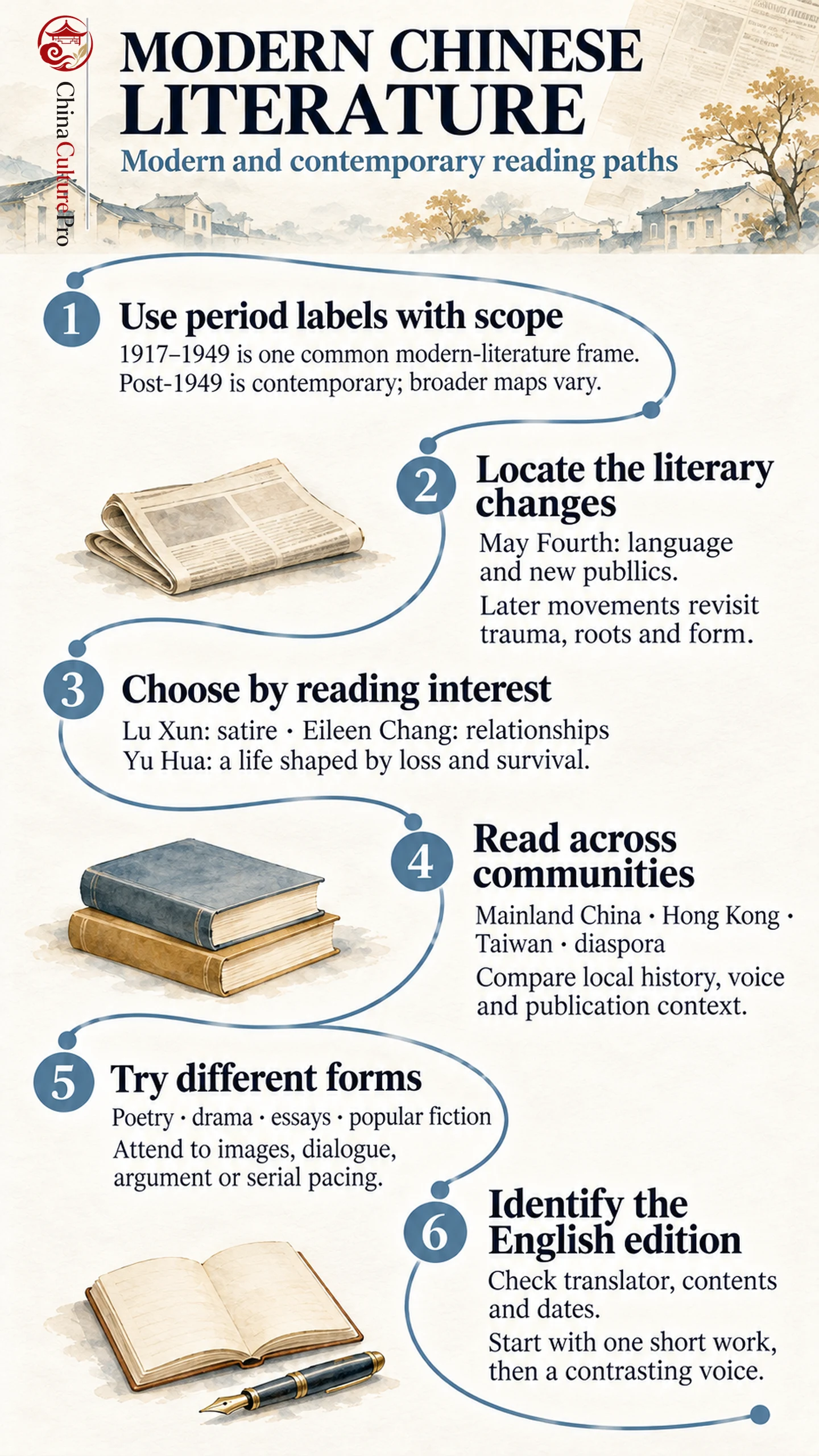
Modern Chinese literature (现代文学, xiàndài wénxué) often refers to 1917–1949 in a common teaching framework, while contemporary Chinese literature (当代文学, dāngdài wénxué) covers writing after 1949. Broader English-language studies may use modern for a longer period reaching from the late Qing toward the present.[1][2][5]
- Start with an interest: Short fiction, family conflict, urban life, experimental writing and science fiction offer different entrances.
- Use history as a map: Language reform, war, revolution and social change help locate a work without determining its whole meaning.
- Read across places: Mainland China, Hong Kong, Taiwan and overseas Chinese-language communities have connected, distinct literary histories.
- Check the edition: A translator’s name, collection contents and original publication context matter when choosing an English book.
There is no required first author. Choose one work whose questions interest you, then read a contrasting voice.
A reader can enter this field through a short satirical story, an intimate family novel or a speculative account of contact with another civilization. The differences are part of its interest. This guide focuses on Chinese-language works available in English translation, using a wider Chinese literature map while giving modern writing its own historical and formal context.
How to Use Period Labels Without Losing the Work
A period label tells you where a course, anthology or study begins and ends. It does not tell you in advance what every writer in that period sounds like. A course organized around 1917–1949 can concentrate on the emergence of new literary forms and communities, while a broader survey follows continuities across that boundary.[1][2]
Modernism (现代主义, xiàndài zhǔyì) is a different kind of label: it concerns artistic approaches and experiments rather than simply the date of composition. A work can belong to the modern period without sharing the same formal aims as another modern writer. Likewise, an author whose career crosses 1949 can appear in more than one historical frame.[2]
Keep three dates apart when choosing a book: when its events are set, when the Chinese text was written or first published, and when the particular English translation appeared. A recent translation can make an older work look like a new release. The edition’s introduction should help place those dates, while the story itself supplies a voice that a chronological label cannot replace.
A Short Map of Periods and Movements
The New Culture Movement (新文化运动, Xīn Wénhuà Yùndòng) involved debates about language, culture and social change. The May Fourth Movement (五四运动, Wǔsì Yùndòng) takes its name from the 1919 protests and is closely connected with that larger intellectual setting.[3]
Literary reform gave new prominence to baihua (白话, báihuà), or vernacular writing. The new literary language brought written expression closer to spoken usage while opening possibilities for new subjects and readers. Language choice became part of the argument over what literature could do.[4]
| Period or context | A useful literary question |
|---|---|
| Late Qing and the 1910s | How could new publications and forms change the public role of literature? |
| 1920s–1940s | How did writers address individual freedom, family hierarchy, city life, regional worlds and war? |
| 1949–1970s, especially mainland institutional history | How did political institutions and expectations shape writing, publication and performance? |
| Late 1970s–1980s | How could literature revisit trauma, recover cultural materials and experiment with narration? |
| 1990s onward | How did urban change, new markets, migration and digital media create further subjects and readerships? |
Several labels help with the post-Mao part of this map, especially in mainland literary history:[5]
- Scar literature (伤痕文学, shānghén wénxué): Writing that revisits the injuries and remembered trauma of recent political experience.
- Roots-seeking literature (寻根文学, xúngēn wénxué): Writing that turns toward cultural memory, local traditions and questions of identity.
- Avant-garde fiction (先锋小说, xiānfēng xiǎoshuō): Experiments that can unsettle narrative order, perspective and expectations of realism.
These approaches overlap. A writer may draw on regional storytelling and formal experiment in the same work, or change direction across a career. The Cultural Revolution is one important historical context for later memory writing; it is not a complete explanation of every work published afterward.
Authors and Books to Start With
The following selections give distinct reading possibilities. They are starting points rather than a ranking or a complete syllabus; the interest column identifies what you might look for in the work.
| 作家 | One English reading option | A useful interest to bring |
|---|---|---|
| Lu Xun (鲁迅, Lǔ Xùn) | The Real Story of Ah-Q and Other Tales of China | Satire, self-deception and the pressure of social judgment.[6] |
| Lao She (老舍, Lǎo Shě) | Rickshaw Boy | A working person’s ambitions and the social world of Beijing.[14] |
| Ba Jin (巴金, Bā Jīn) | 家族 | Generational authority and the conflict between household duty and individual choice.[13] |
| Shen Congwen (沈从文, Shěn Cóngwén) | Border Town | Regional life, affection and the possibilities of a short novel.[15] |
| Ding Ling (丁玲, Dīng Líng) | Miss Sophia’s Diary | A woman’s interior life, desire and resistance to social expectations.[17] |
| Eileen Chang (张爱玲, Zhāng Àilíng) | Love in a Fallen City | Intimacy, calculation and the pressures around private relationships.[7] |
| Mo Yan (莫言, Mò Yán) | Red Sorghum | Rural worlds, history and the energy of folk storytelling.[8] |
| Yu Hua (余华, Yú Huá) | To Live | A life story shaped by loss, survival and historical change.[9] |
| Can Xue (残雪, Cán Xuě) | Five Spice Street | Uncertain perception and the disruption of familiar narrative expectations.[10] |
| Liu Cixin (刘慈欣, Liú Cíxīn) | The Three-Body Problem | Scientific puzzles, contact and decisions on a civilizational scale.[18] |
The short-fiction collection, novella and long novel make different demands. If you want an initial encounter with a writer’s voice, a single story can be enough. If you enjoy watching choices accumulate over a longer span, a novel may be the better first commitment.
Voices Across Mainland China, Hong Kong, Taiwan and Diaspora
The language of a work does not determine a single place or historical experience. Chinese-language literary production has developed through different institutions, migrations, publishing networks and local debates. Reading across those contexts reveals connections that a mainland-only chronology leaves out.[5]
Pai Hsien-yung (白先勇, Bái Xiānyǒng) offers a useful Taiwanese starting point in Taipei People. Its short stories bring memory, displacement and individual lives into a modernist urban collection. A bilingual edition also lets readers who know some Chinese compare the translated page with the source.[11]
Xi Xi (西西, Xī Xī), in My City: a hongkong story, approaches urban experience through a fresh, experimentally flexible voice. The novel’s attention to young protagonists and local language gives the city a texture different from treating it only as a historical backdrop. Eva Hung translated the English edition.[12]
Diaspora adds further routes through language and place. Ask where a writer’s work was first published, whom it addressed and how later circulation changed its readership. A story can carry a regional memory to readers elsewhere without becoming a simple statement of one fixed identity. The broader field includes such movements of people and texts alongside the histories of particular cities.[2]
For comparison, choose two works with a shared concern, such as family, memory or urban life, but different settings. That gives you something concrete to notice: the terms of a social relationship, the voices heard in a neighborhood, or the way a narrator handles remembered loss.
Poetry, Drama, Essays and Popular Fiction
A shelf of translated novels is only one part of the field. Short stories can compress social encounters into a single situation; essays can develop a public argument or a personal observation; drama makes dialogue and performance central to a conflict. Cao Yu’s Thunderstorm is one familiar route into modern Chinese theater.[2]
Misty Poetry (朦胧诗, ménglóngshī), associated with writers including Bei Dao (北岛, Běi Dǎo), gives a different reading task. Suggestive images and indirect connections invite attention to language and ambiguity. A poem’s shifting associations may matter more than reconstructing a single continuous plot. The label describes a loose movement, not a rule that every poet uses an identical method.[16]
The wider Chinese poetry tradition includes both older forms and modern experiments. When choosing an anthology, check whether its selection is historical, regional or focused on a particular generation. That choice affects what kind of map it offers.
Popular storytelling also belongs in a broad literary view. Jin Yong (金庸, Jīn Yōng) developed long martial narratives with extensive social relationships, while science-fiction writers give speculative ideas a central structural role. Chinese wuxia および Chinese science fiction provide distinct routes into those forms.[2]
Digital serialization changes the rhythm of reading and publication again. For someone choosing a long online story, the Chinese web novels guide provides a closer context. A serial installment, a completed novel and a printed selection are different reading objects, even when they carry the same author’s name.
Choosing a Translation and a First Reading Path
Start by choosing the experience you want, then identify the edition. A title can appear in several translations or in collections with different contents. The translator’s name is useful information about the book you will actually read, not a minor detail to discover afterward.
Three examples show what to check:
- A complete fiction collection: Julia Lovell translated The Real Story of Ah-Q and Other Tales of China. Its coverage lets you sample several forms of Lu Xun’s fiction rather than assuming every collection contains the same pieces.[6]
- A collection’s credits: Love in a Fallen City credits Karen S. Kingsbury and Eileen Chang. Look at the contents and translation credits for the particular volume before assuming one translator or selection across editions.[7]
- A particular novel edition: To Live is available in Michael Berry’s English translation. Record the translator along with Yu Hua’s name when locating that edition.[9]
For a compact first path, read one short work and one contrasting form. A Lu Xun story followed by Border Town lets you compare compressed satire with a longer regional narrative. Compare a Chang story’s handling of relationships with a Can Xue work’s uncertain perception to see how different narrative methods shape what a reader can know. These are optional pairings, not a test of cultural literacy.
Read the introduction when context helps, but consider leaving a plot-heavy critical essay until after the story if you prefer discovery. Keep a few notes about voice, setting and the question that seems to drive the work. There is no need to turn an initial reading into a memorization exercise covering every movement.
The most useful next choice comes from what you notice. Follow an author whose voice holds your attention, compare another writer addressing a similar problem, or try a form that changes the kind of attention the page asks from you.
FAQs About Modern and Contemporary Chinese Literature
Are modern and contemporary Chinese literature the same period?
Not in every teaching framework. A common division uses 1917–1949 for modern literature and the post-1949 period for contemporary literature. Broader studies can use modern across a longer span, so check the stated scope.
Do I need to read the classical novels first?
No. Classical references can enrich a reading, but a modern short story or novel can be your starting point. Use notes when a particular allusion becomes important.
Which short work is a useful starting point?
A Lu Xun story is a practical choice for satire, while a story from Love in a Fallen City offers a different focus on relationships. Choose by interest rather than a compulsory order.
Does the field include Hong Kong and Taiwan writers?
Yes, when defined broadly as Chinese-language literary production. Those communities have distinct histories, and regional and diaspora perspectives are important parts of the wider field.
出典
[1] CUHK Shenzhen Library. Introduction to Modern Chinese Literature
[2] Columbia University Press. The Columbia Companion to Modern Chinese Literature
[3] Columbia University, Asia for Educators. Before and After the May Fourth Movement
[4] Yan Jiayan. The origin, features and evaluation of the May Fourth new vernacular
[5] Indiana University Press. Chinese Literature in the Second Half of a Modern Century
[6] Penguin Random House. The Real Story of Ah-Q and Other Tales of China
[7] New York Review Books. Love in a Fallen City
[8] Nobel Foundation. Mo Yan: Facts
[9] Michael Berry. To Live
[10] Yale University Press. Five Spice Street
[11] The Chinese University of Hong Kong Press. Taipei People
[12] CUHK Research Centre for Translation. My City: a hongkong story
[13] Waveland Press. 家族
[14] HarperCollins. Rickshaw Boy: A Novel
[15] HarperCollins. Border Town: A Novel
[16] The Poetry Foundation. Bei Dao
[17] Columbia University, ExEAS. Chinese Women and Modernity
[18] Macmillan. The Three-Body Problem