

Quick Answer: What Is The Three-Body Problem About?
The Three-Body Problem (三体, Sān Tǐ), by Liu Cixin (刘慈欣, Liú Cíxīn), is a science-fiction novel that connects a secret contact project with an alien civilization and a growing mystery on Earth. It opens a three-novel sequence.[1]
- The historical thread: Experiences of political violence shape a scientist’s judgments about humanity.
- The scientific thread: Puzzles about observation, prediction and a strange world drive the mystery.
- The reading order: Begin with this novel before its two sequels; an adaptation follows its own arrangement.
- The award: The first novel, in Ken Liu’s English translation, won the 2015 Hugo Award for Best Novel.[2]
The guide below gives premise-level information while leaving the major explanations and endings for the novel.
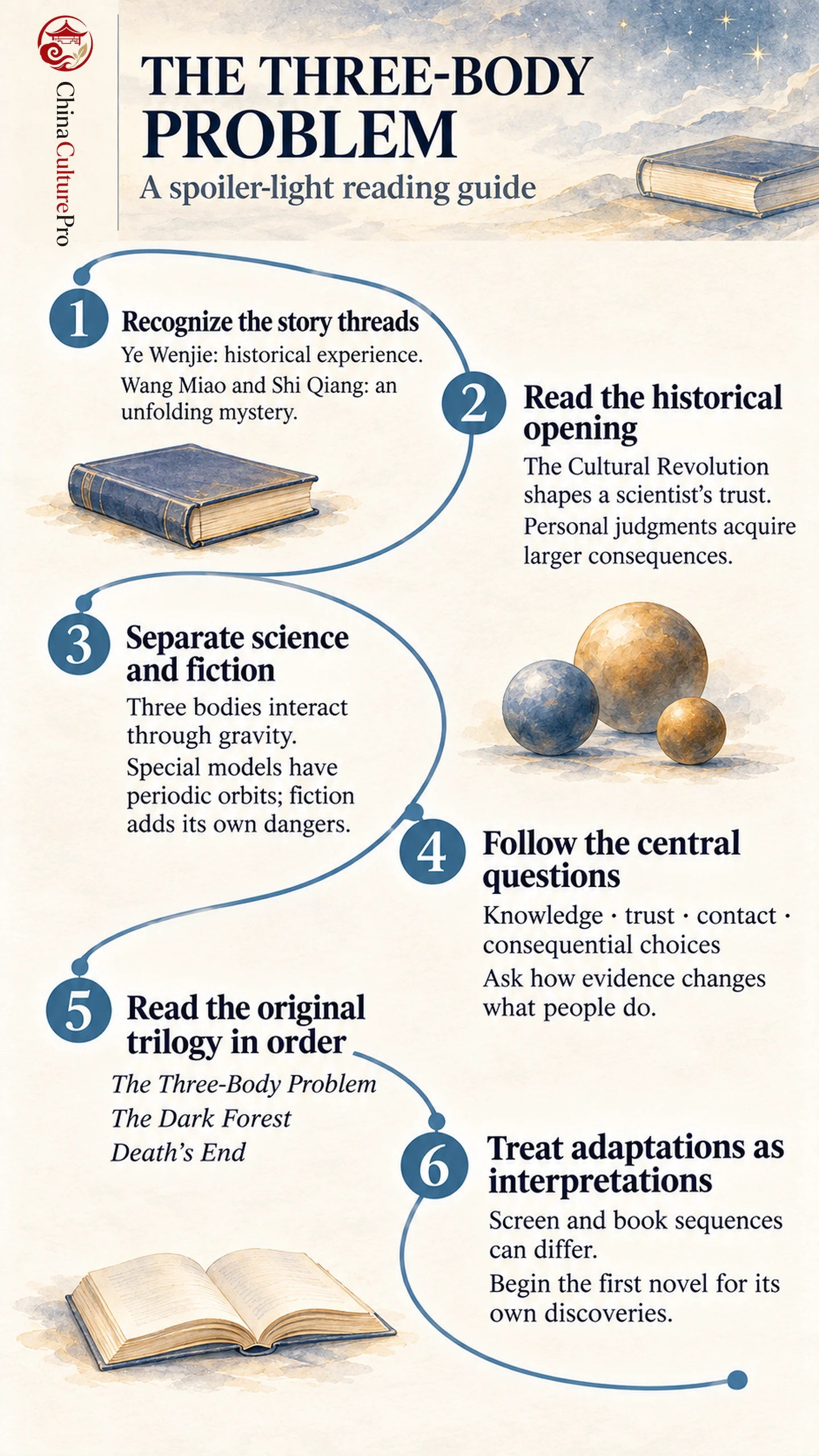
The Liu Cixin novel asks readers to move between a person’s damaged trust and a problem large enough to concern a civilization. For someone entering Chinese science fiction, that combination provides a useful point of orientation: historical experience and speculative science become parts of the same unfolding mystery.
A Spoiler-Light Premise and the Main Characters
A secret project sends signals into space. Contact with an alien civilization creates consequences that divide people on Earth, while a scientist encounters events that make familiar expectations about science seem unreliable. The book gradually connects these different scales of experience.[1]
| 登場人物 | Role to recognize at the outset |
|---|---|
| Ye Wenjie (叶文洁, Yè Wénjié) | A scientist whose experiences during the Cultural Revolution are central to the historical thread |
| Wang Miao (汪淼, Wāng Miǎo) | A nanomaterials researcher drawn into the present-day scientific mystery |
| Shi Qiang (史强, Shǐ Qiáng) | A police investigator whose practical approach offers another way of examining the evidence |
The game called Three Body supplies a further strand of the puzzle through an imagined world with three suns. Its changing conditions connect the title’s scientific problem to the story, while the larger explanations emerge through the sequence of clues. Keep track of what each character knows at a particular moment rather than assuming that information available to the reader is shared by everyone.
This approach also helps with the changes of time and setting. When a chapter moves away from a familiar character, ask which question it is developing, and allow the link to emerge before looking for a summary that reveals the answer.
Why the Historical Opening Matters
In the English translation, the opening places Ye Wenjie amid the violence of the Cultural Revolution. Her family’s experience makes the vulnerability of scientific reasoning a personal matter. Intellectual work takes place among institutions and people who can protect, distort or punish it.[3]
One useful reading question is how a person moves from judging particular people to judging humanity as a whole. The novel’s movement toward extraterrestrial contact gives that change of scale enormous consequences. A private experience can become the basis for a decision about others who did not share it.
Keep explanation and endorsement separate when reading. Understanding how a judgment develops does not require accepting it. The historical opening gives the later ideas emotional weight, while the speculative plot tests what happens when a response to human cruelty reaches far beyond its original circumstances.
For readers interested in historical memory in modern Chinese literature, this is a useful example of a science-fiction narrative carrying the past into questions about the future.
What the Three-Body Problem Means
In physics, the three-body problem concerns the motion of three bodies interacting through gravity. Their positions and motions affect one another, making prediction substantially more complicated than a simple picture of one isolated orbit might suggest. Real three-body systems exist, and some configurations can be stable; the presence of three bodies does not by itself mean inevitable destruction.[4]
Specific models also admit periodic orbits. For example, the circular restricted three-body problem treats a negligible-mass third body moving under the gravity of two larger ones, and a catalog of computed periodic solutions exists for that model. This does not turn every possible three-body configuration into the same simple calculation.[5]
For the novel, the important reading distinction is between a real scientific problem and the imagined consequences built around it. Scientific ideas can supply constraints and metaphors, while fictional circumstances create the narrative danger. You can follow that relationship without solving equations or treating every dramatic invention as established physics.
Science, Trust and Contact: The Central Themes
The premise supports several questions that are useful to keep open while reading. These are interpretive lenses, rather than a claim that the novel has one final message.
- Knowledge and trust: What happens when a researcher doubts the reliability of observation? Distinguish an unexplained event from a conclusion about all of science.
- Judgment and scale: Can experience of particular wrongs justify a decision about an entire civilization? Notice when a character moves between those two levels.
- Contact and disagreement: An external intelligence does not make humanity a single-minded group. The premise already includes conflicting responses to the same prospect.[1]
- The costs of explanation: A solution to one mystery can create a larger ethical or strategic problem. Pay attention to what knowledge permits someone to do, not only what it allows them to understand.
These questions work together because the novel makes explanation consequential. A scientific puzzle does not remain an abstract exercise once people act on their interpretations of it. Likewise, an ethical choice can depend on what someone believes is known, uncertain or impossible.
Reading the book as an investigation and a novel of ideas keeps these two strands connected: how characters interpret evidence, and what follows when they act on that interpretation.
The Trilogy and English Reading Order
Read Liu Cixin’s three original novels in the following order. English listings also use Remembrance of Earth’s Past (地球往事, Dìqiú Wǎngshì) as a name for the sequence.[6]
| 順序 | Novel | English translator |
|---|---|---|
| 1 | The Three-Body Problem | Ken Liu |
| 2 | The Dark Forest (黑暗森林, Hēi’àn Sēnlín) | Joel Martinsen |
| 3 | Death’s End (死神永生, Sǐshén Yǒngshēng) | Ken Liu |
The translator changes for the second volume; the author remains Liu Cixin. The second and third novels build on earlier discoveries, so reading from the first preserves the book sequence’s unfolding explanations.[7][8]
A related book, The Redemption of Time, is by Baoshu. It is not a fourth original novel by Liu Cixin, even when a publisher’s series page displays it alongside the trilogy. Distinguishing author and sequence is more reliable than counting every listing on a store page.[6]
The Hugo record identifies the Chinese book publication as 2008 and the first English version as 2014. Keep those dates separate from the 2015 award.[2]
Reading the Novel Alongside Screen Adaptations
The 2024 series 3 Body Problem uses the trilogy as its source while moving among Chinese historical scenes and international present-day settings. A screen adaptation arranges characters, locations and discoveries for its own medium, so its episode sequence need not match this novel chapter for chapter.[9]
If a screen version brought you to the book, use your familiarity as orientation while remaining open to differences. Begin the first novel instead of jumping to the sequel at the point where a season ended. That keeps the book’s character relationships and unfolding explanations together.
For a first reading, a short character note and a record of unanswered questions are enough. Let the scientific explanations arrive with the narrative. Detailed ending analyses and later-volume summaries are best left until they answer a question you have chosen to investigate.
FAQs About The Three-Body Problem
Do I need a physics background to read the novel?
No formal physics training is required. Follow the explanations as part of the mystery, distinguishing the real scientific problem from the story’s speculative inventions.
Is the dark forest idea explained in the first book?
That idea belongs to the later development of the trilogy, particularly the second novel. Start with the first book rather than treating later concepts as a summary of its entire argument.
Is The Redemption of Time a fourth novel by Liu Cixin?
No. It is a related novel by Baoshu. Liu Cixin’s original sequence contains the three books listed above.
Should I start the trilogy at the beginning after watching an adaptation?
Yes, that is the clearer reading route. Adaptations reorganize material, and the first novel establishes the book sequence’s own characters and discoveries.
出典
[1] Macmillan. The Three-Body Problem
[2] The Hugo Awards. 2015 Hugo Awards
[3] Macmillan. The Three-Body Problem: Excerpt
[4] NASA Hubble Mission Team. NASA’s Hubble Finds Kuiper Belt Duo May Be Trio
[5] NASA Jet Propulsion Laboratory. Three-Body Periodic Orbits
[6] Macmillan. The Three-Body Problem Series
[7] Macmillan. The Dark Forest
[8] Macmillan. Death’s End
[9] Netflix Tudum. 3 Body Problem: Everything You Need to Know About the Series