


Quick Answer: Who Is Mo Yan?
Mo Yan (莫言, Mò Yán), the pen name of Guan Moye (管谟业, Guǎn Móyè), is a Chinese novelist and short-story writer who received the 2012 Nobel Prize in Literature. His fiction brings rural lives into contact with war, political campaigns and economic change, using fantasy, humor and forceful sensory description.[1]
- His name: It means “don’t speak,” an ironic choice for a writer who recalls being a talkative child.
- His literary world: A recurring rural setting becomes a place for invention, not simply a record of his birthplace.
- A reading approach: Follow who tells the story, when events occur and how the teller reshapes them.
Read the particular narrative’s voices and structure alongside its historical setting.[3][10]
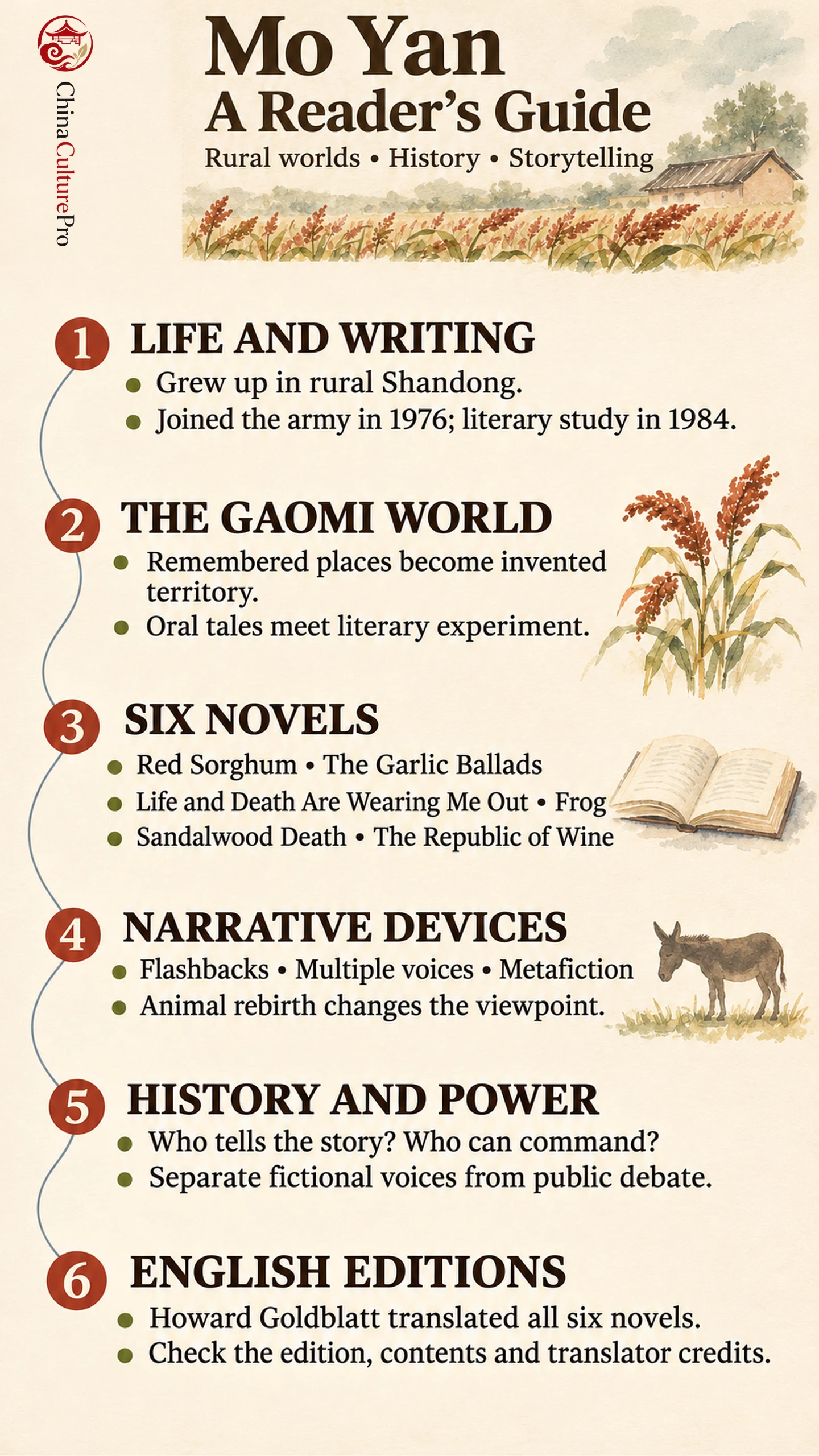
Mo Yan’s books can be exuberant and unsettling in the same scene. A family’s struggle may become a tale of animals, a harvest may lead into an account of official coercion, or an investigation may lose its footing in the stories told around it. This guide offers distinct entry points into his work and its place in modern Chinese literature.
From Rural Shandong to a Writing Career
Mo Yan grew up in a farming family in Gaomi (高密, Gāomì), in Shandong (山东, Shāndōng) province. Childhood hunger, work and remembered village life recur in his account of becoming a writer. He joined the army in 1976 and entered the literature department of the military arts academy in 1984, where reading and formal study helped develop his writing.[2]
There is a genuine discrepancy in biographical dates. His Nobel biography identifies March 25, 1956 as his preferred birthday; many English publisher biographies give 1955 as his birth year. It is more accurate to acknowledge the variant than silently treat all sources as identical.[2][4]
His family-centered fiction also includes Big Breasts and Wide Hips (丰乳肥臀, Fēngrǔ Féitún). Its mother has eight daughters and a son, who narrates the story. Following their unequal positions within a household offers another route into the book’s larger historical sweep.[14]
The rural background matters without explaining everything. His later literary education and encounter with writers including William Faulkner and Gabriel García Márquez also shaped the possibilities he saw for fiction. Local material and international reading belong to the same career.[2]
For regional context, Shandong’s wider cultural traditions offer a useful starting point. They should not be used as a checklist that every character in his novels must represent.
Gaomi as a Literary World
Northeast Gaomi Township (高密东北乡, Gāomì Dōngběi Xiāng) is a recurring literary territory built from remembered places and imaginative transformation. Its fictional families and incidents extend beyond remembered experience.[10]
Oral listening is another part of this background. In his Nobel lecture, Mo Yan recalls hearing marketplace stories, retelling them to his mother and gradually changing details and endings. The remembered audience matters: a story develops through the desire to hold someone’s attention.[3]
He also connects his upbringing with the storytelling heritage associated with Pu Songling (蒲松龄, Pú Sōnglíng). Readers can explore that earlier tradition through supernatural tales and their literary history, while keeping the two writers’ periods and forms distinct. The broader guide to Chinese oral storytelling supplies context for the relationship between a telling voice and its listeners.[3]
When a narrator offers a family legend, ask what the legend makes possible: admiration, blame, belonging or self-justification. That question is more productive than trying to verify every episode against an actual village.
Six Novels and Different Ways In
Choose by the kind of narrative you want to encounter. These six novels do not form a required sequence.
| Novel | Narrative center | A reason to choose it |
|---|---|---|
| Red Sorghum (红高粱家族, Hóng Gāoliang Jiāzú) | Family memory, resistance and conflict, told through flashbacks across generations. | Begin with the collision of family legend and wartime history. |
| The Garlic Ballads (天堂蒜薹之歌, Tiāntáng Suàntái Zhī Gē) | Farmers face a failed market for their crop, official abuse and imprisonment. | Follow material survival, collective anger and the place of song. |
| Life and Death Are Wearing Me Out (生死疲劳, Shēngsǐ Píláo) | An executed landowner returns through successive animal lives as rural society changes. | Explore historical change through radically different bodies and viewpoints. |
| Frog (蛙, Wā) | A nephew recounts his aunt’s career, from delivering babies to enforcing coercive birth-control measures. | Examine loyalty, responsibility and the narrator’s involvement. |
| Sandalwood Death (檀香刑, Tánxiāng Xíng) | Family relationships, rebellion and punishment in the final years of the Qing dynasty (清朝, Qīng Cháo). | Read for the interaction of prose, dramatic voices and operatic forms. |
| The Republic of Wine (酒国, Jiǔguó) | An investigator’s mission intersects with extravagant banquets, letters and embedded stories. | Choose an unstable narrative about appetite, corruption and storytelling itself. |
For a first choice, compare the narrative form: family flashbacks, reincarnation, an account in letters or a story interrupted by other stories.[4][5][6][7][8][9]
Sandalwood Death’s late-imperial setting can be read alongside the Qing dynasty overview. Its extreme punishment scenes belong to the novel’s treatment of power and spectacle; this is not a gentle pastoral reading choice.[8]
How the Storytelling Works
Four devices help describe what to watch for without assigning every book the same style.
| Device | 本記事での意味 |
|---|---|
| Oral storytelling | Narration shaped by a voice addressing listeners. |
| Nonlinear time | Events presented outside a single chronological sequence. |
| Multiple voices | A narrative distributed among different speaking positions. |
| Metafiction | Fiction that draws attention to its own telling or making. |
Red Sorghum’s flashbacks make the ordering of memory part of the reading experience. The Republic of Wine places letters and submitted stories beside an investigator’s increasingly uncertain inquiry. In each case, form affects what the reader can know, rather than merely ornamenting a straightforward plot.[4][9]
Life and Death Are Wearing Me Out makes its transformation premise especially explicit. Ximen Nao’s rebirths include a donkey, ox, pig, dog and monkey before a return to human form. Ask what a changed body can observe about labor, ownership or family life that a single human viewpoint would miss.[6]
The novel draws on a religious idea of rebirth, but its fictional arrangement is not a comprehensive statement of Buddhist teaching. The guide to Chinese Buddhism gives that tradition a wider context. Likewise, Chinese folk tales offer background without making every fantastic episode a direct retelling of an old story.
“Hallucinatory realism,” the term associated with his Nobel recognition, points toward the mingling of extraordinary events and recognizable social experience. Use it as an orientation, then identify the actual device operating in the passage before you.[1]
History, Power and the Debate Around His Work
The novels place large historical forces inside households, fields and individual bodies. In The Garlic Ballads, an encouraged crop becomes unsellable while farmers confront abusive officials. The material problem is inseparable from who can command, punish or refuse responsibility.[5]
Frog similarly asks how a person’s professional identity and political allegiance can become entangled with violence. Its letters also give readers a reason to question Tadpole’s account of his aunt and his own position in the events. The teller is part of the moral problem, not simply an outside reporter.[7][13]
The public debate around Mo Yan should be distinguished from a novel’s internal voices. In a 2012 interview, he argued that imagination and exaggeration could address sensitive subjects under censorship. Critical responses to his Nobel award questioned his accommodation with official institutions and his position on censorship. These are contested judgments about a public writer, not a reason to assume that every character speaks for him.[10][11]
A useful reading separates three questions: what happens in the fictional world, how the narrative frames it, and what the author has said or done publicly. Keeping them distinct allows a political reading to examine the text closely. A Chinese history overview can help situate a period; it cannot settle the meaning of an invented scene.
Reading Mo Yan in English
Howard Goldblatt translated all six novels discussed here. Identify the particular edition before comparing page numbers or quoting a passage. Some publisher listings describe reprints; their displayed year is not necessarily the first Chinese or English publication date.[4][5][6][7][8][9]
Three identifiable starting editions are Red Sorghum, Penguin Books, ISBN 9780140168549; Frog, Penguin Books, ISBN 9780143128380; and Sandalwood Death, University of Oklahoma Press, ISBN 9780806143392. Choose the first for intergenerational wartime storytelling, the second for a narrator’s account of family and responsibility, and the third for operatic form and late-imperial violence.[4][7][8]
Language is also part of the experience. Mo Yan has discussed the importance of regional idioms and puns, and the difficulty of carrying them into another language. An English sentence offers the translator’s solution, so comparing notes or available passages can be more revealing than assuming every unusual expression has an obvious one-to-one equivalent.[10] The guide to choosing Chinese books in translation offers broader edition questions.
For further study, Mo Yan in Context, edited by Angelica Duran and Yuhan Huang, brings together work on translation, humor, religious conventions, politics and reception. Its contents provide specific directions for a reader who wants to investigate the religious framework, translation process or political reception further.[12] If you encounter the work through a screen version, keep the novel and adaptation separate; Chinese cinema provides another medium’s cultural context.
FAQs About Mo Yan
What does the name Mo Yan mean?
It means “don’t speak.” He has described the pen name as self-mockery linked to childhood warnings about his talkativeness.
Which Mo Yan novel should I read first?
Red Sorghum is a useful entry for family memory and wartime storytelling. Choose Frog instead if your main interest is the relationship between a narrator, family loyalty and political responsibility.
Why do sources give different birth years for Mo Yan?
Many publisher biographies use 1955. His Nobel biography explicitly identifies March 25, 1956 as his preferred birthday. A source’s stated convention matters when recording the date.
Are his novels reliable histories of rural China?
They are works of fiction shaped by invention, narrative perspective and exaggeration. Historical research can clarify their settings, but a scene should not be treated as evidence that a particular event happened as written.
出典
[1] Nobel Prize. Mo Yan: Facts
[2] Mo Yan, Nobel Prize. The Story of My Life
[3] Mo Yan, Nobel Prize. Storytellers: Nobel Lecture
[4] Penguin Random House. Red Sorghum
[5] Skyhorse Publishing, Arcade. The Garlic Ballads
[6] Skyhorse Publishing via Google Books. Life and Death Are Wearing Me Out
[7] Penguin Random House. Frog
[8] University of Oklahoma Press. Sandalwood Death
[9] Skyhorse Publishing, Arcade. The Republic of Wine
[10] Mo Yan and John Freeman, Granta. Mo Yan: Interview
[11] PEN America. China’s Nobels
[12] Purdue University Press. Mo Yan in Context: Nobel Laureate and Global Storyteller
[13] Penguin Random House. Frog: Reading Guide
[14] Skyhorse Publishing, Arcade. Big Breasts and Wide Hips