


Quick Answer: What Is Strange Tales from a Chinese Studio?
Strange Tales from a Chinese Studio (聊斋志异, Liáozhāi Zhìyì) is a collection of short narratives by Pu Songling (蒲松龄, Pú Sōnglíng), whose ghosts, fox spirits and unusual encounters bring human desires and social relationships into focus. It is not one continuous novel.[1]
- The range: Horror, humor, romance and social criticism can appear beside one another.
- The form: A compact incident or an extended tale can make an ordinary situation unexpectedly strange.
- The characters: A supernatural appearance does not by itself establish whether someone is cruel, generous or trustworthy.
- The English editions: A selection and a multivolume translation offer different amounts of the collection.
Start with one tale, then try another with a different tone. Check the translator and contents of the actual edition you use.
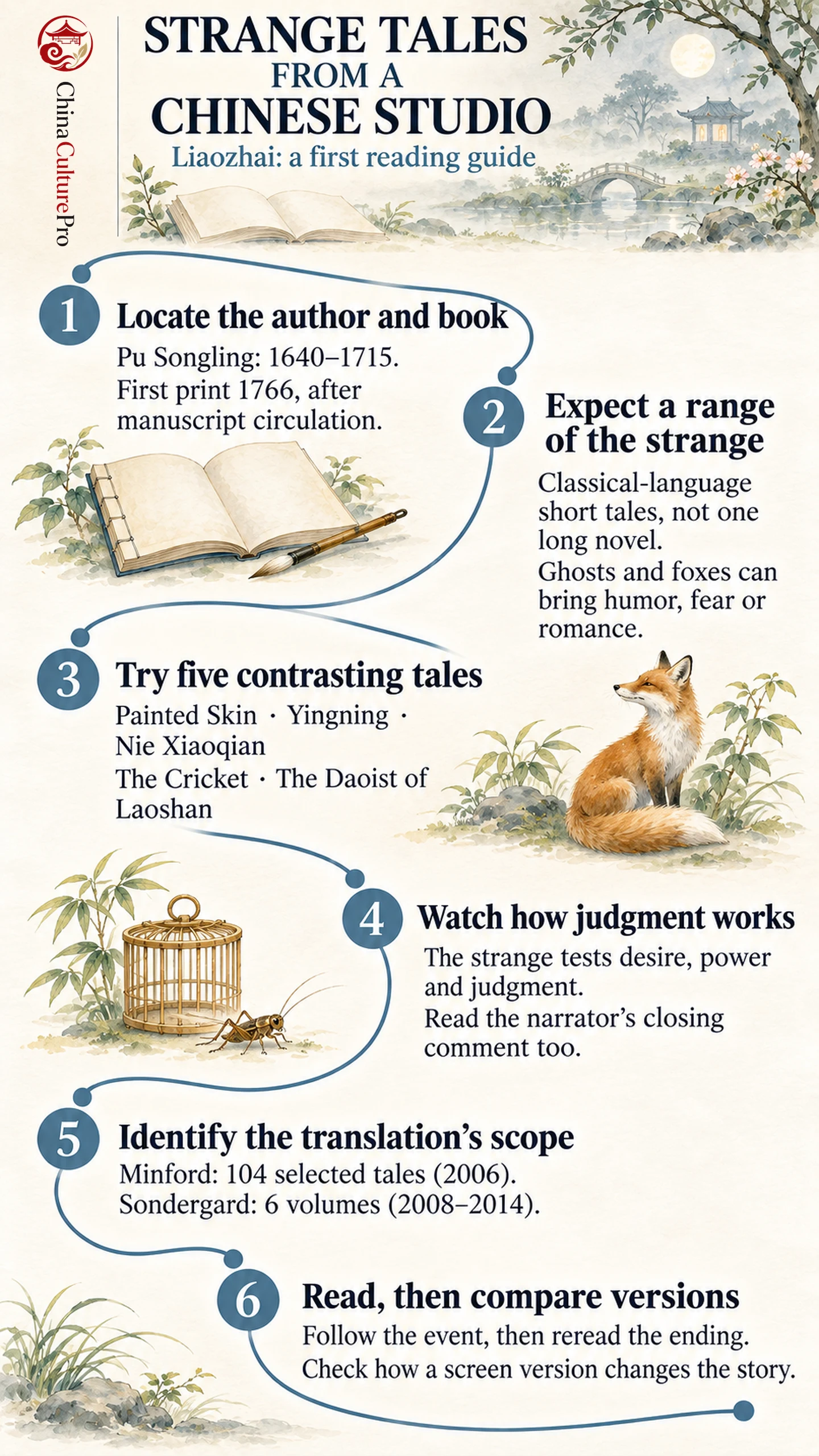
A ghost can become a sympathetic companion, a scholar can mistake desire for good judgment, and a cricket can expose the pressure of official demands. Those possibilities make Pu Songling’s collection a rewarding entrance into Chinese literature. The pleasure lies in the narrative turn: a familiar household, ambition or encounter changes when the strange enters it.
Pu Songling, the Studio and the Making of the Collection
Pu Songling lived from 1640 to 1715 and came from Zichuan in Shandong. The collection belongs to the early Qing dynasty. Liaozhai (聊斋, Liáozhāi) was the name of his private study, which gives the collection its familiar Chinese name.[1]
His experience of the examination world is relevant, but it needs accurate scope. He achieved success in the initial examinations and then repeatedly failed to obtain the provincial qualification. It is misleading to say he never passed an examination at all. The imperial examinations guide explains the different levels behind that distinction.[3]
The collection developed over many years and circulated before its first printed edition appeared in 1766, after Pu’s death. A first publication date is therefore not the same as the date when every story was composed. The book’s history includes manuscript circulation, editing, commentary and later translations.[2]
Readers often encounter a total of nearly 500 tales. Exact counts should be attached to a particular text or edition: catalog descriptions and edited collections do not all use the same total. The English translation section below identifies what two named editions actually contain.[1][6]
This is crafted literary writing, even when a narrative presents itself as a record of something heard or witnessed. Treating every incident as a transparent transcription of folklore misses the author’s choices about sequence, tone and comment.
Ghosts, Foxes and the Range of the Strange
The original uses wenyan (文言, wényán), the classical written language. That matters when choosing a Chinese text: a modern vernacular rendering and the older language are different reading experiences. The classical and modern Chinese comparison helps explain the distinction.[1][3]
The collection also draws on zhiguai (志怪, zhìguài), the tradition of recording the strange. In Pu’s work, an unusual incident can become an occasion for psychological, religious or social reflection. Genre boundaries remain flexible: the uncanny is a way of telling, not a promise that every story will frighten the reader.[4]
Ghosts, animal spirits, marvelous objects and unfamiliar events can enter the same broad literary world. Some narratives dwell on a transformation; others on an encounter, a joke or a disturbing reversal. Penguin’s selection alone includes magical phenomena as varied as an extraordinary pear tree and a woman’s contest with a possessing fox spirit.[5]
The categories also invite comparison. A human official can be less humane than a supernatural visitor, while an attractive appearance can conceal danger. To understand a figure’s role, watch what that figure does to others and how the narrator frames the result. The Chinese ghost-story guide および fox-spirit guide provide wider context without making every tale follow the same pattern.
Five Tales That Show the Collection’s Range
The following selection offers contrasting first readings. English story titles vary by translator; the Chinese titles help locate the same work in a different edition. These are brief premises rather than complete plot summaries.
| Tale | What to notice on a first reading |
|---|---|
| Painted Skin (画皮, Huàpí) | A desirable human appearance conceals a dangerous being; attraction affects what the scholar is willing to believe.[8] |
| Yingning (婴宁, Yīngníng) | A laughing young woman disrupts expectations about courtship, proper speech and social behavior.[9] |
| Nie Xiaoqian (聂小倩, Niè Xiǎoqiàn) | A human encounter with a female ghost complicates the assumption that the supernatural visitor must be the story’s moral enemy.[1][9] |
| The Cricket (促织, Cùzhī) | Official demands for fighting crickets put a household under pressure, with a supernatural turn linking the family’s fate to an insect.[10] |
| The Daoist of Laoshan (劳山道士, Láoshān Dàoshi) | A student wants extraordinary abilities but resists difficult training; his later boast gives the tale its comic reversal.[8] |
Painted Skin is useful for noticing the gap between a warning and its reception. The scholar’s response to what he wants to see helps make the danger possible. A reading concerned only with identifying the creature would miss that human decision.[8]
Yingning and Nie Xiaoqian provide different encounters with unconventional women and supernatural circumstances. Compare how conversation works: who speaks openly, who misunderstands, and which social expectations shape the response. Their tone and relationships should not be flattened into a single “beautiful spirit seduces scholar” formula.[9]
The Cricket brings official power into a household’s most intimate fears. Its changing fortunes make the final outcome worth thinking about, rather than treating the supernatural turn as an isolated trick. The Daoist of Laoshan offers another contrast: an apparently useful ability becomes a test of the learner’s assumptions.[8][10]
Choose the first tale by interest: appearance and danger, unusual courtship, ghostly companionship, social pressure or comic failure. A second contrasting tale will usually reveal more of the collection’s range than five similar premises.
Desire, Power and the Problem of Judgment
Desire affects perception throughout these stories. Attraction, ambition or the wish for an easy solution can make a character accept an explanation too quickly. Painted Skin and The Daoist of Laoshan approach that weakness with markedly different tones, one threatening and one comic.
Power also travels through social relationships. The Cricket begins with an elite amusement becoming an official demand, and the burden passes downward. The household’s distress is connected to that chain of responsibility, not merely to bad luck in catching an insect.[10]
Such episodes invite social criticism, but one formula should not replace close reading. A tale can question the treatment of ordinary people while also making room for moral consequence, extraordinary justice or an unstable reversal. The supernatural event and the social pressure need to be read together.[4]
The narrative voice matters as much as the event. Some tales add a comment in the voice commonly translated as the “Historian of the Strange.” Notice whether that comment directs attention to a particular decision, extends the episode toward society, or changes the mood after the action ends.[3] In The Daoist of Laoshan, the closing comment extends the comic failure toward people who accept flattering promises of acting without obstruction.[8]
This also guards against a simple biographical shortcut. Pu’s examination experience provides context for interests in recognition and judgment, but it does not establish one explanation for every ghost, joke or love story. Read the particular arrangement of the tale before turning it into an example of the author’s life.
Choosing an English Translation
A familiar English title does not tell you how much of the collection a book contains. Two clearly identifiable choices illustrate the difference between a substantial selection and a larger translation project.
| Edition | Verified scope | A useful reason to consider it |
|---|---|---|
| John Minford, Strange Tales from a Chinese Studio, Penguin Classics, 2006 | A selection of 104 stories | A bounded introduction that lets a first reader sample different kinds of tale.[5] |
| Sidney L. Sondergard, Strange Tales from Liaozhai, Jain Publishing, six volumes, 2008–2014 | The publisher describes a complete translation of its 494-story collection, with annotation | A broader reading or reference project, with notes and contextual essays.[6][7] |
The number 494 here describes the Sondergard project’s stated scope. It should not be used to “correct” every catalog that counts another edited text differently. Similarly, 104 is the size of Minford’s selection, not a claim about the total number Pu wrote.
Before choosing a copy, check the translator, volume number, contents and notes. For a particular tale, retain the Chinese title as well as the English one. Two translators can choose different English titles without translating different source stories.
The Chinese classic books guide gives more help with that edition check. A selected volume can be enough for an enjoyable first encounter; a larger set becomes useful when you want to locate a wider range of stories or follow a recurring subject.
Reading a Tale and Comparing a Screen Version
Read the event first, then return to the act of telling. What information does the opening make ordinary? At what point does something no longer fit? Who recognizes the change, and who keeps using the earlier explanation? Those questions make a short tale more than a supernatural plot twist.
On a second pass, look at the ending and any narrator’s comment. Ask whether the apparent solution removes the problem, exposes another one or changes who benefits. Notes can help with an unfamiliar office, allusion or social expectation. The literary allusions guide explains why a small reference can carry so much weight.
For a Chinese-language edition, check whether it presents the original classical text, a modern-language paraphrase or both, and keep commentary separate from the tale. The Chinese writing-system guide provides background for readers new to the script.
For a screen version, compare one concrete change: a character’s motive, the length of a relationship or the ending. Do not assume the film supplies a missing part of the original. Adaptation has a long history; scholarship on the collection’s reception in Japan, for example, traces reworkings well before cinema.[2]
Finally, keep literary narrative and evidence about religious practice distinct. These tales can illuminate cultural imaginings without functioning as instructions for what every community believes or does. The Chinese folk-religion guide supplies a separate introduction to that wider subject.
FAQs About Strange Tales from a Chinese Studio
Is Strange Tales from a Chinese Studio a single novel?
No. It is a collection of short narratives, with different characters, lengths and tones. It can be read by selecting individual tales.
Are all its ghosts and fox spirits evil?
No. Supernatural figures can be sympathetic, dangerous or more complicated. Their conduct and relationships matter more than assuming one moral role from their category.
Does John Minford’s edition contain the complete collection?
No. His 2006 Penguin edition selects 104 stories from the larger collection. Check the contents when looking for a particular tale.
Do I need to read every tale in order?
No. Beginning with a few contrasting tales is a practical approach. Keep the edition’s introduction and notes available for context, and return to its wider selection when you want more.
出典
[1] Library of Congress, Jeffrey Wang. The Strange Tales from Liaozhai
[2] Sino-Japanese Studies, William D. Fleming. Strange Tales from Edo: Liaozhai zhiyi in Early Modern Japan
[3] Academy of Chinese Studies. Strange Tales from the Idle Studio
[4] Wiley, Luo Hui. Mastering a Minor Tradition: Pu Songling and the Chinese Ghost Tale
[5] Penguin Random House. Strange Tales from a Chinese Studio, translated by John Minford
[6] Jain Publishing. Strange Tales from Liaozhai, Volume1
[7] Jain Publishing. Strange Tales from Liaozhai, Volume6
[8] Pu Songling, Chinese primary text via Wikisource. Liaozhai zhiyi, Volume1: Painted Skin and The Daoist of Laoshan
[9] Pu Songling, Chinese primary text via Wikisource. Liaozhai zhiyi, Volume2: Yingning and Nie Xiaoqian
[10] Pu Songling, Chinese primary text via Wikisource. Liaozhai zhiyi, Volume4: The Cricket