

Quick Answer: What Is Chinese Arrowhead Cigu?
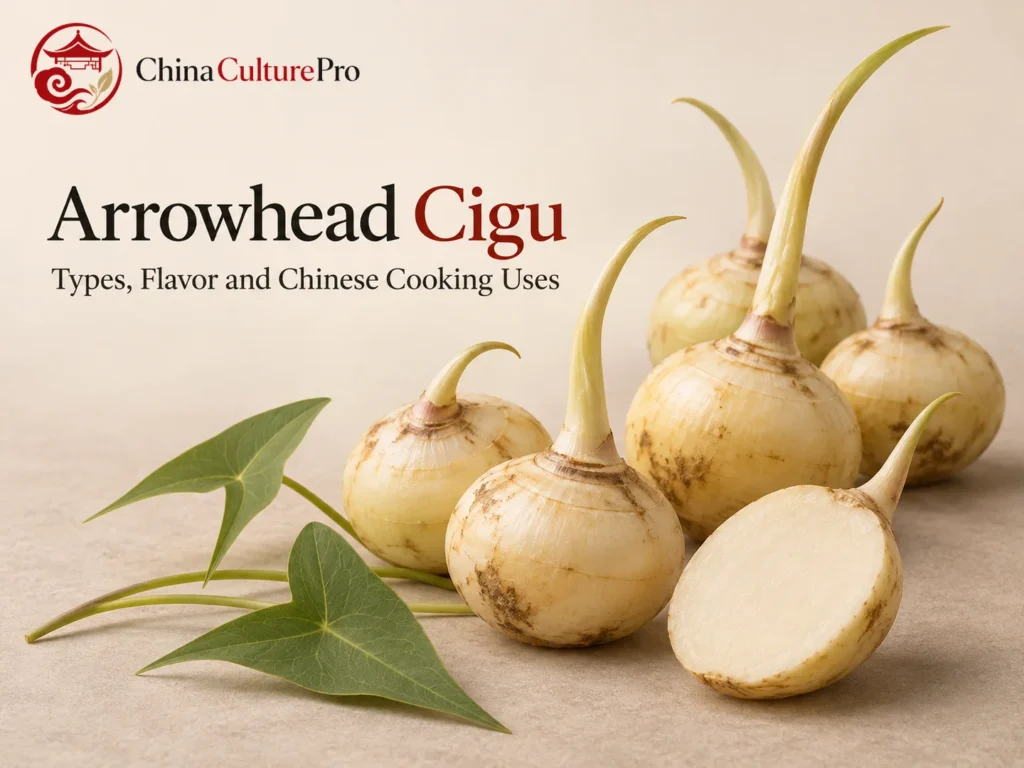
Chinese arrowhead, or cigu (慈姑, cígū), is an aquatic vegetable eaten for its starchy underground storage organ. The rounded piece often has a pointed shoot and ring-like markings. It is cooked as a vegetable, notably in pork braises, stir-fries and thin fried chips.[1][7]
- Ingredient: A swollen underground stem, commonly sold as arrowhead root.
- Texture: Starchy and tender when cooked, with a flavor that can include slight bitterness.
- Forms: Fresh whole pieces for cooking, or prepared crisp chips for snacking.
Similar English shop names can refer to different ingredients. Identify the fresh vegetable separately from other aquatic produce and processed starches.
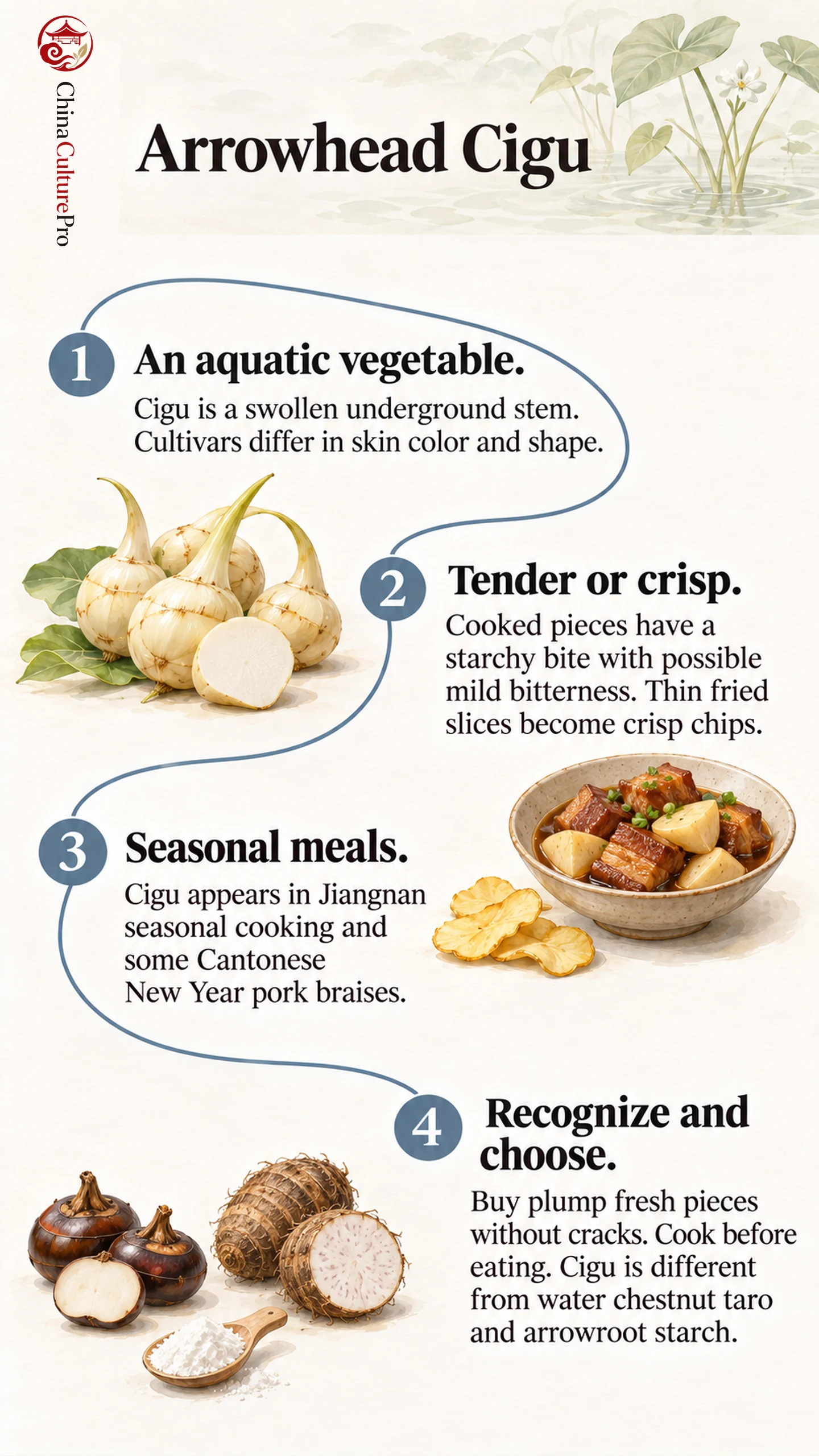
A small pale vegetable with a pointed shoot can be easy to overlook among winter market produce. Cigu becomes more memorable at the table: cooked pieces have a starchy bite, while thin fried slices make a completely different, crisp snack.
An Aquatic Vegetable with Several Cultivars
The plant’s arrow-shaped leaves give it the English name. It grows in shallow water and muddy ground. The food comes from below the surface, where the plant forms swollen storage organs along its underground stems.[1][9]
Among Chinese vegetables, cigu is a corm: a swollen underground stem commonly described as a root in shops. Its skin can be pale, yellowish or grey-blue, and the flesh is generally pale. A curved shoot and bands around the body help distinguish whole pieces on a produce stall.[2]
There are several cultivated forms. Suzhou Huang (苏州黄, Sūzhōu huáng) has an oval shape and yellow skin; white cigu (白慈姑, bái cígū) is described as flatter and white-skinned. Skin color and shape therefore vary within the ingredient category.[2]
Flavor, Texture and Chinese Cooking Uses
The dense flesh becomes tender and starchy, often compared with a potato, while retaining its own mild earthiness and slight bitter or astringent edge. Cultivar, cut and surrounding ingredients affect the finished flavor.[3]
Braising with pork is a familiar direction. Cigu accompanies hong shao rou (红烧肉, hóngshāoròu), red-braised pork, and can also appear in pork-rib soup. The vegetable takes on the savory character of the surrounding meat and liquid while keeping a distinct starchy interior.[4]
One Cantonese-style family braise pairs pork belly and cigu with red fermented bean curd. That fermented seasoning gives the sauce a different character from a plain soy-seasoned braise. Other braises use different seasonings.[6]
Sliced cigu can also accompany stir-fried pork. Thin slices fried into chips become golden and brittle instead of soft and floury. Changing the cut and cooking method therefore changes the eating experience even though the starting vegetable is the same.[4][5]
Jiangnan Markets and New Year Meals
Cigu has a seasonal place in Jiangnan food culture. Agricultural records describe it as a winter-to-spring vegetable, while a Shanghai market report records fresh arrivals in autumn lasting toward the New Year. This is a seasonal pattern, not a guarantee of stock in every shop.[4][9]
In Suzhou, within Jiangsu’s regional cooking traditions, both arrowhead braised with meat and crisp arrowhead chips are remembered local foods. These preparations show how a single seasonal crop can belong to the meal and the snack table.[5]
Cigu also appears in Chinese New Year meals in Cantonese family accounts, including the pork-belly braise described above. The festive association extends beyond one regional cooking tradition.[6]
Buying Cigu and Recognizing Similar Ingredients
Look for fresh cigu at Chinese or other Asian produce shops when it is in season. Choose plump pieces without cracks or obvious deterioration. The sprout may be present or trimmed, so its absence alone does not identify a different vegetable. Refrigerate whole, unpeeled pieces and follow any supplier directions.[3]
Wash away dirt, peel and cook the vegetable for its intended dish. Cut surfaces can darken through oxidation; keeping freshly prepared pieces in water is a common way to limit that change. Prepare it close to cooking.[4][7]
Water chestnut (荸荠, bíqi) and taro (芋头, yùtou) are separate vegetables. Compare their appearance and eating texture.[7][8]
| 食材 | Useful identifying feature | 主な違い |
|---|---|---|
| Cigu / Chinese arrowhead | Often a pointed shoot and bands around a pale or yellowish body | Starchy cooked vegetable; can have a slight bitter edge. |
| Water chestnut | Small round dark-brown body before peeling | Known for a sweet, crisp bite. |
| Taro | Coarser brown or grey skin, sometimes with visible fibers | A different starchy vegetable, without cigu’s characteristic shoot. |
| Arrowroot starch | A processed starch sold as powder | A thickening ingredient, not a fresh cigu vegetable. |
Cigu itself is a vegetable, but a pork braise is a meat dish. For vegetarian choices, check the sauce, broth and other ingredients separately.
FAQs About Arrowhead Cigu
Is cigu the same as a water chestnut?
No. Both are aquatic vegetables, but cigu develops a starchier cooked texture; water chestnut is valued for its crisp bite.
Is Chinese arrowhead the same as arrowroot powder?
No. The fresh vegetable and the processed thickening powder have different culinary roles. Do not substitute by the English name alone.
Can cigu be eaten raw?
It should be cooked before eating. Washing and peeling prepare the vegetable; they do not replace cooking.
Why does cigu sometimes taste bitter?
A mild bitter or astringent note can be part of its flavor. Cultivar and preparation affect the result; it is not necessarily a uniformly sweet vegetable.
出典
[1] Hong Kong Wetland Park, Agriculture, Fisheries and Conservation Department. Chinese Arrow-head: Plant and Edible Underground Stem
[2] China Agriculture Press, Zhihui Sannong. Cigu: Botanical Features and Main Cultivars
[3] Specialty Produce. Chi Gu: Description, Taste and Culinary Applications
[4] Shanghai Hongkou District Government. Cigu and Water Chestnuts Arrive at Seasonal Markets
[5] Our Jiangsu. Suzhou Memories of Crisp Arrowhead Chips
[6] Judy Leung, The Woks of Life. Cantonese-Style Braised Pork Belly with Arrowhead Root
[7] USDA Agricultural Marketing Service. Specialty Fruits and Vegetables: Arrowhead, Arrowroot and Taro
[8] Uwajimaya. Water Chestnuts: Appearance and Texture
[9] Chinese Academy of Agricultural Sciences, China Agricultural Science and Technology Information Network. Cigu Cultivation: Underground Stems and Winter-Spring Vegetable Use