

Quick Answer: What Does Jin Chan Tuo Qiao Mean?
Jin Chan Tuo Qiao (金蝉脱壳, jīn chán tuō qiào) literally means “the golden cicada sheds its shell.” It describes a departure that goes unnoticed at first because an outward appearance remains. The empty shell is what makes the idiom more specific than simply leaving.[1][3]
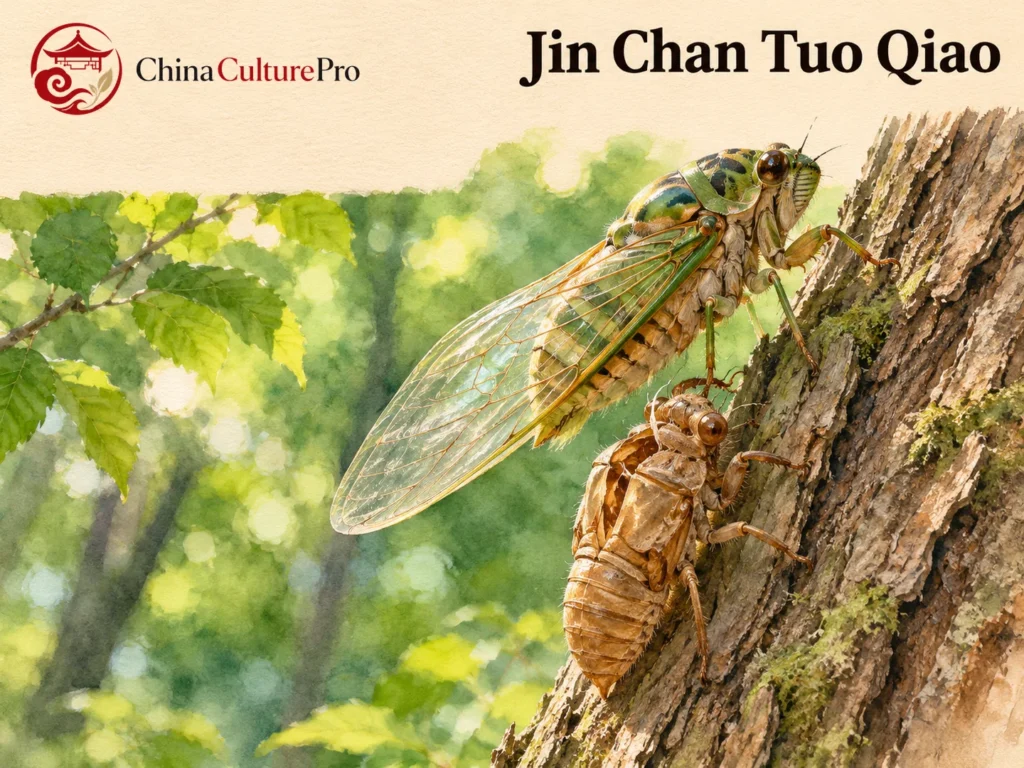
- Literal image: A cicada emerges and leaves its outer shell behind.[1]
- Figurative meaning: Someone slips away while a misleading impression persists.[1][3]
- Pronunciation: Mainland usage commonly has qiào. Taiwan’s Ministry of Education dictionary gives ké.[1][3]
Look for what remains visible after the person is gone.

An empty shell can stay attached to a branch after the cicada has emerged. From a distance, the shape is still there. That difference between an appearance and what it contains gives the expression its meaning.[1]
What the Cicada Leaves Behind
Jīn means golden, chán is a cicada, tuō means to shed or come out of, and 壳 is the shell. The phrase evokes the outer covering left after a cicada molts. In figurative use the shell stands for what observers take to be a continuing presence.[1][3]
The idiom does not require that the “shell” be an object. In a story, the misleading impression may be that a character is still part of a scene after the person has already gone. The narrator can reveal the gap between the visible sign and the actual departure at a later moment.[1][3]
Where the Phrase Appears in Literature
An early narrative parallel appears in the Pinghua of the Three Kingdoms. In a story about Sun Jian and Lü Bu, the narration compares Sun Jian’s departure to the cicada shedding its shell. The words in that passage are a variant of the familiar form. The passage attests the cicada image in an early narrative. It does not fix a date for the later wording.[1]
Another form, 脱壳金蝉, reverses the order. A dictionary entry records it in a Yuan play by Guan Hanqing. Later sources also use the familiar order. These variants point to the same image of a cicada and what it leaves behind.[2][3]
How to Use Jin Chan Tuo Qiao Today
A theater reviewer might say 魔术师一转眼就不见了,这一幕真像金蝉脱壳。 The audience’s impression lasts for a moment after the performer has vanished. The idiom makes the scene feel like a clever exit rather than merely noting that someone went away.[1][3]
For a plain English translation, “slipped away unnoticed” may be enough. If the surrounding passage calls attention to an appearance that remains, keep that detail in the translation. A literal “shed its shell like a cicada” can work in a literary discussion of the image.[1][3]
How It Differs From An Du Chen Cang
An Du Chen Cang (暗度陈仓, àn dù Chéncāng) can describe a hidden action more generally. Jin Chan Tuo Qiao specifically calls up a departure and a misleading sign left in its place. Look for whether the scene turns on a departure or on some other concealed action.[1][4]
FAQs About Jin Chan Tuo Qiao
Is 壳 pronounced qiào or ké?
The final syllable is commonly qiào in mainland Mandarin. The cited Taiwan dictionary gives ké for this expression.[1][3]
Does the phrase describe any departure?
It describes a departure that people do not notice at first. The idiom evokes a remaining appearance after the person has gone.[1][3]
What is a natural English translation?
“Slip away unnoticed” is often natural. Keep the cicada and shell if the image is important to the passage.[1][3]
Sumber
[1] Taiwan Ministry of Education. Idiom dictionary entry for 金蟬脫殼
[2] Taiwan Ministry of Education. Variant entry for 脫殼金蟬
[3] Guoxue Dashi. Dictionary entries for 金蝉脱壳
[4] Taiwan Ministry of Education. Idiom dictionary entry for 暗度陳倉