


Quick Answer: What Does Han Dan Xue Bu Mean?
Han Dan Xue Bu (邯郸学步, Hándān xué bù) means to imitate others unsuccessfully and lose a skill or quality of your own in the process. In the Zhuangzi (庄子, Zhuāngzǐ), a young man tries to learn how people walk in Handan and ends up crawling home.[1][2]
- Literal image: Learn the steps of people in Handan.[1]
- Two losses: The young man fails to learn the new walk and forgets his old one.[1][2]
- Modern use: Criticize copying that costs a person or group an existing strength.[2]
The loss of the original ability is what makes the idiom more specific than a failed imitation.
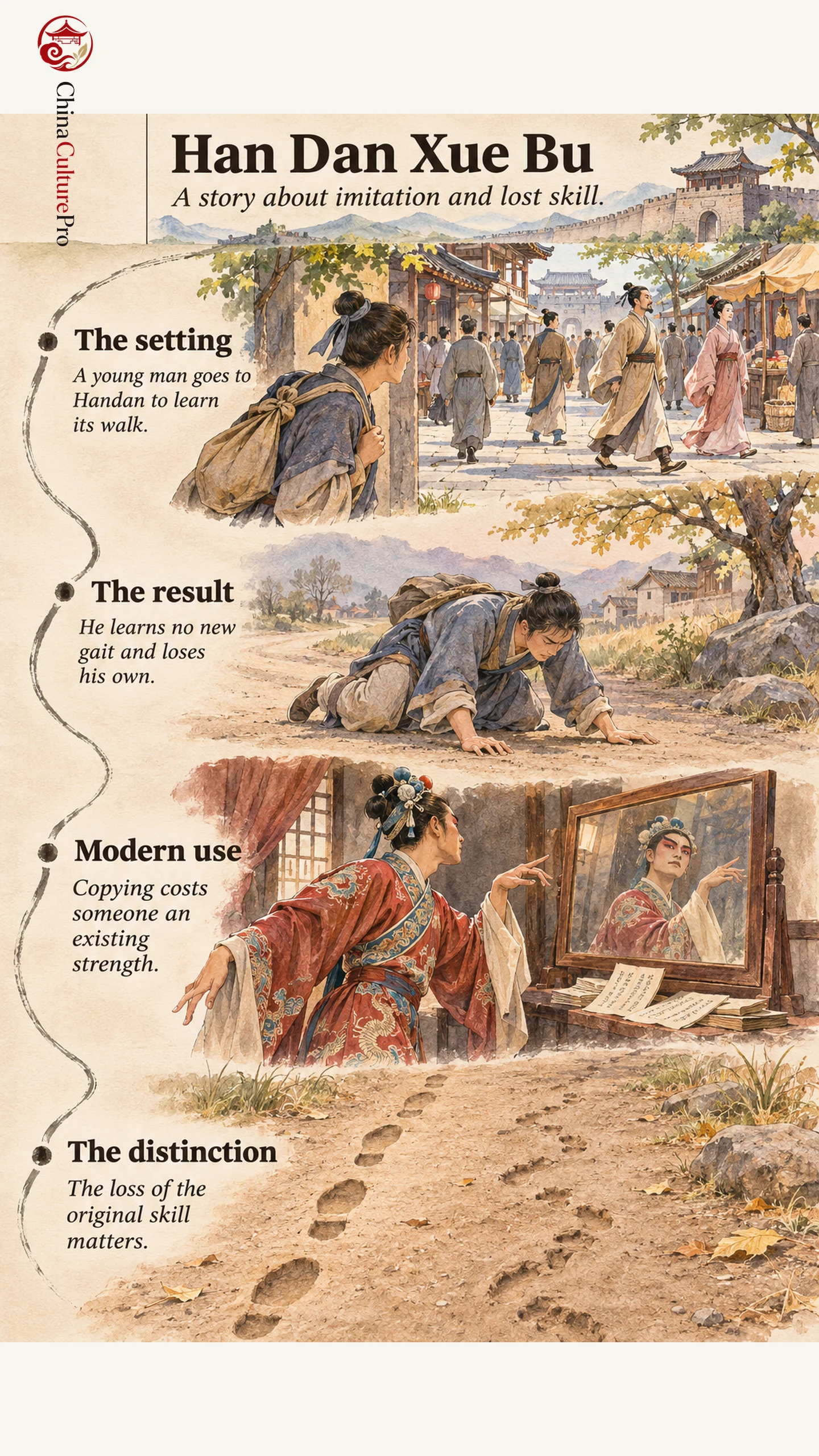
Most stories about imitation ask whether the copy is convincing. This one also asks what the imitator gives up. The young man leaves Handan without the new walk he wanted or the familiar one he brought with him.[1][2]
What Happens to the Young Man in Handan
In the Autumn Floods chapter, a young man from Shouling tries to learn the way people walk in Handan. The text identifies Handan as the place of the attempt. It gives no description of how the people there placed their feet or why their gait would have looked distinctive.[1]
The story gives the attempt a double cost. He fails to acquire the new gait and loses the one he already knew. The final image is of him crawling back. That ending makes the loss concrete and gives a warning about imitation its memorable form.[1][2]
Why the Zhuangzi Tells the Story
The anecdote appears in a conversation between Gongsun Long and Wei Mou. Gongsun Long is confident in his reasoning but finds himself at a loss when he hears about the Zhuangzi. Wei Mou questions whether he can approach it with the tools he is using.[1][2]
The young man’s return gives Wei Mou a way to make the warning sharper. Someone can take up a new practice badly enough to damage what they could do before. In the dialogue, the warning is about approaching another way of thinking without losing command of your own.[1][2]
How to Use Han Dan Xue Bu Today
A drama teacher might say 他的表演原来很自然,照搬别人的腔调之后,倒成了邯郸学步。 The actor adopts another performer’s delivery without making it work for his own role. In the process he loses the natural quality he once had.[2]
In English, “lose your own style trying to copy someone else” gives the full sense. “A failed imitation” is shorter, but drops the point about what was lost. If the passage is already about a talent being undermined, the surrounding sentences can supply the second part.[1][2]
How It Differs From Dong Shi Xiao Pin
Dong Shi Xiao Pin (东施效颦, Dōng Shī xiào pín) describes a copied gesture that produces the wrong effect. Han Dan Xue Bu puts greater emphasis on the damage to the imitator’s own way of doing things. Choose the Handan image when the original skill or style is part of what the reader needs to notice.[1][3]
FAQs About Han Dan Xue Bu
Is Handan a real place?
Yes. Handan was the capital of the state of Zhao in the Warring States period. The anecdote uses it as the place where the young man tries to learn another gait.[1]
What does the story say the young man lost?
He loses his original way of walking and fails to learn the new one. The story ends with him crawling back.[1]
Does Han Dan Xue Bu criticize all imitation?
It criticizes imitation that fails and displaces an existing ability or style. Learning from someone while keeping what works for you falls outside that criticism.[1][2]
Sumber
[1] Taiwan Ministry of Education. Idiom dictionary entry for 邯鄲學步
[2] Taiwan Ministry of Education. Usage examples for 邯鄲學步
[3] Taiwan Ministry of Education. Idiom dictionary entry for 東施效顰