
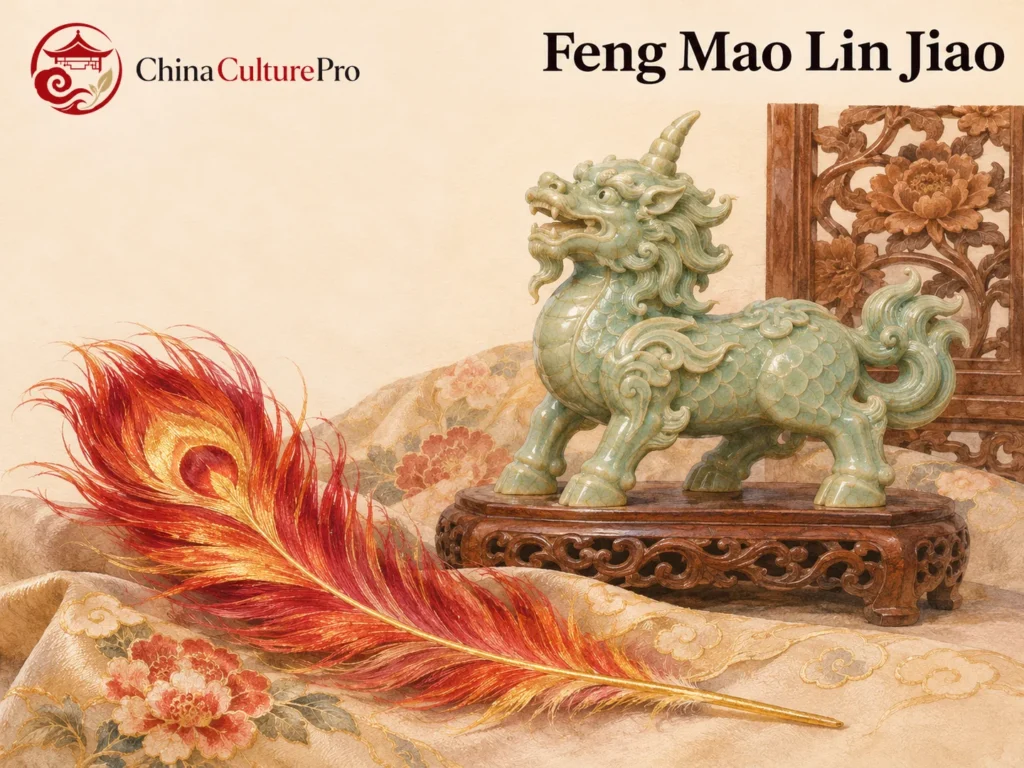

Quick Answer: What Does Feng Mao Lin Jiao Mean?
Feng Mao Lin Jiao (凤毛麟角, fèng máo lín jiǎo) describes someone or something exceptionally rare and often highly valued. Literally it refers to the feather of a fenghuang (凤凰, fènghuáng), or Chinese phoenix, and the horn of a qilin (麒麟, qílín), another legendary creature.[1][2]
- The image: A phoenix feather and a qilin horn suggest rarity.[1]
- The sources: The two halves are associated with different classical passages.[2]
- Modern use: Describe rare people, objects or examples of a valued quality.[1][3]
Use “few and far between” for quantity, or “a rare treasure” when the context emphasizes value.

The idiom puts two unlikely objects side by side. Each half had its own literary associations before writers used the feather and horn together to describe rare excellence.[1][2][3]
What the Feather and Horn Stand For
Fèng máo means a phoenix feather, and lín jiǎo means the horn of a qilin. Both objects come from legendary creatures. In an ordinary sentence the speaker is usually making a judgment about scarcity, with the image adding a sense that the scarce thing is remarkable.[1]
The word jiǎo means horn here. Readers may also see the terms in the reverse order, 麟角凤毛. The reversal retains the same two objects and the sense of precious rarity.[3]
Two Images From Different Texts
One source for the feather is A New Account of the Tales of the World. Huan Wen sees Wang Shao and remarks that he has a phoenix feather. In that setting the praise recognizes qualities reminiscent of Wang Shao’s father. The feather is a figure for inherited distinction.[1][2]
The horn supplies a different comparison in an essay by Jiang Ji preserved in a later anthology. People who study are compared with the many hairs of an ox. Those who truly attain something are as scarce as the horn of a qilin. The paired idiom draws these images together. A Ming play is one place where the four characters appear together.[2][3]
When to Use Feng Mao Lin Jiao
Imagine an archive that holds one of the few remaining letters from a little-known writer. A curator might say 这位作家留下的手稿已是凤毛麟角。 The idiom gives a sense of how little survives and can imply that the manuscripts are worth preserving.[1]
It also works for people. If a speaker says that craftspeople with a particular skill are 凤毛麟角, the focus is on how few such people can be found. The idiom can convey admiration simply by stressing how uncommon the skill is.[1][3]
Choosing an English Equivalent
“Few and far between” fits a plural group or a scarce quality. “Exceptionally rare” gives a more neutral register. When the sentence values a particular object, “a rare treasure” can preserve the praise. A literal rendering can be useful in a discussion of the creatures or of the idiom’s imagery.[1][2]
FAQs About Feng Mao Lin Jiao
Does the phrase describe people as well as objects?
Yes. The expression can describe rare talents, unusual objects or a scarce quality in a group.[1][3]
Is there one original story about the two creatures?
The feather and horn have separate classical associations. The later expression pairs the two images.[1][2][3]
Is Feng Mao Lin Jiao always praise?
It often values what is rare, but the sentence may simply emphasize how few people or things fit a description.[1]
Sumber
[1] Taiwan Ministry of Education. Idiom dictionary entry for 鳳毛麟角
[2] Taiwan Ministry of Education. Classical passages and later literary evidence
[3] Taiwan Ministry of Education. Revised idiom reference for 鳳毛麟角