


Quick Answer: What Is Zouwu?
Zouwu (騶吾, Zōuwú) is a rare beast in the Classic of Mountains and Seas. The Within the Northern Seas chapter describes it as the size of a tiger, with five colors and a tail longer than its body. A rider can travel a thousand li in a day on it.[1]
- Home: The text places it in the country of the Lin clan.
- Shape: Size, colors and tail length identify it.
- Related name: Guo Pu proposes a reading associated with Zouyu (騶虞, Zōuyú).
The beast’s appearance and speed come from the main text. The connection to another name comes from commentary.[1][2][3]
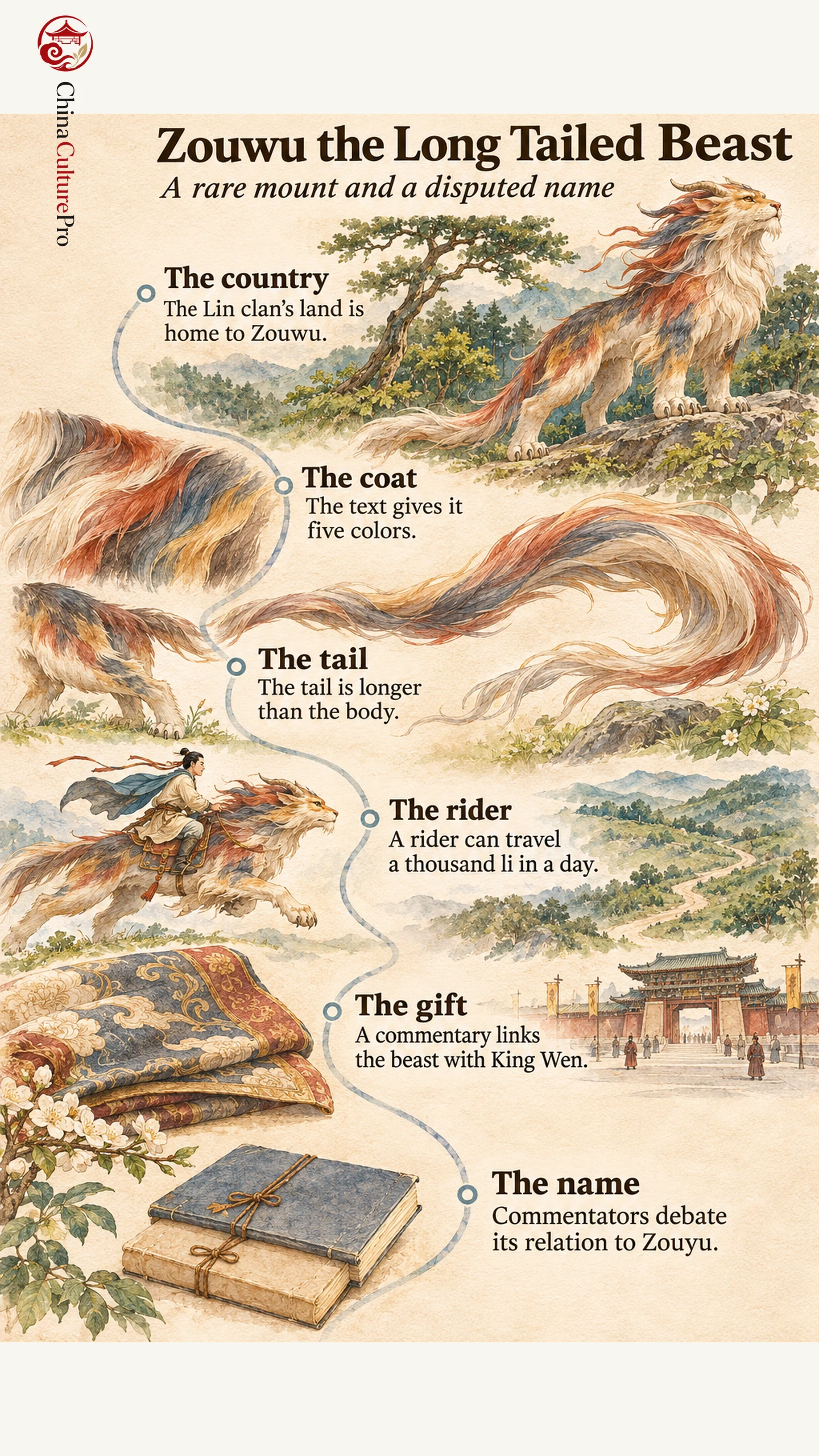
Zouwu’s tail is its most specific visual clue. In the classical passage, what the animal can do for a rider is just as important as its appearance.
The Long Tail and Five Colors
The Within the Northern Seas chapter of the Classic of Mountains and Seas names the country of the Lin clan as the home of a rare beast. It is as large as a tiger, has five colors and carries a tail longer than its body. The account then names it Zouwu.[1]
Tiger size supplies a comparison of scale. The source does not specify the head, paws or markings of an ordinary tiger. A painter can interpret the colors in various ways because the text leaves their distribution open. The tail’s proportion is the detail an image can follow most directly.[1]
Why Zouwu Is Described as a Mount
The next line says a person riding Zouwu can cover a thousand li in one day. It describes the benefit to the rider rather than giving a calculation of the animal’s speed. The distance belongs to the scale of extraordinary travel in the story.[1]
Other mythical animals have their own distance claims. The luduan is associated with faraway languages and travel in a different tradition. Zouwu’s entry uses the large number to make the beast a remarkable mount.[1]
The Story Guo Pu Adds About King Wen
Guo Pu’s commentary cites a tale in which King Wen is held by the last Shang ruler. People seeking his release obtain the beast from the Lin country and present it. The ruler is pleased by the gift and frees King Wen in the tale. The annotation turns a rare animal into a gift that can influence the ruler’s decision.[2]
That story belongs to the annotation. The main entry gives the Lin country, the animal’s features and the journey it makes possible. A retelling about a gift and a captive king follows the extra context in the commentary.[1][2]
Zouwu and Zouyu in the Sources
The same annotation compares another name for a long-tailed beast and proposes reading the last character of Zouwu as yu. That brings the name close to Zouyu. A later philological work objects and argues that the animal in the northern entry and the name in the Book of Songs should be distinguished.[2][3]
The commentaries document a disagreement about whether the names should be read together. The long tail and thousand-li ride identify the Zouwu passage. A poem or an account of auspicious conduct can use the other name with different details.[1][2][3]
FAQs About Zouwu
What does Zouwu look like?
It is described as tiger-sized and five-colored, with a tail longer than its body. The entry supplies no exact pattern for the colors.[1]
How far does Zouwu travel in a day?
The text says a rider can travel a thousand li in a day on Zouwu. The number belongs to the legendary account of a remarkable mount.[1]
Is Zouwu the same as Zouyu?
Guo Pu connects the names through a proposed reading. A later writer disagrees. Keep the visual features and roles attached to their individual sources.[2][3]
Sources
[1] Chinese Wikisource. Classic of Mountains and Seas, Within the Northern Seas
[2] Chinese Wikisource. Classic of Mountains and Seas, Guo Pu’s commentary
[3] Shidian Classics. Corrections and Supplements to the Two Han Histories, volume six