


Quick Answer: What Is Youpo Mian?
Youpo Mian (油泼面, yóupō miàn) is a Shaanxi wheat-noodle dish defined by its hot oil finish.
- Noodles: A chewy wheat base, often hand-stretched, with broad ribbons a familiar choice.
- Aromatics: Chili flakes, garlic and scallions commonly sit above the noodles; vinegar adds tang, and greens offer freshness.
- Finishing technique: The noodles are boiled first. Hot oil then sizzles over the seasonings, releasing their aroma rather than cooking raw noodles.
- Eating: Toss the warm noodles thoroughly to distribute the oil, seasoning and any vinegar beneath them.
Width and toppings vary: Youpo Mian need not use belt-wide noodles, and a meat-free appearance does not guarantee a vegan bowl.
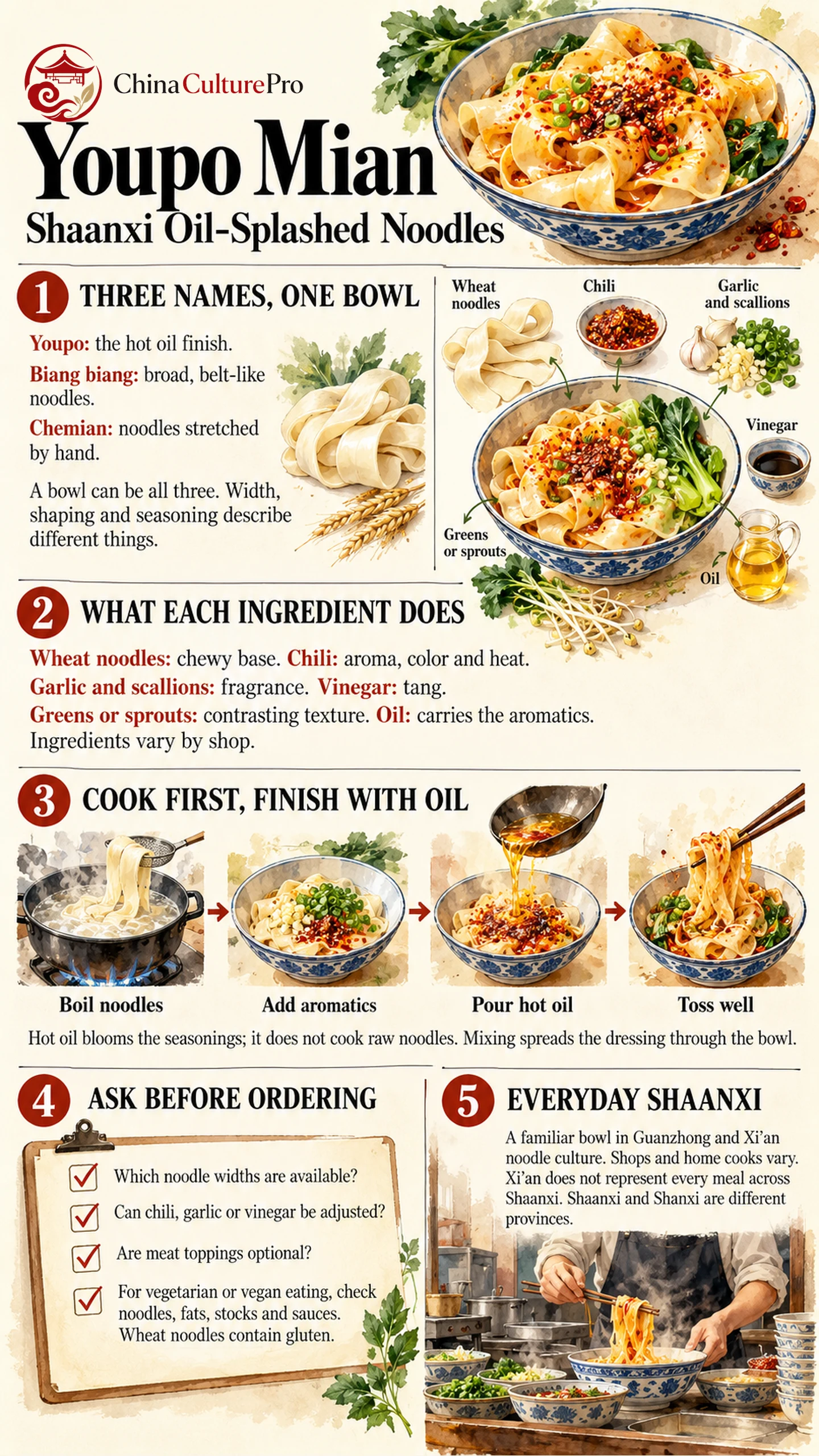
The first impression is often the sizzle: hot oil meets chili, garlic and scallions above a bowl of chewy noodles. Within the wider family of Chinese noodles, this Shaanxi favorite is distinguished as much by its finishing touch as by its shape.
Youpo Mian, Biang Biang Noodles and Chemian: Name Differences
These names emphasize different features of a bowl. Youpo (油泼, yóupō) means the hot oil finishing method; chemian (扯面, chěmiàn) describes noodles shaped by stretching pieces of dough by hand. Biang biang noodles (𰻝𰻝面, biángbiáng miàn) is the familiar name for especially broad, belt-like Shaanxi noodles.
| Nom | Ce qu’elle décrit | How it overlaps |
|---|---|---|
| Youpo Mian | The finished dish and its oil-splashed seasoning | Different noodle shapes can receive this finish. |
| Biang biang noodles | Broad, belt-like hand-stretched noodles | They can be served with a hot oil finish or other toppings. |
| Chemian | The hand-stretching method | The resulting noodles can vary in width and seasoning. |
A bowl can therefore be all three: hand-stretched, belt-wide and oil-splashed. Our biang biang noodles guide focuses on the broad noodle form. Chemian also belongs to the wider world of hand-stretched noodles, but its shaping should not be confused with the repeated pulling into many strands associated with lamian.
Noodles and Aromatics: What Goes into Youpo Mian
The wheat noodles supply the chew. Broad ribbons give a substantial bite and a large surface for the dressing; narrower noodles feel different on the chopsticks without changing the basic identity of the finish. Hand-stretching is common, but the seasoning method does not require it.
The remaining ingredients perform different jobs:
- Chili flakes or powder: Add pepper aroma, red color and varying heat. Their appearance alone cannot tell you how spicy the bowl will be.
- Garlic and scallions: Bring a pungent, fresh fragrance that changes when the hot oil meets them.
- Vinegar and savory seasonings: Add acidity and saltiness. Chinese black vinegar is a familiar choice; soy sauce appears in some versions.
- Greens or bean sprouts: Interrupt the noodles’ dense chew with leafy softness or a lighter crunch.
- Oil: Carries the aromatics and coats the noodles. Rapeseed oil is one option, rather than a compulsory ingredient.
This is a guide to common roles, not a fixed Shaanxi-wide ingredient list. A shop may change the vegetables, omit an aromatic or offer meat toppings. The proportions of sourness, chili and garlic also vary between cooks.
What the Hot Oil Finish Does
The defining sequence has three stages. They explain the finished bowl without requiring one fixed noodle width or ingredient formula.
- Cook the noodles first. The noodles and vegetables are boiled before they go into a bowl.
- Finish over the aromatics. Seasonings are added, then hot oil is poured over chili, garlic and scallions.[1]
- Mix through the dressing. Turn the noodles through the oil and seasonings so the flavors reach the whole bowl.
The brief contact with hot oil produces the characteristic sizzle and a fresh burst of chili and garlic fragrance. The oil helps spread those flavors over the noodle surface. It is a dressing step, rather than deep-frying or stir-frying the noodles; the bowl is not relying on the splash to cook raw dough.
This also explains the distinction from simply tossing noodles with ready-made Chinese chili oil. Both can produce a red, glossy bowl, but the classic oil-splashed finish blooms aromatics at the end. Adaptations using prepared chili oil exist; the color alone does not reveal which approach was used.
How to Order and Eat Youpo Mian
A few questions are more useful than assuming every noodle shop offers the same choices:
- Ask about the noodles. Check which widths are available. A shop may serve one house style rather than a full range of broad and narrow options.
- Discuss the seasoning early. Ask for less chili before the bowl is seasoned. Mention garlic and vinegar preferences at the same time; once the oil and chili are mixed through, removing visible flakes will not undo the heat.
- Check additions. Ask whether the bowl comes with meat or whether extra toppings are optional. A menu may offer several dressings for the same noodle base.
- Mix before eating. Turn the noodles through the dressing while warm so that the top and bottom of the bowl taste balanced.
For vegetarian or vegan eating, ask about the noodles, cooking fat, stock powders and sauces as well as visible toppings. One published meat-free-looking adaptation, for example, includes chicken bouillon.[2] Wheat noodles also contain gluten. These checks are separate from choosing a milder bowl, and customization depends on the kitchen.
Youpo Mian in Shaanxi Food Culture
Youpo Mian fits into everyday wheat-noodle eating associated with Guanzhong, the central Shaanxi region that includes Xi’an. Recent reporting from a Xi’an noodle shop describes busy mealtimes, practiced dough handling and the passing of skills to apprentices.[3] The appeal is both practical and sensory: a filling bowl, a resilient noodle and an aromatic finish.
Noodle-making and dressing are useful to understand separately. The same stretched noodle can receive an oil-splashed finish or a different dressing, such as fried bean sauce.[4] The dough handling determines the bite; the finishing choice changes the flavor. Asking about both gives a clearer picture than ordering by noodle width alone.
For the wider setting, see our Shaanxi cuisine guide. Xi’an’s familiar bowls are one part of a varied province, rather than a template for every local meal. Shaanxi and neighboring Shanxi are different provinces, each with its own noodle traditions.
FAQs About Youpo Mian
Is Youpo Mian Just Noodles with Chili Oil?
The classic distinction is the finishing splash of hot oil over aromatics on cooked noodles. Simply mixing in prepared chili oil gives a related flavor without necessarily using that same step.
Does Youpo Mian Have to Be Hand-Pulled?
No. Hand-stretched wheat noodles are common, but the name emphasizes seasoning. Broad ribbons, narrower noodles and other wheat-noodle shapes can all receive an oil-splashed finish.
Is Youpo Mian Vegetarian or Vegan?
It can be, but check the noodles, oil and seasonings. Removing meat toppings is insufficient if animal fat, stock or bouillon remains in the bowl.
Is Youpo Mian Always Very Spicy?
No. Heat depends on the chili variety and amount. Request less chili before seasoning, where the kitchen allows it; a bright red color does not reliably measure heat.
Sources
[1] The Woks of Life. 15-Minute Chinese Hot Oil Noodles (You Po Mian)
[2] Lee Kum Kee. You Po Mian
[3] China News Service, via Xinhua. 陕西面食手艺人深耕传统制面技艺 传承地道“老陕味”
[4] Pingliang Culture, Broadcasting, Television and Tourism Bureau. 寻味平凉(七) | 扯面