

Quick Answer: What Did Xunzi Teach?
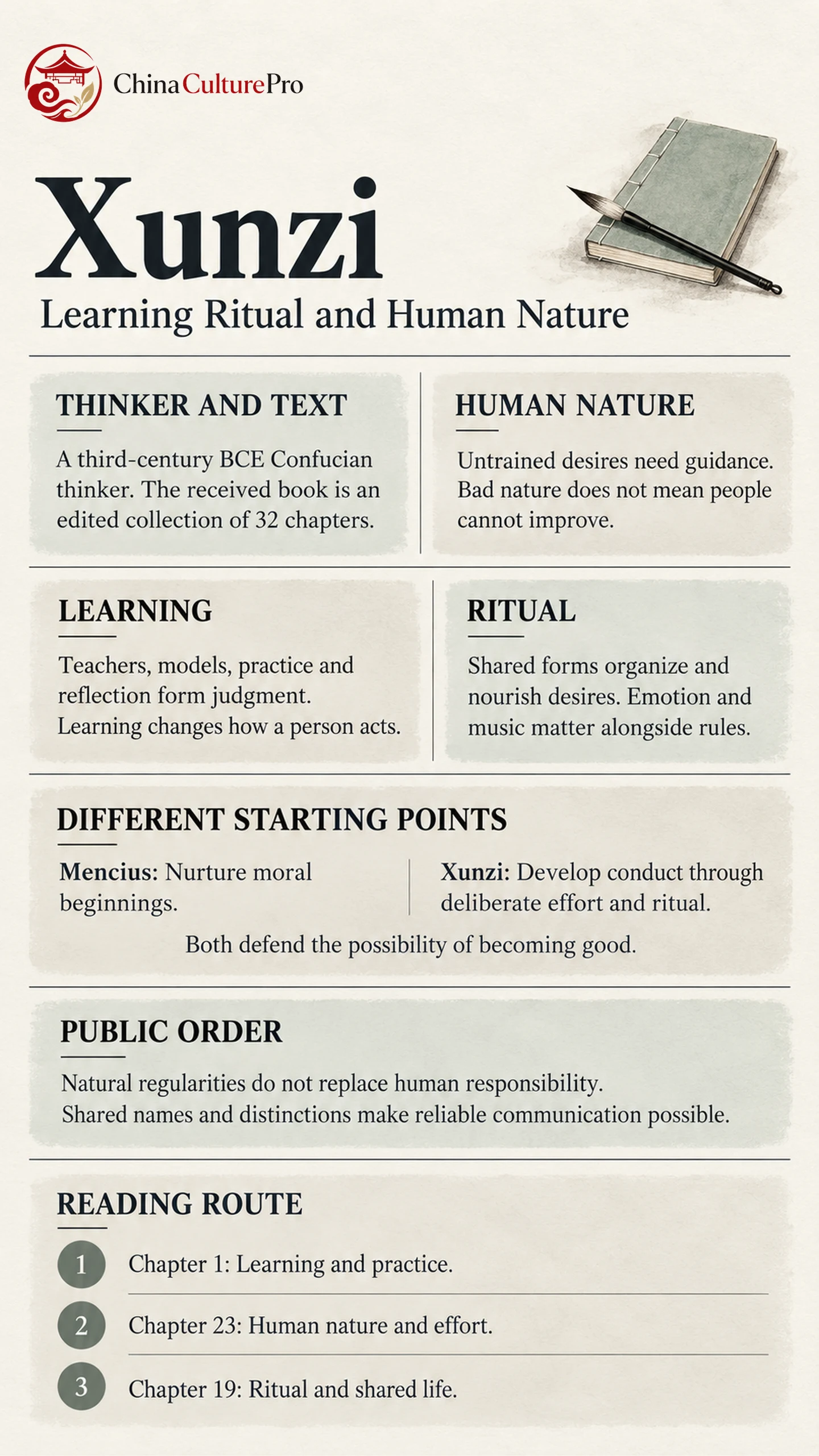
Xunzi (荀子, Xúnzǐ) was a Confucian thinker active in the third century BCE. He argued that good conduct requires learning, teachers, sustained effort and shared ritual forms; people do not become good simply by following their spontaneous desires.[1][3]
- His claim that human nature (性, xìng) is bad concerns untrained dispositions, not an inability to improve.
- Education includes practice and judgment, rather than collecting information alone.
- Ritual gives desires and emotions organized expression within relationships and society.
His philosophy is an account of how goodness can be achieved, not merely a pessimistic verdict about humanity.
The familiar slogan about bad human nature can obscure the question that drives Xunzi’s thought: how can people with competing wants learn to live well together? His answer connects personal formation with institutions, customs and public standards.
Within Chinese philosophy, Xunzi offers a demanding account of cultivation. Understanding its moving parts is more useful than treating him as the thinker who simply disagreed with everyone else’s optimism.
The Thinker and the Book Called Xunzi
Xunzi belonged to the late Warring States intellectual world and the tradition now called Confucianism. His precise birth and death dates remain uncertain; the third century BCE is a sounder introduction than a confidently exact lifespan.[1]
The name also identifies the received collection of writings associated with him. Its thirty-two chapters include sustained arguments, instructional material and other literary forms. The collection was edited after his lifetime, so it should not be approached as a single manuscript arranged by its author exactly as readers encounter it today.[1]
His arguments address education, ritual, political order, language and the natural world. Those concerns connect him with the legacy of Confucius while giving his work a distinct argumentative character.
What Human Nature Is Bad Means
In Xunzi’s account, human nature concerns capacities and desires present from birth rather than acquired through instruction. Hunger, attraction and the wish for advantage do not automatically supply standards for distributing goods or treating others fairly.[3]
The argument is conditional: letting desires run without guidance produces competition and disorder. Calling this starting point bad does not mean every infant consciously chooses cruelty, nor does it mean a person is permanently corrupt.
Deliberate effort (伪, wěi), often translated as conscious activity or artifice, names the acquired work through which people develop ordered conduct. Here the term does not simply mean deception. Teachers, models and repeated practice help produce abilities that spontaneous impulse alone does not provide.[3]
The distinction is between what arises without learning and what human activity achieves. That is why Xunzi can be severe about the starting point while defending the possibility of moral improvement. The broader debate about human nature involves different definitions of what counts as natural, not just rival descriptions of people’s everyday behavior.
Learning Is a Practice of Becoming Different
For Xunzi, learning forms the person who acts. Reading and reflection matter, but a student also needs teachers, worthwhile models and practice in the conduct being learned.[2]
The opening chapter makes its point through images of material being worked and skills becoming possible through appropriate means. Wood can be shaped and metal sharpened; learning likewise depends on processes that do something, rather than on passive exposure to information.[4]
A useful modern illustration is learning to participate in a difficult conversation. Knowing a rule about respectful listening is different from developing the ability to pause, understand an objection and respond appropriately. This is an illustration of the distinction, not an example quoted from Xunzi.
The goal is more than mechanical obedience. A cultivated person can recognize what a situation requires because training has shaped attention, feeling and judgment. The ideal of the exemplary person therefore concerns a way of acting across circumstances, not a score on a knowledge test.
Ritual Organizes Desire and Shared Life
Li (礼, lǐ), ritual propriety, includes patterned conduct in family, social and public life. It is broader than a religious ceremony or an isolated rule about table manners.
Ritual is not only a device for stopping desire. Xunzi’s discussion also describes it as nourishing people: food, sound, visual form and bodily arrangements can meet desires within an organized social world.[5] The issue is how wants are given proportionate expression without turning every encounter into a struggle.
Mourning illustrates the importance of shared form. Grief is personal, yet patterned observance gives it a socially recognizable expression. Music likewise matters because cultivation concerns emotion and coordinated life, not reasoning alone.[2]
This connects ritual with the wider Confucian ethical vocabulary. Xunzi’s account remains historically hierarchical; explaining its social function does not require treating every inherited rank or practice as a model for contemporary life.
Xunzi and Mencius: Different Starting Points
Mencius (孟子, Mèngzǐ) and Xunzi both defend the possibility of becoming good. Their disagreement concerns the starting resources and processes of cultivation, including what each means by human nature.[3][8]
| Question | Mencius | Xunzi |
|---|---|---|
| What receives emphasis at the start? | Moral beginnings or tendencies that can develop | Inborn desires and capacities that need guidance |
| What does cultivation involve? | Nurturing and extending those beginnings | Learning through models, effort and ritual practice |
| Can people improve? | Yes; good development still requires attention | Yes; goodness is an achievement rather than an automatic result |
The comparison does not make one thinker a believer in effortless goodness and the other a believer in hopeless wickedness. Both accounts demand cultivation. The Mencius guide explains the alternative position in its own terms.
Heaven, Government and the Use of Names
Tian (天, tiān), commonly rendered Heaven, has a substantially naturalistic role in Xunzi’s account. Natural regularities do not change to reward a good ruler or punish a bad one; human beings remain responsible for preparation and social organization.[6] This is a useful distinction within Chinese thought about nature.
Government therefore needs more than appeals to favorable signs. Institutions, trained judgment and shared standards belong to the human task of creating order. Xunzi’s interest in orderly life also helps explain why ritual extends beyond private self-improvement.
Rectifying names (正名, zhèngmíng) concerns the proper use of distinctions and words in shared understanding. Language must enable people to identify things and communicate reliably; confused terminology can undermine deliberation and public order.[7] His concern with social harmony thus includes the conditions for meaningful disagreement, not simply the absence of argument.
Where to Begin Reading Xunzi
An introductory Xunzi reading route can start with three chapters whose questions connect closely:
- Chapter 1: Learning. Begin with sustained study, practice and the use of models.
- Chapter 23: Human nature. Read the argument about untrained dispositions and deliberate effort.
- Chapter 19: Ritual. See how shared forms organize desires and social relationships.
Read the chapters together rather than letting one translated slogan decide the meaning of the whole collection. Pay particular attention to whether a passage describes an inborn capacity, an acquired achievement or the social conditions that make an achievement possible.
FAQs About Xunzi
Did Xunzi think people could become good?
Yes. His account depends on improvement through learning and deliberate effort. Bad human nature does not mean that moral achievement is impossible.
Was Xunzi a Legalist?
He belongs to the Confucian tradition. His association with figures later identified with Legalism does not make punishment or coercion the whole basis of his own philosophy.
Does ritual mean religious ceremony only?
No. Ritual propriety also includes patterned conduct, roles and forms of expression within family and social life.
Is the Xunzi one book written at one time?
The received book is an edited collection associated with Xunzi, not a single manuscript whose final arrangement he personally authorized.
Sources
[1] Stanford Encyclopedia of Philosophy. Xunzi
[2] Internet Encyclopedia of Philosophy. Xunzi
[3] Columbia University, Asia for Educators. Selection from the Xunzi: Human Nature is Evil
[4] Chinese Text Project. Xunzi — Encouragement of Learning
[5] Chinese Text Project. Xunzi — Treatise on Ritual Propriety
[6] Chinese Text Project. Xunzi — Discourse on Heaven
[7] Chinese Text Project. Xunzi — Correct Naming
[8] Columbia University, Asia for Educators. Selections from the Mencius: On Human Nature