


Quick Answer: Is Wushu the Same as Kung Fu?
Wushu (武术, wǔshù) is a collective term for Chinese martial arts. Kung fu (功夫, gōngfu) is also used in English for those arts, while the Chinese word has broader meanings involving skill, time and effort. They are overlapping terms, not two unrelated fighting styles.[1][2]
- Traditional wushu includes varied lineages, techniques, weapons and ethical traditions; it is often called kung fu.[4]
- Modern sport wushu includes taolu (套路, tàolù), judged routines, and sanda (散打, sǎndǎ), an unarmed contact discipline.[5][6]
- Forms are not exclusive to modern sport: traditional systems also use routines to preserve their methods.[5]
Ask which meaning is intended before comparing a school, demonstration or competition. The name alone does not tell you what a lesson contains.
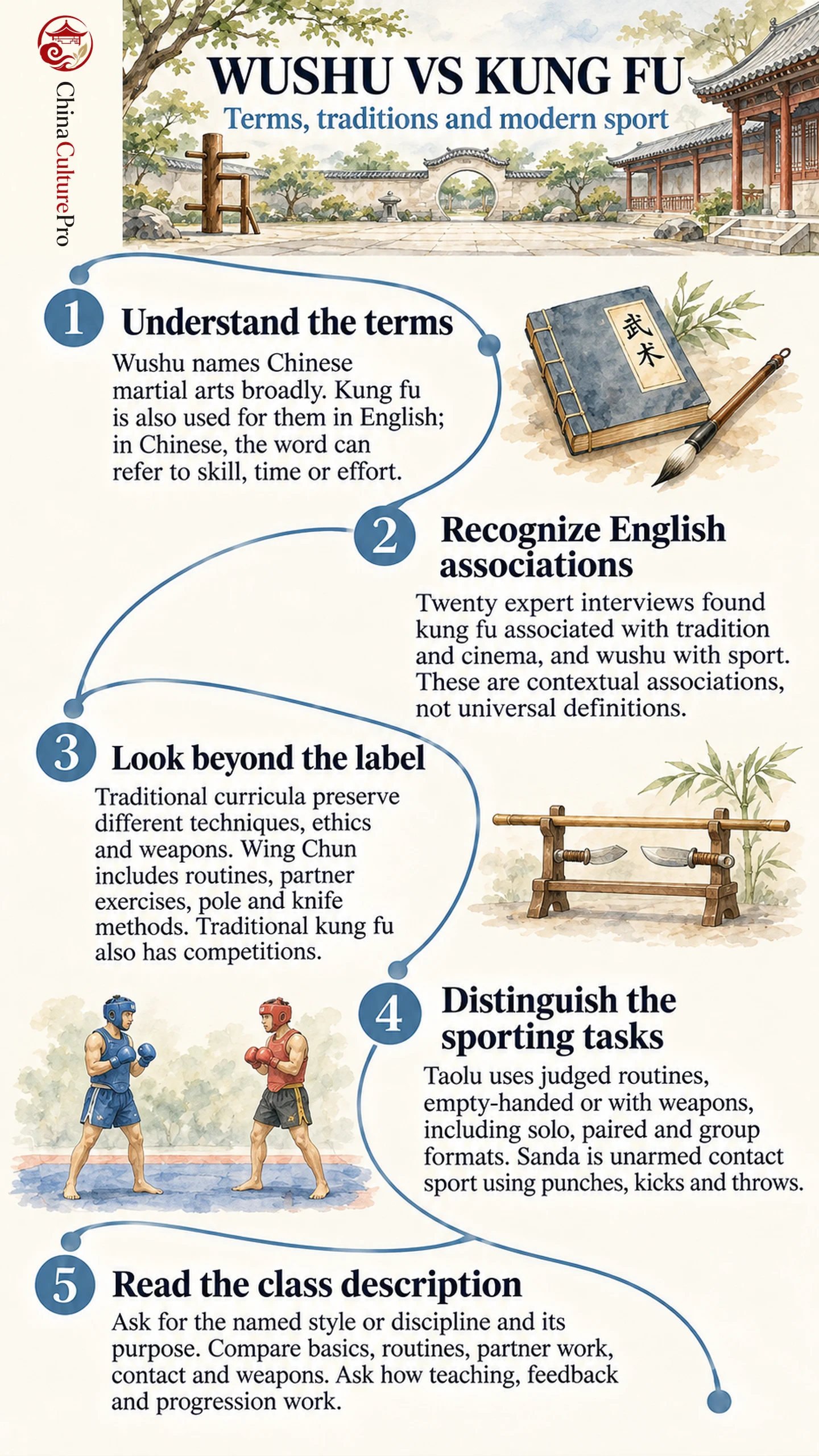
A school advertising kung fu and an event advertising wushu may both be presenting Chinese martial arts. The useful distinction is between vocabulary, a particular tradition and the task being practiced. Separating those three makes a comparison clearer than assigning all fighting to one label and all performance to the other.
What the Main Terms Mean
Use this glossary to identify the category before drawing conclusions about training.
| Terme | Signification | What the label does not establish |
|---|---|---|
| Wushu | A collective term for Chinese martial arts, including traditional practice and modern sporting forms. | It does not identify one style or require that a class prepares for competition.[2] |
| Kung fu | An English name for Chinese martial arts; the Chinese word can also refer to skill, time or effort. | It does not identify a single curriculum, and its Chinese meanings are not exclusively martial.[1] |
| Taolu | Practice of predetermined, connected movement routines, performed empty-handed or with weapons. | It does not mean that every routine is modern or performed alone.[5] |
| Sanda | A modern unarmed combat sport using punching, kicking, throwing and defensive techniques. | It is not another name for all traditional partner training.[6] |
Gongfu is the pinyin spelling corresponding to the familiar English kung fu. In ordinary Chinese, the word can describe proficiency in something such as painting, as well as martial skill. Translating it only as fighting loses that wider use; insisting that it can never mean martial arts also goes too far.[1]
Why English Usage Creates a Contrast
A 2023 qualitative study based on twenty expert interviews found contrasting associations: kung fu evoked inherited styles and martial cinema, while wushu evoked competitive sport. It examined how the arts were represented, not whether every speaker everywhere used the words identically. The contrast is useful context, not a rule that overrides Chinese usage.[3]
Modern sporting organization is part of the explanation. During the twentieth century, wushu became a name for exhibition and full-contact sporting forms developed from older martial practices. Post-1949 sporting development should not be mistaken for the invention of Chinese martial arts themselves. A modern competition routine and a lineage routine can share movement material while having different purposes.[8]
When someone contrasts traditional kung fu with modern wushu, the intended comparison may therefore be reasonable. Clarify that they mean particular training settings, rather than two historically separate arts with mutually exclusive names.
Traditional Practice Is More Than a Label
Traditional systems preserve different combinations of technique, tactics, weapons and ethical expectations through teaching relationships. Their content varies: hand methods may be prominent in one curriculum, leg methods or wrestling in another. The word traditional identifies a relationship to inherited practice; it does not supply a universal lesson plan.[4]
For a concrete example, Wing Chun (咏春拳, yǒngchūnquán) includes hand routines, pole and knife methods, wooden-dummy practice and partner exercises. Its documented emphasis on close distance and center-line relationships is more informative than simply calling it kung fu. The example also shows why traditional training cannot be reduced to either free fighting alone or solo performance alone.[7]
Traditional practice and competition can overlap, too. The first World Traditional Kungfu Championships was held in 2004. The existence of such events makes the claim that kung fu never competes untenable, while participation in an event does not describe everything a lineage teaches.[4]
Modern Sport Includes Taolu and Sanda
In taolu competition, athletes perform routines under rules and judges evaluate their performance. Empty-hand and weapon routines are both represented; routine practice also includes paired and group formats. Examples include changquan (长拳, chángquán), often translated as long fist; nanquan (南拳, nánquán), southern fist; and tai chi (太极拳, tàijíquán). Taolu is a practice format and sporting discipline, not one additional traditional family style.[5]
Sanda asks a different question: how does an athlete perform against an opponent under contact-sport rules? Punches, kicks, throws and defensive skills are central. Judging a routine and contesting a bout are different tasks, even though both belong within sport wushu. Consequently, a spectacular solo routine does not demonstrate every kind of combat training, and sport wushu is not exclusively acrobatics.[6]
Olympic context also needs precision. As of November 2026, wushu is listed as a competition sport on the Dakar 2026 Youth Olympic Games programme. It does not appear on the published Los Angeles 2028 Olympic sports list. A Youth Olympic programme and a particular Summer Olympic programme are separate matters.[9][10]
How to Read a Class Description
First identify the actual curriculum. Wushu can serve cultural, recreational or competitive purposes, so the most informative follow-up is what the teacher asks students to practice.[2]
- Name and purpose: Which style, lineage or sporting discipline is taught? Is the emphasis inherited practice, judged routines, contact competition or another stated goal?
- Lesson content: How much time goes to basics, solo routines, partner exercises, contact practice and weapons? Ask what beginners actually do.
- Progression: How are students corrected and assessed, and how does later training build on the introductory material?
These questions also help when comparing Chinese arts with other traditions, including kung fu and karate. For a map of individual systems, continue with Chinese martial arts styles.
FAQs About Wushu vs Kung Fu
Is wushu only acrobatics?
No. Sport wushu includes sanda, which involves contact with an opponent. Taolu also covers varied routines, so an aerial movement seen in one event should not stand for the whole field.[2][6]
Does traditional kung fu have forms and competitions?
Yes. Traditional methods can be preserved in routines, and traditional kung fu also has organized competitions. Those are parts of practice, not a complete description of every school.[4][5]
Is kung fu the same word as gongfu?
Yes. Kung fu is the established English spelling; gongfu is the pinyin spelling. Context determines whether the Chinese word refers to martial arts, proficiency or another sense.[1]
Does either label guarantee self-defense training?
No. Ask about partner practice, contact and applications. A label on its own does not establish which skills are taught or how students practice using them.
Sources
[1] Ministry of Education, Taiwan. Revised Mandarin Chinese Dictionary: Gongfu
[2] United States of America Wushu Kungfu Federation. What Is Wushu?
[3] Han, Theeboom, Zhu and Derom. Promoting the Chinese Martial Arts Internationally: Is It Kung Fu or Wushu?
[4] International Wushu Federation. Traditional Wushu
[5] International Wushu Federation. Taolu
[6] International Wushu Federation. Sanda
[7] China Intangible Cultural Heritage Digital Museum. Foshan Wing Chun
[8] Guangxi Wang. Chinese Kung Fu, Third Edition: Publisher Excerpt
[9] International Olympic Committee. Dakar 2026 Sports Programme
[10] LA28. 2028 Olympic Games Plan