

Quick Answer: What Did Wang Yangming Teach?
Wang Yangming (王阳明, Wáng Yángmíng; 1472–1529) taught that moral understanding must become part of how a person actually responds and acts.[1][4]
- Heart-mind (心, xīn) includes thinking, feeling and moral responsiveness.
- Liangzhi (良知, liángzhī) is an innate capacity for recognizing moral right and wrong.
- Unity of knowing and acting (知行合一, zhī xíng hé yī) connects genuine moral understanding with conduct.
- Self-cultivation addresses selfish motives through reflection and engagement with actual affairs.
These are claims within a Confucian ethical philosophy, rather than evidence that intuition supplies every factual answer.[2][5]
Why can someone explain a moral duty yet repeatedly avoid fulfilling it? Wang Yangming made that gap a central philosophical problem. His answer connects the source of ethical judgment with the work of becoming a better person. Within Chinese philosophy, he offers an influential account of learning as a transformation of the learner’s conduct.
A Ming Official Concerned with Moral Learning
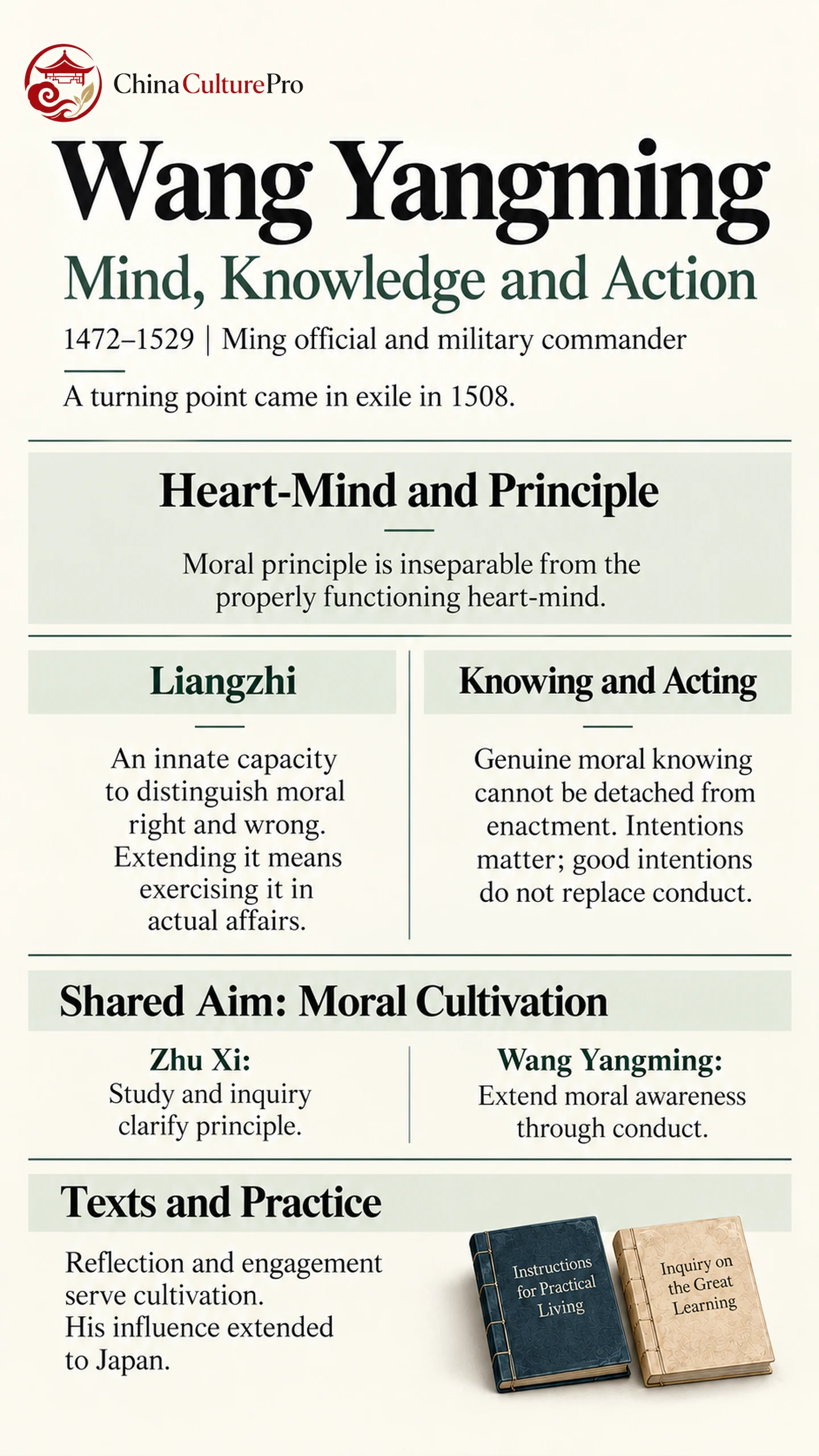
Wang was born Wang Shouren (王守仁, Wáng Shǒurén) and served the Ming state as an official and military commander. His period of exile in Guizhou brought a philosophical turning point in 1508. The mature teaching developed through conversations, letters and public responsibilities, rather than through a single systematic philosophical treatise.[1]
He belongs to Neo-Confucianism, the evolving tradition that reinterpreted earlier Confucian texts while debating Buddhist and Daoist ideas. His teaching asks how moral learning can shape relations with parents, neighbors and the wider world. Treating him simply as a motivational writer removes this ethical setting.
Heart-Mind and Principle
Principle (理, lǐ) refers here to the normative pattern of things and relationships. Wang’s formula “heart-mind is principle” (心即理, xīn jí lǐ) means that moral principle is inseparable from the properly functioning heart-mind. It challenges the idea that the moral source of one’s response must first be found in an external object.[2][3]
His example of a child approaching a well makes the point concrete. The child’s danger occasions a compassionate response, but the capacity for that response belongs to the person who recognizes the danger. The practical question of how to help remains connected to the situation; moral concern does not arrive as a detached fact stored in the child.[3]
This is a claim about the relation between moral awareness and the world. Translating it as “my private opinion makes everything right” misses the distinction between a heart-mind expressing its moral capacity and one distorted by selfishness.
Liangzhi: Innate Moral Knowing
Liangzhi is the innate capacity to distinguish moral right and wrong. Wang develops this idea from Mencius, whose account of human goodness treats moral responsiveness as something people can cultivate. Innate knowing is not an inventory of information: possessing it does not mean already knowing a language, a medical diagnosis or the details of an unfamiliar dispute.[2][6]
Extending innate knowing (致良知, zhì liángzhī) means bringing this capacity fully to bear in one’s affairs. Self-serving explanations, greed and fear can obscure its expression. The learner’s work is therefore to examine motives honestly and respond appropriately, rather than merely announce confidence in an inner voice.[5][6]
Wang’s account supplies one important position in the broader debate about human nature in Chinese philosophy. Its optimism concerns the possibility of moral cultivation. It does not describe everyone as consistently virtuous already.
Why Knowing and Acting Belong Together
Genuine moral knowing and its enactment cannot be separated into independent tasks. In a dialogue recorded by his student Xu Ai, Wang challenges the claim that a person truly understands filial responsibility while consistently failing to treat parents accordingly. Being able to repeat the right words is a weaker achievement than the knowing his doctrine concerns.[4]
Consider an illustrative case: someone recognizes that a colleague deserves credit but conceals the colleague’s contribution to gain praise. Wang’s question reaches beyond whether the person can define fairness. It asks whether moral awareness is fully present in the response itself.
“Action” also reaches into the formation of intentions. A selfish intention already matters morally before it becomes a visible deed. Yet having a good intention is not a substitute for carrying it through when the situation calls for conduct. The doctrine ties intention, awareness and response together.[6]
Scholars disagree about the exact kind of unity Wang proposes, including whether knowing and acting should be described as literally identical. For a first reading, the essential contrast is between a divided program of learning now and acting someday, and cultivation in which understanding and conduct develop together.[7]
How Wang Yangming Differs from Zhu Xi
Zhu Xi (朱熹, Zhū Xī) and Wang share a concern with moral cultivation and the Confucian classics. Their disagreement concerns the learner’s route to realizing that aim, not a simple choice between books and experience.
| Question | Zhu Xi’s emphasis | Wang Yangming’s emphasis |
|---|---|---|
| Where does learning begin? | Sustained study and inquiry clarify principle | Recover and extend the heart-mind’s moral awareness |
| How do knowledge and action relate? | They support each other, while remaining distinguishable | Genuine moral knowing cannot be detached from enactment |
| What failure needs correction? | Confused understanding and insufficient cultivation | Detached explanation and selfish obstruction |
Wang criticized a separation that allowed learners to postpone conduct indefinitely. That criticism should not erase Zhu Xi’s own insistence that understanding and action support each other.[1][7]
Texts, Practice and Later Influence
Two useful starting texts are Instructions for Practical Living (传习录, Chuánxí lù), a collection of conversations and letters, and Inquiry on the Great Learning (大学问, Dàxué wèn). The former exposes questions and objections; the latter connects cultivated humanity with concern extending beyond oneself to other people and beings.[5]
Quiet sitting appears in Wang’s teaching, but he also warns against attachment to tranquility that produces aversion to ordinary activity. Actual affairs provide occasions for examining and exercising moral responsiveness. Solitude and engagement should therefore be understood through the work they do in cultivation.[5]
His influence extended beyond China, notably to Japan. Later readers also questioned whether appeals to innate moral awareness could excuse subjective certainty. This enduring tension—confidence in moral capacity alongside the danger of self-deception—makes his place in Confucian thought worth studying critically.[1][2]
FAQs About Wang Yangming
Is Wang Yangming the same person as Wang Shouren?
Yes. Wang Shouren was his personal name; Wang Yangming is the name by which the philosopher is commonly known.
Does innate knowing mean that study is unnecessary?
It means moral capacity is not manufactured by accumulating information. Reading, questioning and learning about circumstances can still belong to cultivation; knowing facts alone does not make a person virtuous.
Is knowledge and action unity just learning by doing?
It includes learning through engagement, but makes a stronger ethical claim: genuine moral knowing cannot be treated as complete while its enactment is indefinitely postponed.
Was Wang Yangming a Buddhist?
He was a Confucian thinker. His work engages ideas and practices also discussed in Buddhism and Daoism, while directing cultivation toward Confucian moral relationships and responsibilities.
Sources
[1] Stanford Encyclopedia of Philosophy. Wang Yangming
[2] Internet Encyclopedia of Philosophy. Wang Yangming
[3] Columbia University, Asia for Educators. The Identification of Mind and Principle
[4] Columbia University, Asia for Educators. Wang Yangming on the Unity of Knowing and Acting
[5] Wing-tsit Chan, translated selections hosted by University of Washington. Dynamic Idealism in Wang Yang-ming
[6] Journal of Confucian Philosophy and Culture. Wang Yangming’s Doctrine of the Unity of Knowing and Acting in the Light of Kant’s Practical Philosophy
[7] Harvey Lederman. What Is the Unity in the Unity of Knowledge and Action?