


Quick Answer: How Do Wade-Giles and Pinyin Differ?
Wade-Giles(威妥玛拼音,Wēituǒmǎ pīnyīn)and Hanyu Pinyin(汉语拼音,Hànyǔ Pīnyīn)are systems for representing Mandarin pronunciation with Latin letters. Wade-Giles is associated with Thomas Wade and Herbert Giles; Pinyin became the more widely used modern standard.[1]
- Letters: The systems can spell the same syllable differently.
- Marks: Wade-Giles uses an aspiration mark; Pinyin uses different conventions.
- Names: Older books may preserve forms unlike those used in a modern index.
A different Latin spelling does not automatically mean a different Chinese name or language. Nor does every old English spelling belong to systematic Wade-Giles.
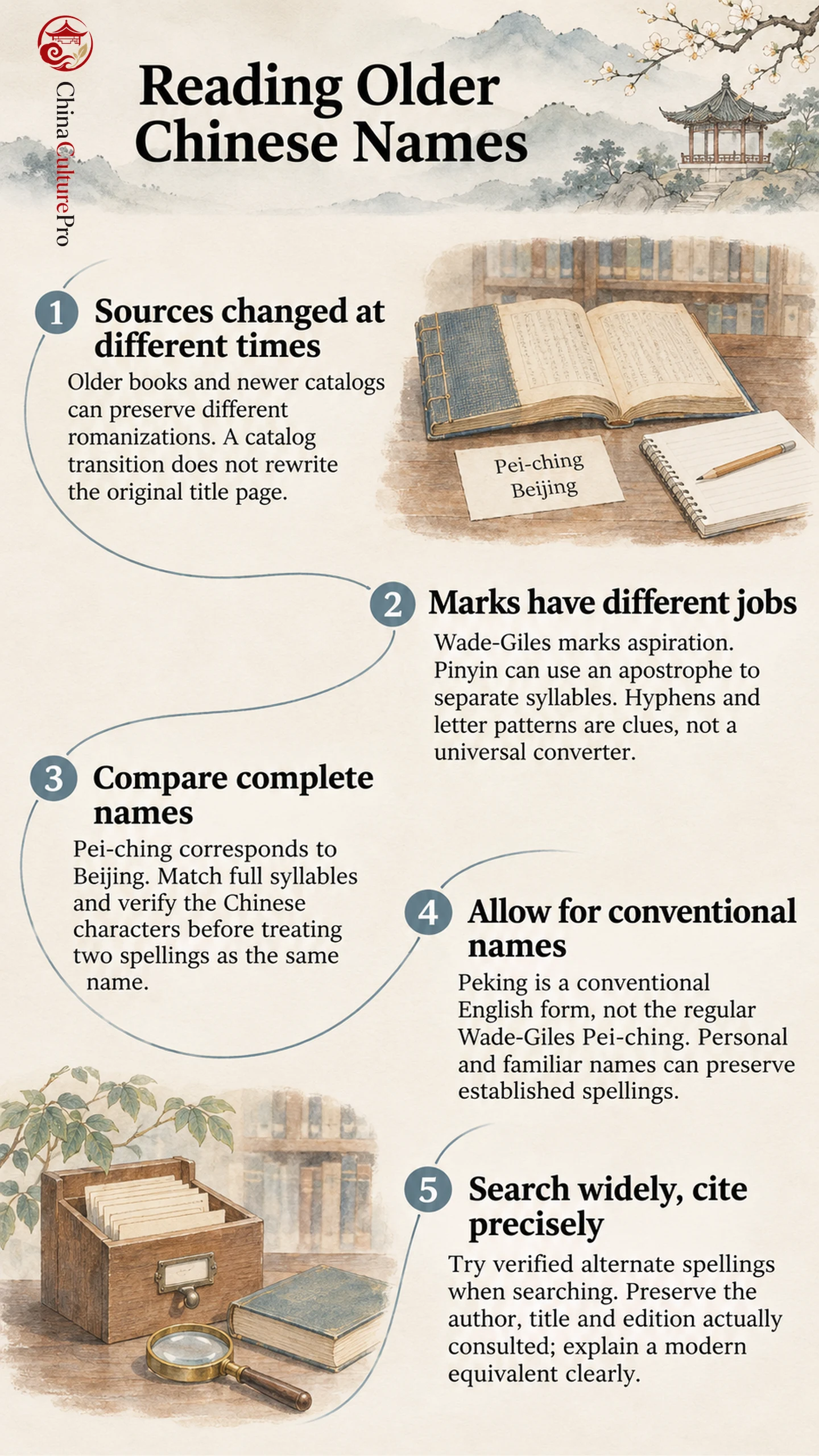
An older index can send a reader searching for a name that seems absent from a newer book. Often the name is still there under another romanization. Knowing a few spelling clues helps connect references, but the original Chinese characters, the source’s conventions and the identity of the person or place remain the strongest checks.
Why Older Sources Use Different Spellings
Wade-Giles was widely used in English-language reference work, while Pinyin now appears in many modern learning materials and catalogs. The change happened through institutions and publishing practices, rather than every writer switching on the same day.
The Library of Congress, for example, discontinued Wade-Giles in favor of Pinyin for name and subject headings in October 2000. Its policy records a later 2012 decision concerning Pinyin for Taiwan geographic headings.[2] These are specific cataloging milestones, not dates when everyone changed a personal name or a published book.
An author’s older spelling can consequently remain on a title page even when a catalog supplies a newer access point. A person may also continue to use an established spelling. Recognizing both forms is more useful for reading sources than assuming one era had a single uniform English naming system.
Apostrophes, Letters and Hyphens
The Wade-Giles aspiration mark indicates a stronger puff of air. Thus p and p’ distinguish sounds; dropping the mark can hide that distinction.[3]
Pinyin’s apostrophe has another job: it can clarify a boundary between joined syllables. Xi’an(西安,Xī’ān)is a familiar example. That mark is not the Wade-Giles aspiration sign and does not identify a tone.[4]
Wade-Giles hs often corresponds to Pinyin x; its hyphens can separate syllables joined in modern name forms.[3] Treat these as recognition clues. A complete syllable correspondence is safer than a global instruction to replace one letter wherever it occurs.
Tone notation is another layer. Library Pinyin can omit tone marks that a language-learning text would include.[4] Missing tone information does not mean Mandarin itself lacks tones. For the modern pronunciation system, the Pinyin guide explains that separate task.
Examples of Regular Correspondences
These documented name correspondences show untoned comparison forms; the first column also gives toned Pinyin for learning.[3]
| Nom | Wade-Giles form | Pinyin form |
|---|---|---|
| Beijing(北京,Běijīng) | Pei-ching | Pékin |
| Shanghai(上海,Shànghǎi) | Shang-hai | Shanghai |
| Guangzhou(广州,Guǎngzhōu) | Kuang-chou | Guangzhou |
| Chongqing(重庆,Chóngqìng) | Ch’ung-ch’ing | Chongqing |
The first and last examples show letter differences; the second makes the spacing change especially clear. An unfamiliar combination of letters can therefore point to a familiar place.
The Chinese-name column also serves another purpose: it anchors the comparison to an identifiable written name. Similar Latin spellings can represent different characters, and a character may have more than one reading. Use Chinese characters or a reliable authority entry to check identity before applying a conversion.
Conventional Names and Personal Preferences
Peking is a familiar conventional English name, but the systematic Wade-Giles form in the table is Pei-ching. Calling every older name “Wade-Giles” hides this distinction. The Library of Congress treated conventional Chinese place names separately because many were not systematically romanized in Wade-Giles and could not be converted simply by manipulating their letters.[5]
The practical result is that a correspondence chart cannot explain every name on an old map, menu or title page. Some forms preserve established usage or reflect a different pronunciation tradition. They require an identified name, not a guessed replacement rule.
Personal names need the same care. Current official descriptions acknowledge continuing Wade-Giles-related usage in some names and communities.[1] A person’s preferred published spelling is part of their identity; a modern explanatory Pinyin form can help readers without silently replacing that spelling in a quotation or bibliographic reference.
Searching and Citing Older Sources
Search both the older form and a verified Pinyin equivalent when tracing a reference. Hyphenated, separated and joined forms can also be useful variants. Check results against dates, Chinese characters and biographical or geographic details rather than accepting a similar-looking match.
The Library of Congress conversion project retained older personal and geographic forms as references in relevant authority records.[6] That is evidence of an access problem being managed, not proof that every search system contains every variant.
When citing a book, preserve the author and title information appropriate to the edition actually consulted. If a modern form helps identify the subject, add it clearly as an explanation. Avoid silently rewriting an old title, merging two people with similar romanized names or treating a converted spelling as evidence that a place was officially renamed.
Other systems serve other spoken varieties. Jyutping records Cantonese pronunciation; it is not another Wade-Giles-to-Pinyin conversion route. Identifying the language and notation comes before comparing the letters.
FAQs About Wade-Giles and Pinyin
Is Peking Wade-Giles for Beijing?
Peking is a conventional English form. The regular Wade-Giles form corresponding to Beijing is Pei-ching.
Do the apostrophes matter?
Yes. The Wade-Giles aspiration mark distinguishes sounds; Pinyin’s syllable-boundary apostrophe has a different purpose.
Do different spellings mean a place changed its name?
Not necessarily. Two romanizations can represent the same Chinese name. Actual historical renamings also occur, so check the characters and date.
Should personal names always be changed to Pinyin?
No. Preserve a person’s established spelling and the source’s bibliographic identity. Add a verified equivalent when it helps identification.
Sources
[1] Bureau of Consular Affairs, Taiwan. Introduction to Four Romanization Systems, 2026
[2] Library of Congress. Subject Headings Manual H 690: Geographic Headings
[3] Library of Congress. Differences Between Wade-Giles and Pinyin
[4] Philip Melzer, Library of Congress. Introduction to Chinese Romanization Guidelines
[5] Library of Congress. Chinese Conventional Place Names
[6] Library of Congress. An Outline of Pinyin Conversion