
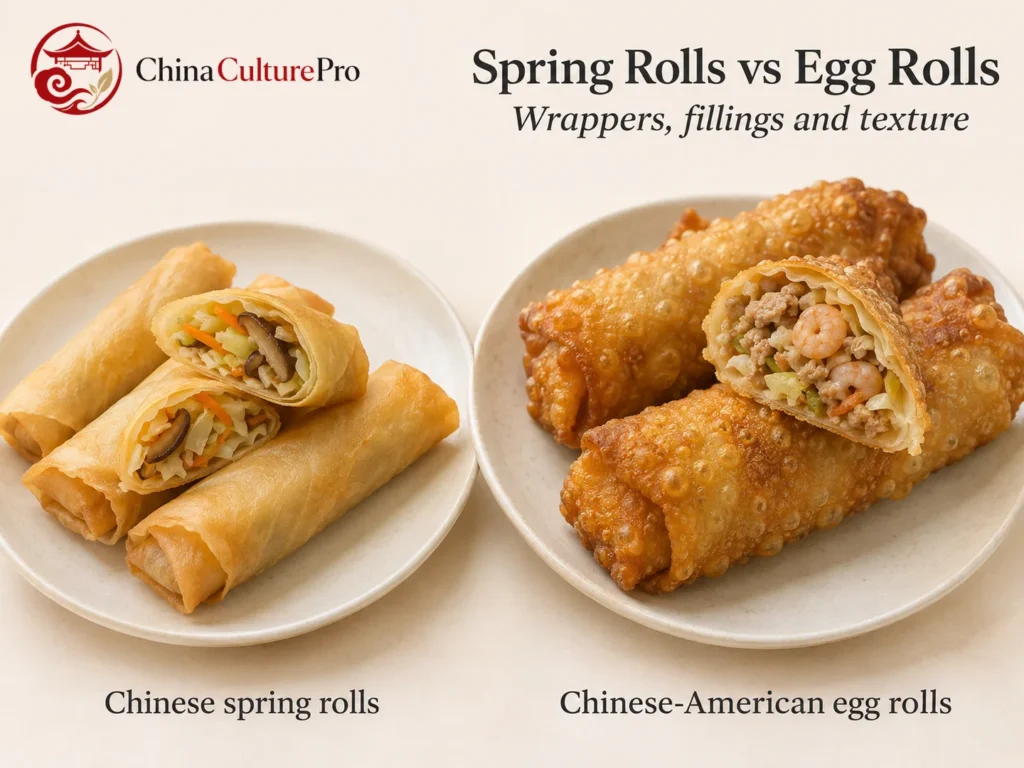

Quick Answer: What Is the Main Difference?
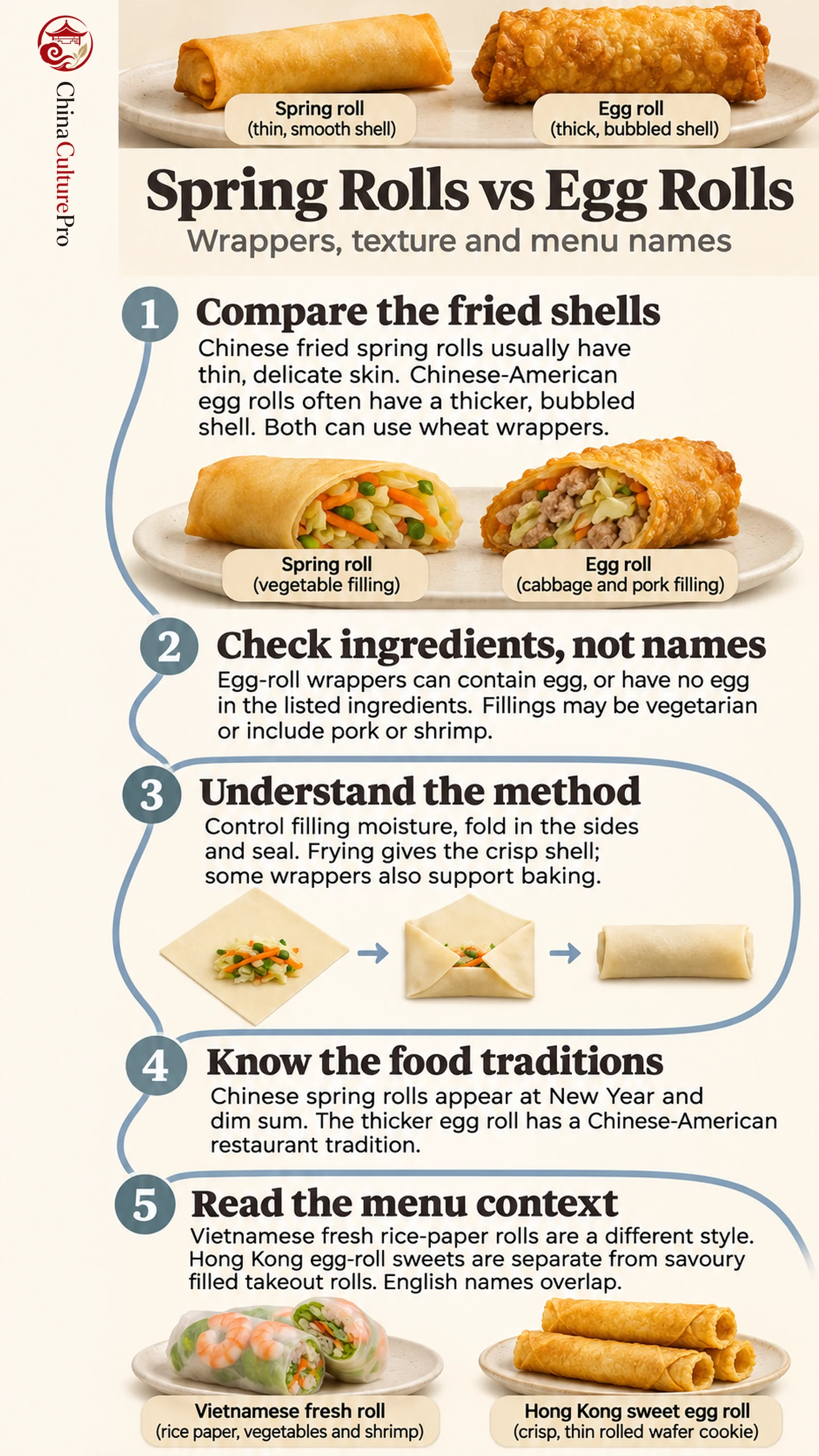
For the fried Chinese and Chinese-American rolls compared here, start with the wrapper. Chinese spring rolls, Chun Juan (春卷, chūn juǎn), usually have a thinner, more delicate shell; Chinese-American egg rolls often have a thicker, bubbled shell.[1][2]
- Both can use wheat-based wrappers.
- Fillings overlap, including vegetables, pork or shrimp.
- “Egg roll” does not guarantee that the wrapper contains egg.[1][2][3][4][5]
English menu names overlap, so these are useful patterns rather than universal naming rules.[1]
Compare the Two Fried Rolls
The contrast below focuses on thin-skinned Chinese fried spring rolls and the thicker Chinese-American takeout style:[1][2]
| Caractéristique | Chinese fried spring roll | Chinese-American egg roll |
|---|---|---|
| Enveloppe | Thin pastry skin | Usually thicker wheat wrapper |
| Fried surface | Delicate and crisp | Bubbled, crunchy and more substantial |
| Filling examples | Vegetables, mushrooms or pork | Cabbage, roast pork and sometimes shrimp |
| Texture | A light shell around the filling | A thicker shell with more chew |
| Familiar setting | Chinese snacks and dim sum | Chinese-American restaurant takeout |
Fillings and names vary between kitchens.[1][2][5]
Ingredients: Why the Name Does Not Guarantee Egg
Manufacturer ingredient lists provide a concrete counterexample to an easy assumption: one egg-roll wrapper lists egg as an ingredient or allergen, while another lists wheat flour, water, vinegar, starch, salt and wheat gluten, with no egg in the listed ingredients.[3][4]
Check the actual package or ask the kitchen. The word “egg” in the dish name is an unreliable way to identify its ingredients.
Fillings also cross the naming boundary. One Cantonese thin-skinned recipe combines cabbage, mushrooms, vermicelli and other vegetables. Another Chinese spring-roll recipe uses pork, carrot and napa cabbage. A takeout-style egg roll can combine vegetables with roast pork and shrimp.[1][2][5]
How Filling, Folding and Frying Shape the Texture
Wrapper choice explains much of the shell, but moisture control matters too. A restaurant-style recipe blanches its vegetables and squeezes them thoroughly; excess water can make the finished rolls soggy.[2]
The basic folding pattern is shared: put filling near the lower part of a diamond-oriented wrapper, fold the bottom over it, bring in the sides, then roll upward and seal the last corner. This explains the shape, not one universal cooking temperature or filling formula.[3]
Thin-skinned Cantonese rolls are deep-fried for a crisp finish. Thicker takeout rolls also develop their characteristic bubbles during frying. Some packaged wrappers additionally support baking, so “always fried” is too absolute across all home versions.[1][2][3]
Chinese Traditions and Chinese-American Adaptations
Chinese spring rolls appear among Nouvel An chinois foods and as part of dim sum. A cook’s account also describes preparing them with an older generation, connecting the rolls with shared food-making.[5]
The thicker egg roll has its own Chinese-American restaurant context. A family’s takeout recipe records making large batches with cabbage, roast pork and shrimp.[2]
When the Names Mean Something Else
In Vietnamese restaurant English, “spring rolls” may mean fresh rice-paper rolls. Those are a different comparison from the two fried wheat-wrapper styles above.[1]
In Hong Kong snack shops, “egg rolls” can also mean crisp, buttery rolled sweets made with flour and eggs. These are separate from savoury filled takeout rolls.[6]
FAQs About Spring Rolls and Egg Rolls
Are all spring rolls vegetarian?
No. Pork and vegetable spring rolls exist alongside vegetarian versions.[5]
Do all egg roll wrappers contain egg?
No. Actual commercial formulas include both egg-containing and egg-absent ingredient lists. Check the product you use.[3][4]
Are Vietnamese fresh rolls the same as Chinese fried spring rolls?
No. The fresh rice-paper version has a different wrapper and serving method from the thin fried Chinese pastry roll.[1]
Can egg rolls be baked?
Some commercial wrappers are intended for baking as well as frying. Use the instructions for the chosen wrapper and filling.[3]
Sources
[1] Made With Lau. Egg Rolls: Cantonese Thin-Skinned Spring Rolls
[2] Bill. Chinese Takeout Egg Rolls
[3] Nasoya. Egg Roll Wraps: Ingredients and Preparation
[4] Twin Marquis. Egg Roll Wrapper: Product and Allergen Information
[5] Elaine. Chinese Spring Rolls
[6] Kee Wah. Hong Kong Eggrolls: Product Description