


Quick Answer: What Is the Siku Quanshu?
The Siku Quanshu (四库全书, Sìkù Quánshū), or Complete Library of the Four Treasuries, is an eighteenth-century imperial collection of selected books commissioned under Qianlong (乾隆, Qiánlóng) in the Qing (清, Qīng) dynasty. It is a congshu (丛书, cóngshū), a collection of separate works.[1][4]
- Four branches: Classics, History, Masters and Collections organize its contents.
- Scale: It contains more than 3,400 works, rather than one continuous authored text.
- Research route: Identify a work, check its catalogue status, then locate the particular edition and passage.
“Complete” is part of its title and ambition. It does not mean that every Chinese book was included, or that every work mentioned in its catalogue was copied into the collection.
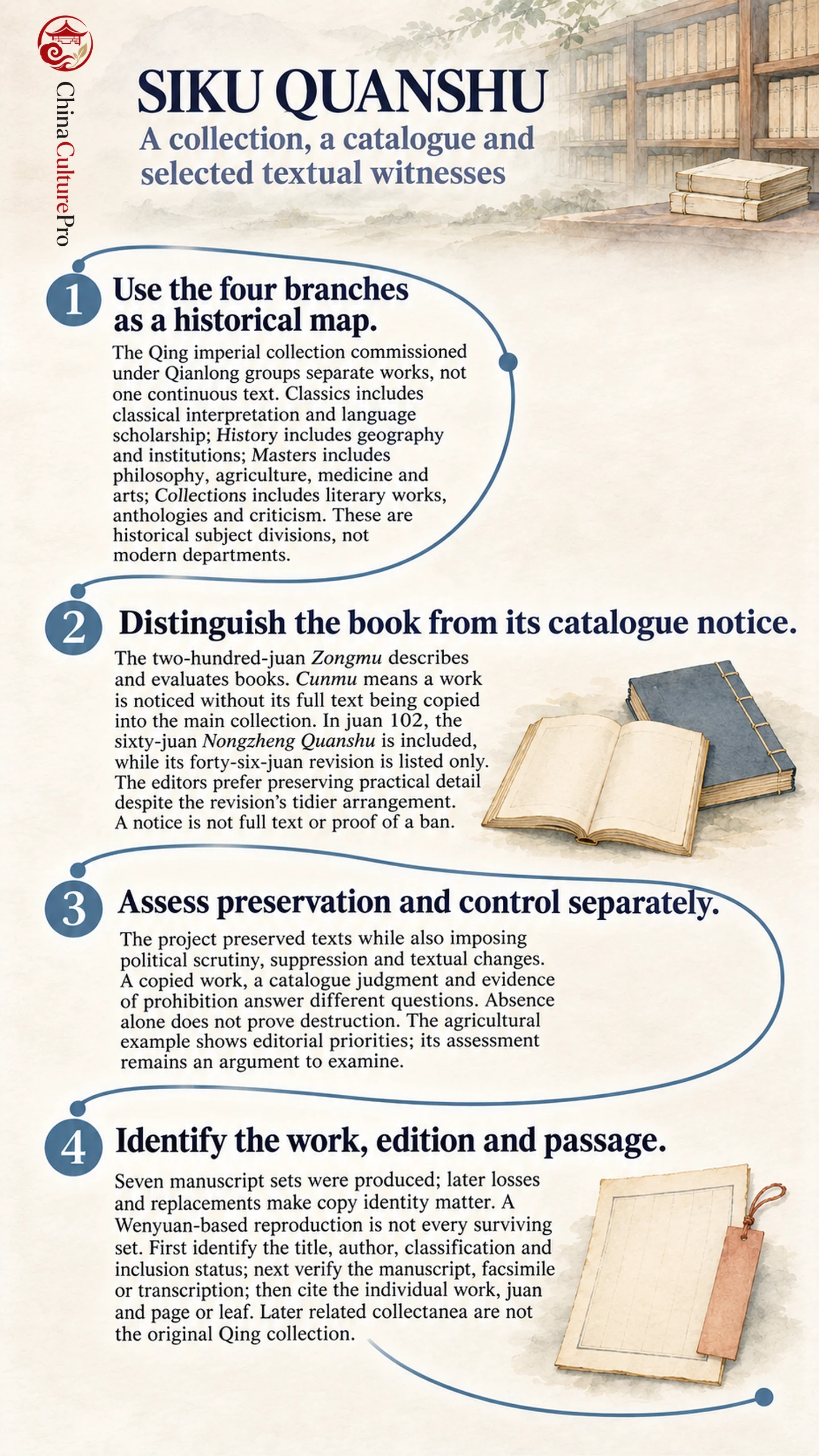
A reference to the Siku Quanshu may point to a copied book, a catalogue description or a modern reproduction. These are different reading objects. Understanding their relationship makes it easier to locate a passage and assess the edition behind a citation.
A Library Organized into Four Branches
The four branches subdivide into more specific subject classes. Their boundaries reflect a historical organization of learning, not the departments of a modern university. The catalogue’s classification headings make that arrangement visible.[2]
| Branche | Examples of its coverage |
|---|---|
| Classics: jing (经, jīng) | Classical texts and their interpretation, including ritual studies and lexicographical scholarship. |
| History: shi (史, shǐ) | Historical works, biographies, geography, institutions and bibliography. |
| Masters: zi (子, zǐ) | Philosophical writings alongside subjects such as agriculture, medicine, astronomy and the arts. |
| Collections: ji (集, jí) | Collected literary works, anthologies, poetry and prose criticism, and song-related writing. |
“Masters” therefore does not mean philosophy alone, while “Classics” includes scholarship on language and written texts. When locating a work such as the Shuowen Jiezi (说文解字, Shuōwén Jiězì), begin with the historical classification rather than assume that dictionaries belong in a modern reference-book section.
The Yongle Encyclopedia (永乐大典, Yǒnglè Dàdiǎn) represents a different format: a leishu (类书, lèishū), an encyclopedic compilation arranged through excerpts and topics. Siku editors could recover texts from an encyclopedia without making their own collection one.[1]
The Collection, Its Catalogue and Books Listed Only
The Siku Quanshu Zongmu (四库全书总目, Sìkù Quánshū Zǒngmù), associated with Ji Yun (纪昀, Jǐ Yún) and other editors, is the classified general catalogue. Its two hundred juan (卷, juàn) describe books, discuss authorship and editions, and offer editorial judgments. They are not the texts of all the books they describe.[2]
An important category is cunmu (存目, cúnmù): a work is noticed in the catalogue without its full text being copied into the main collection. This is a statement about inclusion, not automatically a prohibition.[3]
| Reading object | What it gives you |
|---|---|
| The collection | The selected works copied into the imperial library. |
| The general catalogue | Bibliographical descriptions and assessments, including works not copied. |
| A cunmu entry | A catalogue notice for a work omitted from the main copied collection. |
Juan 102 supplies a concrete example. Under agriculture it records the sixty-juan Nongzheng Quanshu (农政全书, Nóngzhèng Quánshū), attributed to Xu Guangqi (徐光启, Xú Guāngqǐ), among the included works. A forty-six-juan Bieben Nongzheng Quanshu (别本农政全书, Biéběn Nóngzhèng Quánshū), associated with Chen Zilong’s (陈子龙, Chén Zǐlóng) revision, appears among the cunmu notices.[3]
The editors acknowledge the revision’s tidier arrangement but argue that practical agricultural detail need not be rejected merely for being extensive. They retain the fuller work and list the other version only. Thus a catalogue judgment records a selection between versions; it does not prove that the shorter text was forbidden or that both texts appear in full.
Preservation, Selection and Censorship
Collection and preservation were substantial parts of the project: books were gathered, compared, copied and sometimes reconstructed from material preserved elsewhere. At the same time, the undertaking involved political scrutiny, suppression and changes to texts. Preservation and control belonged to the same imperial enterprise.[1]
These processes leave different kinds of evidence. A copied work shows what a particular set transmits. A catalogue notice shows how editors described and evaluated a work. Evidence of prohibition or alteration requires its own documentation. The mere absence of a title does not establish that its text was destroyed.
The agricultural example also shows how classification and evaluation express priorities. The preference for retaining practical detail tells readers something about the compilers’ standards. Such judgments are historical arguments to examine, not neutral summaries that settle every question about an earlier book.
How to Find and Cite a Work in the Siku Quanshu
Seven manuscript sets were produced for different libraries. Later losses, repairs and replacements make the identity of the copy relevant. A label such as Wenyuan Pavilion (文渊阁, Wényuān Gé) identifies a textual witness or a reproduction based on it; it is not another title for every surviving set.[1][4][5]
- Identify the work: Record its title, attributed author, subject class and catalogue status.
- Verify the edition: Establish which manuscript set, facsimile or digital transcription you are using, including any later commentary or replacement material.
- Cite the passage: Give the individual work’s title, juan and page or leaf, together with enough edition information for another reader to find it.
The National Diet Library’s research guide distinguishes the original collection, reproductions and later related collectanea, and points to title and author indexes. A later series containing cunmu or excluded works is valuable, but it is not evidence that those texts were in the eighteenth-century copied collection.[4]
FAQs About the Siku Quanshu
Is the Siku Quanshu the same as its Zongmu catalogue?
No. The Siku Quanshu is a collection of books; the Zongmu is its classified general catalogue and commentary on books. A notice is not the full text of the work described.
Were all books outside the collection banned?
No. Cunmu notices include works omitted for bibliographical or editorial reasons. Establish prohibition from relevant evidence rather than infer it from noninclusion alone.
Do all copies and reproductions contain exactly the same text?
Do not assume so. Identify the manuscript set and later edition or transcription used. A collection title alone is insufficient to establish that two cited passages have identical wording.
Sources
[1] Tong Zhenglun, National Library of China / Ancient Books Preservation. The Siku Quanshu and the Wenlan Pavilion copy
[2] Public-domain Chinese catalogue. Siku Quanshu Zongmu: classification headings
[3] Public-domain Chinese catalogue. Siku Quanshu Zongmu, juan 102: agriculture and cunmu
[4] National Diet Library, Research Navi. How to research the Siku Quanshu and related collectanea
[5] Jao Tsung-I Academy of Sinology, Hong Kong Baptist University. Yingyin Wenyuange Siku Quanshu: manuscript sets and a reproduction