

Quick Answer: What Are Saozi Noodles?
Saozi mian(臊子面,sàozi miàn)is a Shaanxi noodle preparation particularly associated with Qishan in Baoji. Its familiar Qishan form combines thin wheat noodles, a vinegar-and-chili-flavored soup and small pieces of meat and vegetables.[1]
- The meat: Saozi(臊子,sàozi)in the Qishan pork preparation means cooked meat pieces, commonly diced rather than machine-ground.[2]
- The bowl: Fine noodles sit in a generous quantity of seasoned soup.
- The variation: Vegetable combinations, seasoning and local serving customs differ.
“Minced pork noodles” is therefore an incomplete English description of the Qishan dish. The meat, soup and strands each contribute something distinct, and one version cannot define every regional bowl.

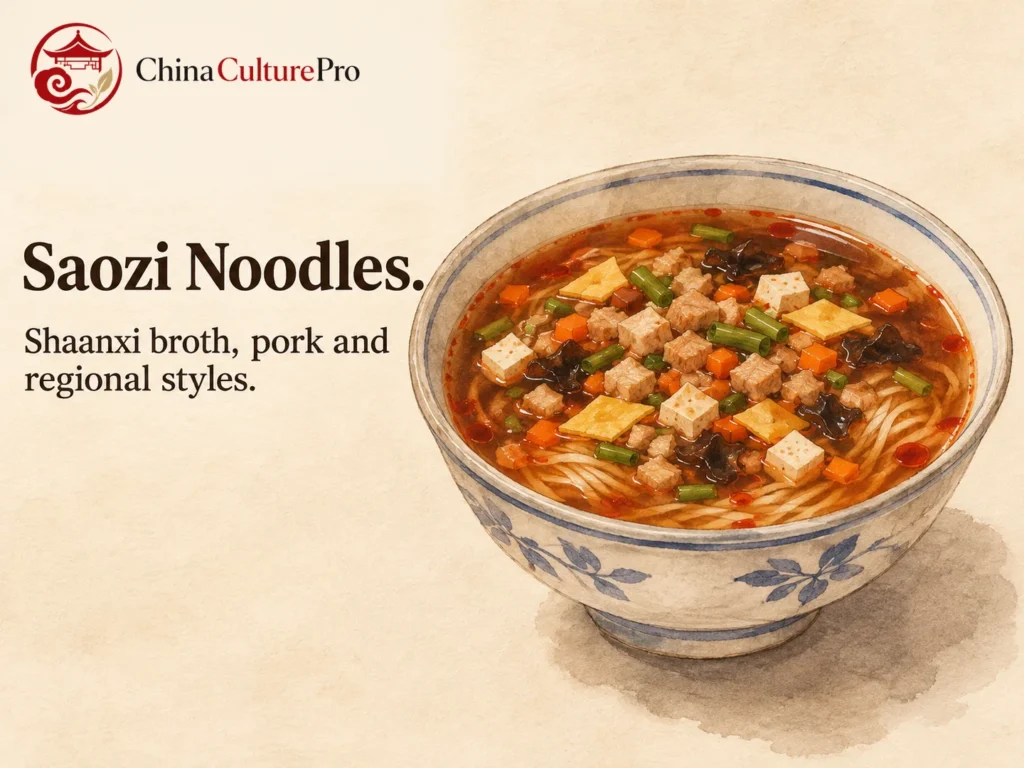
Fine wheat strands sit beneath red-tinged soup, with pork, tofu, vegetables and pieces of egg adding small flashes of color. The first impression is a bowl with plenty of liquid; the next is its sharp, savory aroma. Within Chinese noodle culture, saozi noodles bring several separately prepared components together.
Thin Wheat Noodles and a Generous Broth
Qishan’s traditional description prizes thin, firm and smooth noodles. The cultural account of its making also emphasizes the relationship between the strands and a generous, aromatic soup.[3] This is a different format from noodles coated only with a dense meat sauce.
Hand-rolling and cutting are associated with the traditional craft. The fine, resilient strands remain distinct within the soup. Wheat supplies the noodle base; the colorful pieces floating around it are separate ingredients.
The amount of noodles in a serving can look modest alongside the liquid. That proportion is part of the familiar presentation, not necessarily a sign that a topping has been forgotten. Portion sizes and refill arrangements depend on the setting, so ask what an order includes rather than assuming every restaurant follows one small-bowl format.
Pork Saozi and the Vegetable Layers
The pork component is a preparation in its own right. A published Shaanxi food-standard definition describes Qishan saozi meat as cooked pork pieces seasoned with ingredients including vinegar, chili and aromatics. Its stated scope is a packaged meat product, which can be used for noodle soup, mixed noodles or bread fillings.[2] It is not a complete definition of every restaurant’s assembled bowl.
A practitioner’s account describes preparing the fatty and lean pork components and then combining their flavor with the other elements. The same account names vegetables, tofu, wood ear and egg sheets among the bowl’s contrasting ingredients.[4] The small pieces spread flavor through the soup while remaining distinguishable.
The vegetables are not one fixed national checklist. Reporting based on an interview with a local food-industry representative explicitly notes seasonal choices, including different combinations of carrot, beans, tofu, garlic shoots and day lily.[5] Color and texture come from that assortment; choosing a different seasonal vegetable does not turn every bowl into a different named dish.
Vinegar, Chili and the Qishan Flavor
Vinegar is central to the recognizable Qishan flavor. The pork preparation and the soup work together: meat contributes savory depth and fat, while the acidic seasoning keeps the bowl sharp. A local practitioner’s description gives vinegar an important place in both the preparation and its overall character.[4]
Chili contributes fragrance, heat and the red oil visible on the surface. Its role differs from the vinegar’s sourness. The broader guide to Chinese chili oil helps distinguish that condiment from a broth or a meat topping.
These layers explain why a bowl should not be reduced to “pork stock with noodles.” Nor does a red surface specify a single level of heat. Ask about the kitchen’s balance of acidity and chili if you prefer a gentler version. An adjustment to chili need not remove the vinegar character.
Qishan, Fufeng and Regional Variation
Qishan is the main reference point here, within a wider Shaanxi food landscape. Baoji’s local food account presents its sour-and-spicy noodles alongside other regional foods, rather than as the only noodle preparation of the area.[1]
Nearby Fufeng has its own saozi-noodle tradition. A local-custom record describes a soup-rich form and even notes differences in assembly within the county: most places put noodles into the bowl before adding soup, while the county-town area is described as reversing that order.[6] Variation can therefore exist within a local name, as well as between counties.
For a menu, the regional description is a useful clue, not a full ingredient declaration. Ask which style the kitchen makes and what its meat and soup contain. Avoid using one bowl’s color, garnish or acidity as a test that all other Shaanxi versions must pass.
Hospitality, Customs and Origin Stories
Qishan’s cultural account connects the dish with celebrations, receiving guests and ritual hospitality. It also records a local custom of eating the noodles while leaving the soup.[3] That is a described regional practice, not a rule governing every restaurant meal in China. Follow the actual setting and ask the host when a custom is unfamiliar.
Accounts of the name and origins include folk narratives, including a sister-in-law story and a dragon story. The report presents these as legends.[7] They do not establish a documented inventor or an unchanged ancient recipe.
At a gathering, the practical connection is sharing food and welcoming people. The wider guide to Chinese banquet traditions places that role in context. A description of older serving customs should not be treated as an instruction to reuse another diner’s leftover soup.
Ordering and Dietary Checks
Start with the ingredients already in the soup. A pork-based saozi bowl remains a meat dish after visible pork pieces are removed, because fat and seasoning have dispersed through it. A vegetarian adaptation needs a suitable soup base, cooking fat and topping combination; see Chinese vegetarian food for broader ingredient checks.
Wheat noodles contain gluten. Egg sheets, tofu and soy-based seasonings may introduce egg and soy, while other compound sauces can add ingredients not obvious at the surface. The FDA identifies wheat, egg and soy among major food allergens.[8] Confirm the complete preparation and relevant shared equipment rather than checking only the garnish.
A packet of cooked saozi meat and a complete noodle kit contain different components. Read their ingredient lists and follow the directions for the product you buy.
FAQs About Saozi Noodles
Does saozi mean minced pork?
Not invariably. Qishan’s characteristic pork preparation uses small meat pieces, often diced; “minced” can obscure that texture.
Are saozi noodles always spicy?
Qishan’s familiar version emphasizes sourness and chili, but regional and kitchen versions vary. Ask about both heat and acidity.
Do you have to leave the broth?
It is a recorded Qishan custom, not a universal dining rule. Follow the host or restaurant’s actual setting.
Can saozi noodles be vegetarian?
An adapted version can be, with a plant-based soup, fat and toppings. Removing pork from a traditional bowl is insufficient.
Sources
[1] Baoji Commerce Bureau. Xifu Foods at the 2026 Baoji Food Exhibition
[2] Shaanxi Health Commission. Published 2022 Qishan Saozi Meat Standard: Product Definitions
[3] Shaanxi Cultural Center, reproduced by the Shaanxi Heritage Digital Museum. Qishan Saozi Noodle-Making Craft
[4] Shaanxi Daily. Practitioner Interview: Qishan Saozi Meat, Vinegar and Bowl Ingredients
[5] Shaanxi Daily. Local Food-Industry Interview: Seasonal Choices in Qishan Saozi Noodles
[6] China Regional Conditions. Fufeng County: Everyday Customs and Food
[7] Xinhua. Qishan Food Customs and Recorded Origin Legends
[8] U.S. Food and Drug Administration. Food Allergies: What You Need to Know