


Quick Answer: What Does Po Fu Chen Zhou Mean?
Po Fu Chen Zhou (破釜沉舟, pò fǔ chén zhōu) describes committing to a course of action and giving up the option of going back. The words literally mean “break the cooking pots and sink the boats.” They evoke a passage about the late Qin commander Xiang Yu (项羽, Xiàng Yǔ).[1]
- The image: Cooking vessels and boats stand for the means of going back.[1]
- The emphasis: The idiom conveys resolve when the stakes are high.[1]
- In English: “Burn your boats” can convey the choice to leave no way back.
A speaker may use the expression as praise or as a warning about what commitment costs.
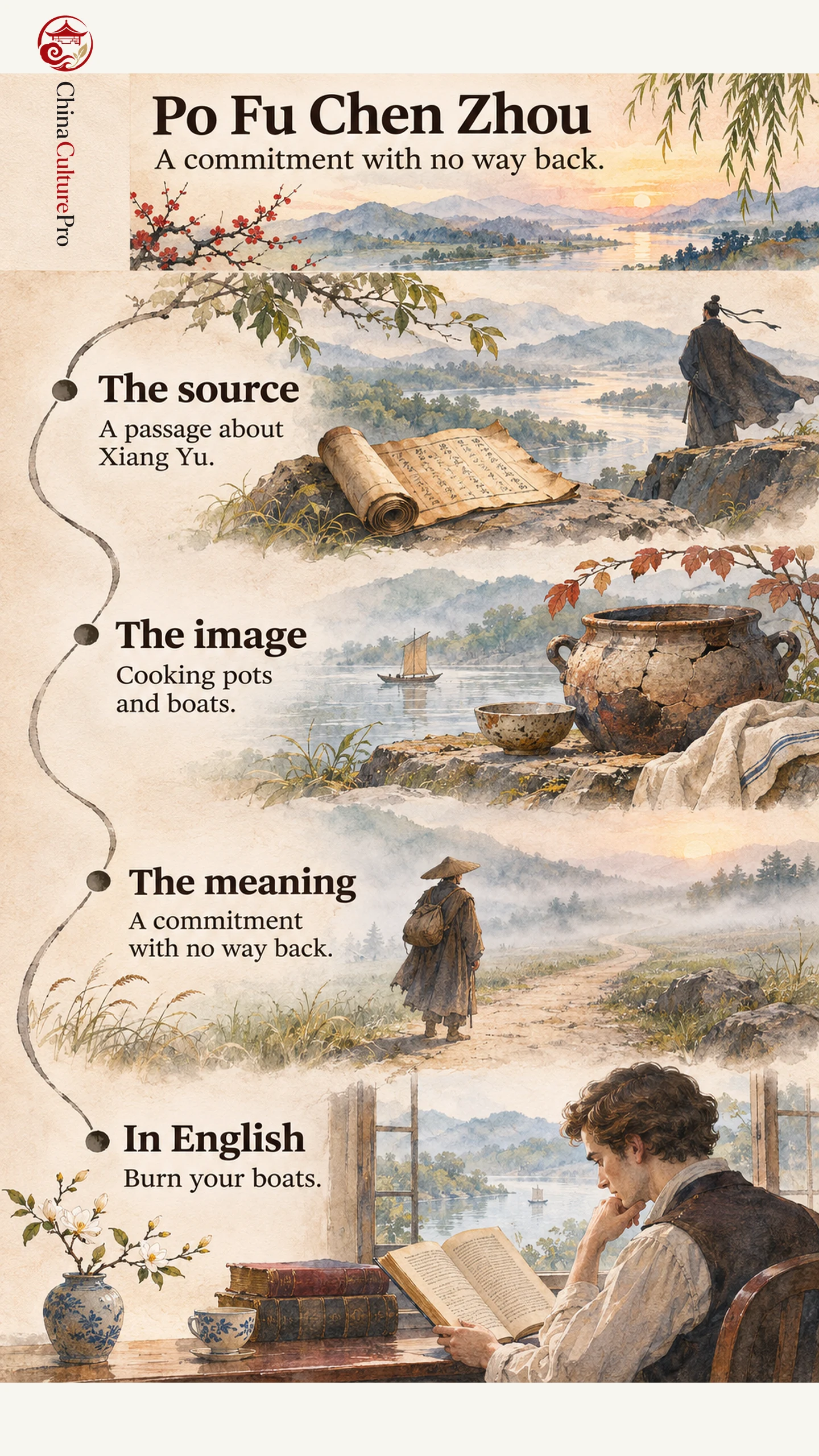
The image behind this idiom is a decision with consequences that cannot simply be undone. That is why it carries more weight than an ordinary promise to try hard.[1]
The Image in the Account of Xiang Yu
Sima Qian’s Records of the Grand Historian (史记, Shǐjì) gives the episode in its account of Xiang Yu. The passage is set in the closing years of the Qin dynasty, around the fighting at Julu. The account says his force’s boats were sunk and its cooking vessels broken after a river crossing. It presents those acts as a statement of determination.[1]
The familiar four-character expression condenses the episode to the cooking pots and boats. Later readers can invoke them without recounting the battle or taking a position on Xiang Yu himself.[1]
What Breaking Pots and Sinking Boats Conveys
Fǔ (釜) refers to a cooking pot, and zhōu (舟) means a boat. The vessels evoke the means to sustain an ordinary course, and the boats evoke the way back. By removing those options, the passage gives resolve a visible cost. The figurative sense can be a willingness to relinquish an alternative for the sake of a difficult goal.[1]
How to Use Po Fu Chen Zhou Today
Imagine a publisher has decided to retire an old product and devote its team to a replacement. An observer might describe the decision as Po Fu Chen Zhou if the old product genuinely cannot be brought back. A short extra push with the old options still available lacks the irreversible choice in this example.
Nan Yuan Bei Zhe raises a different question, about whether actions advance their stated goal. The expression Po Fu Chen Zhou tells us how thoroughly someone has committed. Whether the decision will succeed still depends on the situation.[1]
Po Fu Chen Zhou and the English Phrase Burn Your Boats
“Burn your boats” and “leave yourself no way back” are close when the choice is deliberate. “Go all in” can sound more conversational and stresses the scale of the commitment. A translation of the historical passage can keep both the pots and the boats because the reader has the scene that makes them meaningful.[1]
FAQs About Po Fu Chen Zhou
What Kind of Pot Is a Fu?
It is a cooking vessel. The historical passage mentions more than one type of cooking vessel, while the four-character expression retains fǔ.[1]
Does the Idiom Always Sound Admirable?
It often sounds admiring when used about determination. If a speaker thinks giving up an alternative was unwise, the same image can sound dramatic or critical.[1]
Does It Mean the Same as Burn Your Bridges?
They overlap in the loss of a way back. “Burn your bridges” can also mean damaging a relationship or cutting off a future opportunity.
Sources
[1] Taiwan Ministry of Education. Dictionary of Chinese Idioms entry for Po Fu Chen Zhou