


Quick Answer: What Does Xiang Ru Yi Mo Mean?
Xiang Ru Yi Mo (相濡以沫, xiāng rú yǐ mò) describes people helping one another through shared hardship with whatever little they have. It comes from the Zhuangzi (庄子, Zhuāngzǐ), which pictures fish moistening one another after their spring dries up. The passage then imagines the freedom those fish would have in open water.[1][2]
- The image: Fish stranded together share what little moisture they can.[1]
- The larger passage: Life in rivers and lakes would let them swim without depending on that help.[1]
- Modern use: The idiom can praise mutual care among partners, friends or others facing difficulty together.[1][2]
The phrase itself highlights the help they give each other.
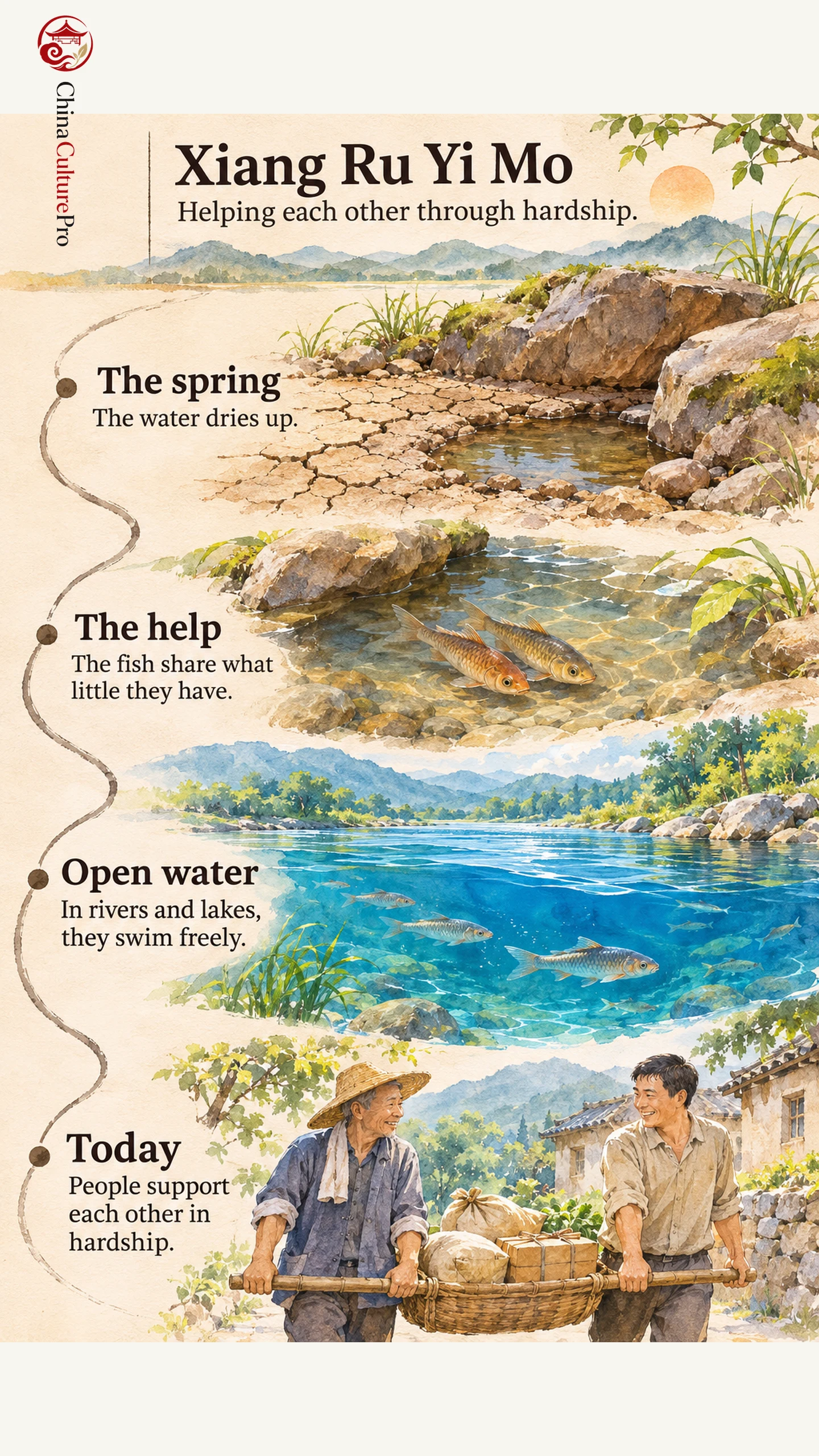
The fish in the story have little to offer each other, and that makes their help striking. The next line imagines the same fish living in waters where they can swim freely.[1]
The Fish After the Spring Dries Up
In the chapter often translated as The Great Ancestral Teacher, the spring dries up and the fish are left together out of water. The text says they moisten one another with the froth from their mouths. Rú (濡) means to moisten. The first character, xiāng (相), marks the action as mutual. Each fish offers the other what it can.[1]
Why the Zhuangzi Imagines Open Water
The passage says it would be better for the fish to forget one another in rivers and lakes. In open water they would have no need to keep each other alive this way. The contrast brings out the difference between making do together in hardship and living freely in conditions that suit them. The image also appears in another chapter of the Zhuangzi.[1]
How the Standalone Idiom Is Used
A speaker can use the four characters on their own to praise two friends sharing scarce resources or a couple supporting one another through difficult years. The words emphasize the support each person gives the other while the difficulty lasts. Po Jing Chong Yuan addresses a different moment in a relationship, when people come together again after separation.[1][2]
How to Translate Xiang Ru Yi Mo
“They helped each other through hard times” is a natural English equivalent. In a translation of the Zhuangzi, keeping the stranded fish and the open water helps readers see why the comparison continues past the act of helping.[1][2]
FAQs About Xiang Ru Yi Mo
What Does Mo Mean in the Idiom?
Mò (沫) is froth or foam. Here it is the small amount of moisture the fish have available to share.[1]
Is It Only for Couples?
The phrase is often used for partners, but it can describe anyone who shares a difficult situation and offers mutual help.[1][2]
What Does Forgetting Each Other Mean?
In the Zhuangzi’s image, fish in open water no longer have to rely on one another for moisture. They can swim freely and go about their lives.[1]
Sources
[1] Taiwan Ministry of Education. Dictionary of Chinese Idioms entry for Xiang Ru Yi Mo
[2] Taiwan Ministry of Education. Revised dictionary reference for Xiang Ru Yi Mo