

Quick Answer: Who Is Mulan?
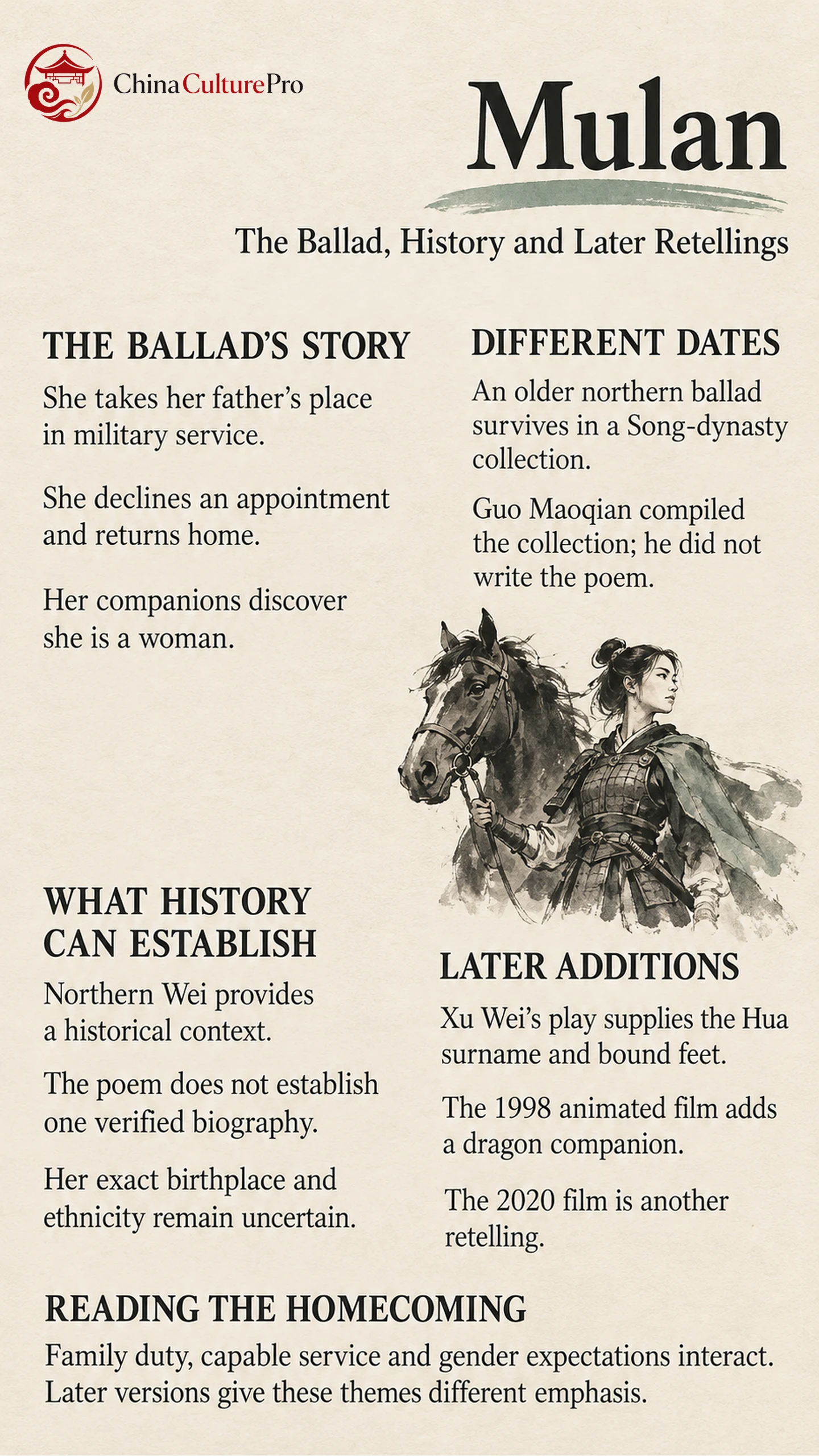
Mulan (木兰, Mùlán) is the legendary heroine of the Ballad of Mulan (木兰诗, Mùlán Shī), an anonymous Chinese narrative poem. She takes her father’s place in military service, serves successfully and returns home.
- The ballad: A short poem supplies the central substitution and homecoming story.
- Historical questions: Its northern setting offers context, not a verified biography of one woman.
- Later versions: Plays, illustrated books and films add names, characters and different emphases.
The heroine is older than any modern screen adaptation. To identify an “original” detail, begin with the poem rather than combining every later version.
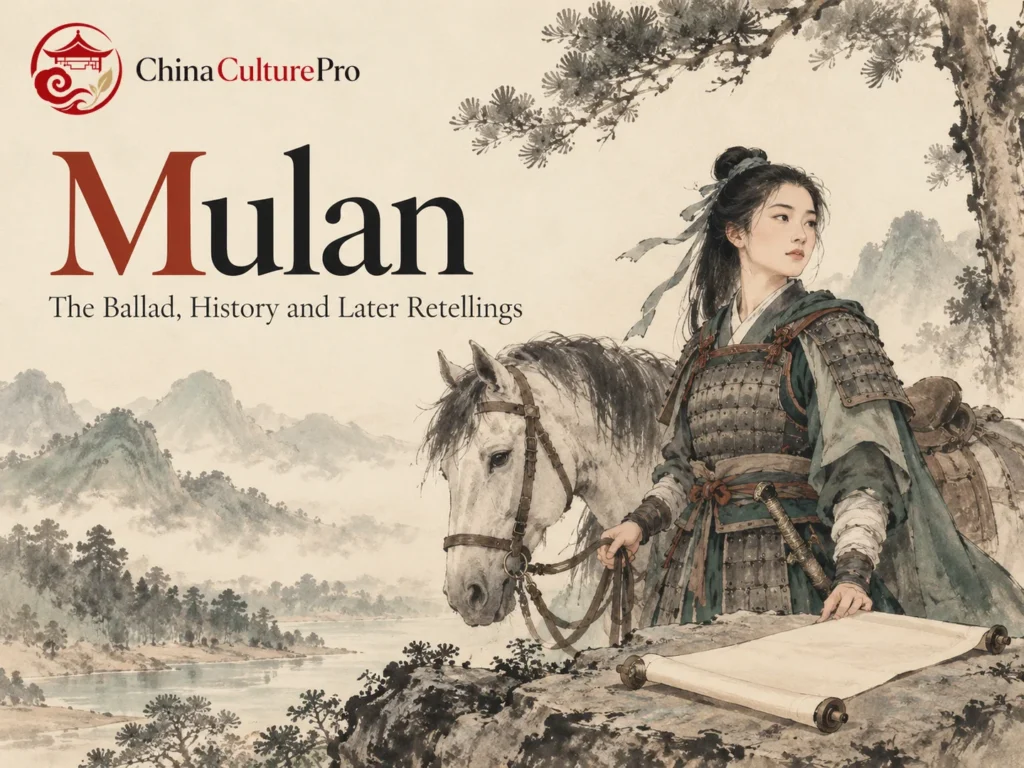
The familiar image is a daughter putting on a soldier’s clothing to protect her father. Beyond that shared premise, Mulan’s story changes considerably. This guide approaches her as a legendary human heroine within the wider world of Chinese mythology and folklore, separating the ballad, historical questions and later retellings.
What Happens in the Ballad of Mulan?
The poem opens with Mulan at a loom, troubled by a military summons that includes her father’s name. He has no grown son to replace him, and she has no elder brother. Mulan decides to go herself, buys a horse and riding equipment, then leaves her parents behind.[1]
The account of war evokes distance, cold and dangerous service, with little detail about individual battles. When Mulan returns to the ruler, she declines an official appointment and asks to go home. Her parents, sister and younger brother prepare to welcome her.[1]
At home, she changes out of her military clothing and resumes her former appearance. Her companions are astonished to discover that she is a woman. The poem closes with an image of two rabbits running together, making the distinction between male and female difficult to see.[1]
That is a remarkably compact story in Chinese poetry. Its central movement is from domestic work to military service and back home. It does not need a named romantic partner or a supernatural helper to complete its narrative.
How Old Is the Story?
The ballad is generally associated with the fifth or sixth century and the northern world of the Northern and Southern Dynasties. That proposed context is earlier than the anthology through which its text survives.[2]
The song is preserved in the Yuefu Shiji (乐府诗集, Yuèfǔ Shījí), compiled during the Song dynasty by Guo Maoqian (郭茂倩, Guō Màoqiàn). Guo’s role as compiler does not make him the poem’s author. The collection preserves material with a longer history of transmission.[3]
These dates answer different questions. The likely background of a song, the compilation of a surviving collection and the publication of a modern edition are separate events. An anonymous poem can have an older history without allowing us to name its first singer or assign it one certain year of composition.
In Chinese literature, a surviving source may preserve a much older story.
Was Mulan a Real Historical Person?
The surviving story supports treating Mulan as a legendary figure; it does not establish a securely documented individual. The ballad gives a narrative, not the identifying evidence needed for a verified life history. A later portrait, shrine or claim about her hometown cannot by itself establish who the heroine was.
There is nevertheless a historical world behind the poem. Its ruler is called both Khan and Son of Heaven, language that makes sense in the culturally mixed north. The Northern Wei dynasty, founded by the Tuoba Xianbei, provides an important context for understanding that combination.[2]
Context should not become overconfidence. These clues do not settle Mulan’s personal ethnicity, exact birthplace or the date of a particular campaign. Nor should a film’s opposition between an entirely uniform Chinese society and northern outsiders be read as a literal reconstruction of the ballad’s world.
How Later Retellings Change Mulan
The sixteenth-century playwright Xu Wei (徐渭, Xú Wèi) gives the heroine the family name Hua, producing the familiar name Hua Mulan (花木兰, Huā Mùlán). His play also introduces bound feet, a feature absent from the ballad and associated with a later social world.[4]
| Version | A distinctive addition or emphasis | Ce que cela permet d’établir |
|---|---|---|
| Xu Wei’s Ming-dynasty play | The Hua surname and bound feet reshape the heroine for a different setting. | Evidence of a later dramatization, not proof of the ballad heroine’s biography.[4] |
| The 1998 animated film Mulan | A guardian dragon and a lucky cricket help the heroine. | Those companions belong to this film; they do not occur in the ballad.[6] |
| The 2020 live-action film Mulan | The soldier-disguise premise is retold alongside a character with supernatural powers. | It is another adaptation, not a documentary reconstruction of early medieval China.[7] |
The stage version’s foot-binding detail is particularly revealing: a retelling can introduce the expectations of its own audience into an older story. Opéra chinois, illustrated books and films have similarly provided different settings for Mulan’s transformation.[4]
These changes are part of the legend’s history. They become confusing only when details from several versions are presented as though they all belong to the earliest poem.
Family Duty, Gender and the Return Home
Filial piety (孝, xiào) is one enduring way of reading Mulan: her decision protects her father. Yet retellings have also emphasized loyalty, patriotism, female virtue and personal independence. Those emphases change with the period and audience.[5]
The poem’s homecoming leaves room for more than one reading. Mulan can perform a soldier’s work, then choose to return to domestic life. Her restored clothing and makeup help produce the moment when her companions recognize her differently. The ending asks readers to reconsider how reliably outward appearance reveals a person’s capabilities.[1]
That interpretation need not turn the ballad into a manifesto written for a modern political debate. Its power lies partly in the contrast it stages; later writers decide which possibilities to expand. A loyal daughter, a capable warrior and a figure questioning gender expectations can occupy the same narrative without every version giving them equal weight.[5]
FAQs About Mulan
Did Mulan have a dragon companion?
Not in the ballad. The guardian dragon familiar from the 1998 animated film belongs to that adaptation.
Was Mulan’s surname always Hua?
No. The ballad calls her Mulan without the surname Hua. Xu Wei’s later play supplies the familiar family name.
Does Mulan die at the end of the original ballad?
No. She returns home, resumes her former appearance and surprises her companions. A tragic ending in another version should not be transferred to the ballad.
Was Mulan a princess?
The ballad does not identify her as one. She is a daughter who undertakes military service and declines an official appointment on her return.
Sources
[1] Anonymous, Chinese text via Wikisource. Ballad of Mulan
[2] Columbia University, Asia for Educators. The Ballad of Mulan (Ode of Mulan)
[3] Guo Maoqian, Chinese text via Wikisource. Yuefu Shiji, Volume 25
[4] Minjie Chen, Princeton University Library. Who Is Hua Mulan?
[5] Lan Dong, Temple University Press. Mulan’s Legend and Legacy in China and the United States
[6] Disney. Mulan (1998)
[7] Disney. Mulan (2020)