


Quick Answer: What Is a Mang Robe?
A mang robe, or mangpao (蟒袍, mǎngpáo), is a Chinese robe decorated with dragon-like figures called mang (蟒, mǎng). The name can refer to a garment granted by the Ming emperor, a Qing robe worn on auspicious occasions, or a garment made for the stage.[2][3][6]
- Ming gift: Surviving robes from the Confucius family are recorded as imperial grants.[2]
- Qing distinction: Four claws occur on some examples. A Qing prince’s robe cataloged as a mangpao has five-clawed figures.[3][4]
- Stage version: An eighteenth-century theater robe also uses five-clawed figures, in a different dress context.[6]
Check the cut, the pattern as a whole and the record of the intended wearer before drawing conclusions from a claw count.
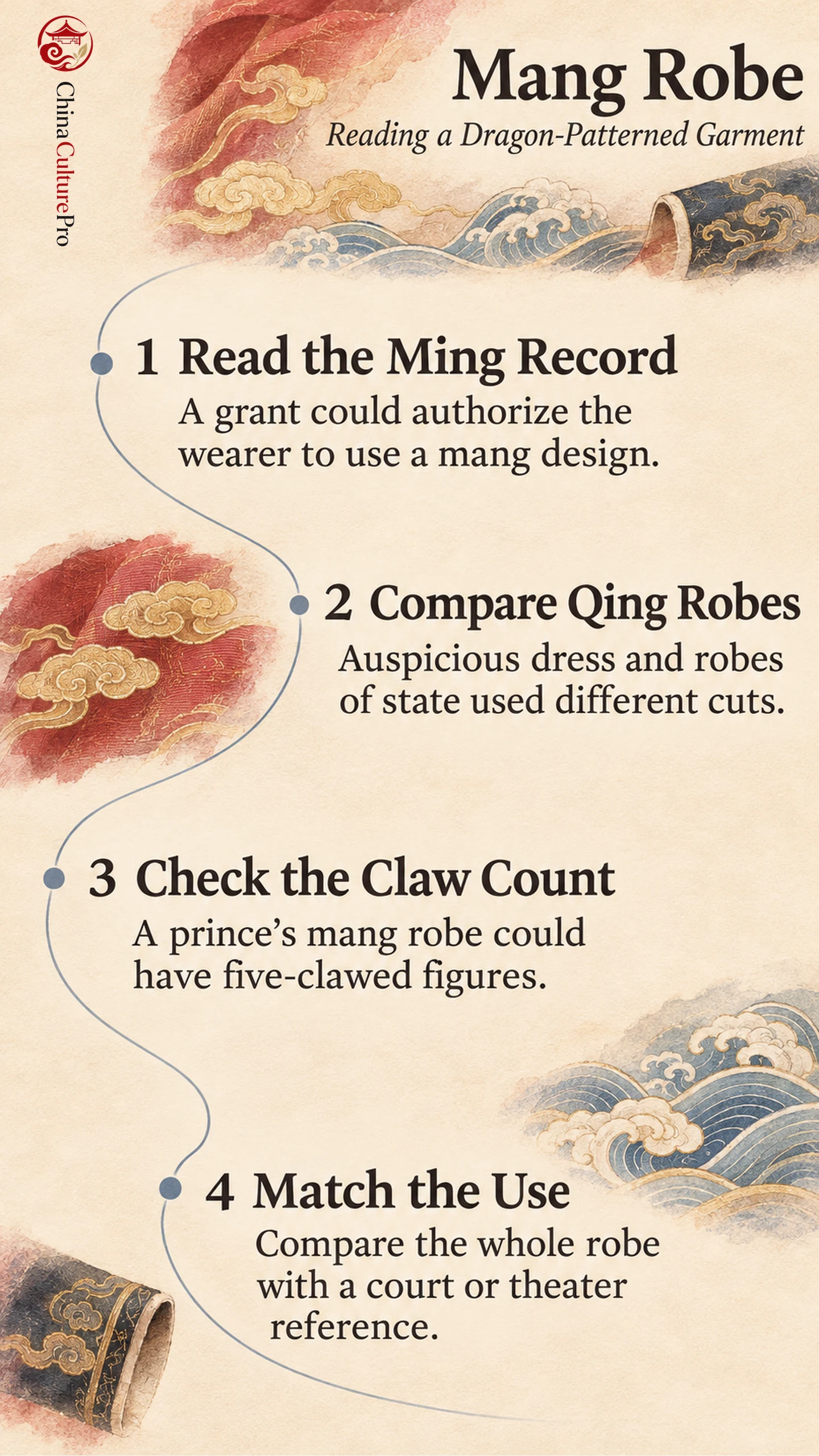
When you see a dragon-like figure on a Chinese robe, start by looking at the whole garment. Its sleeves, fastening and hem can help tell you what kind of clothing it was. The same detail in a close-up can take on a different meaning in an imperial gift, a Qing court wardrobe and a theater costume.
How the Mang Motif Appeared on Ming Gift Robes
The Ming dynasty court could grant the right to wear distinctive dragon-like designs. A study of the 1537 clothing rules records restrictions on the unauthorized use of mang garments and other granted patterns. A Ming account describes the mang design in relation to the imperial dragon, with one fewer claw. Read the claw description with the restriction on use. The number describes the motif, while an imperial grant explains why a person could wear it.[1]
A blue gauze robe preserved by the Confucius family gives a concrete example. The Shandong gazetteer describes it as a gift to the Duke Yansheng. It has a round neck, a right-side fastening and wide sleeves. Gold-thread figures on the chest and back connect across the shoulders, with related decoration on the sleeves and lower garment.[2]
Look where the decoration crosses seams. A museum photograph of a fragment may show one animal in full, but the complete garment can show whether that figure was part of a shoulder design, a panel or a repeated arrangement. The goldwork embroidery guide explains how metal threads can form a raised surface.
What Qing Cut and Motifs Can Tell You
One Qing dynasty mangpao in Beijing is deep crimson and made with kesi (缂丝, kèsī), a silk tapestry technique. Its sleeves end in horsehoof-shaped cuffs and the hem opens at the front and back. Nine four-clawed figures appear with clouds and water imagery. The museum identifies it as jifu (吉服, jífú), auspicious attire, for a Qing noble holding the title beile.[3]
A smaller apricot-yellow robe cataloged as a prince’s mangpao has five-clawed designs. The museum explains that under Qing dress naming conventions, a prince’s auspicious garment could be called a mangpao even when its imagery resembled that of a longpao (龙袍, lóngpáo), or dragon robe. This is a documented reason to consider the wearer alongside the design.[4]
There is also a difference between an auspicious robe and a formal robe of state, or chaofu (朝服, cháofú). A dark-blue Qing robe of state in the Metropolitan Museum has four-clawed figures. The catalog identifies it as dress for the most formal rites, a different dress category from the prince’s auspicious robe. Compare the Qing robe categories before treating a motif as the name of a garment.[5]
Why a Claw Count Needs Context
Count the claws on a complete, unobstructed figure. A folded sleeve or a damaged motif may hide part of a foot. Then compare the other visible figures, the overall placement of the decoration and any information about the date. Five-clawed designs circulated more widely in the late Qing than restrictions alone might lead a viewer to expect.[7]
Theater adds another context. An eighteenth-century satin-brocade mangpao cataloged by the Metropolitan Museum has five-clawed figures and is associated with the imperial theater. The museum describes this type of robe as costume for several high-status roles. The textile gives evidence of a stage wardrobe and its conventions.[6]
How to Choose a Modern Interpretation
Decide whether the garment you want to wear follows a dated court piece, a Ming gift robe or a performance costume. Ask for photos of the front and back, the cuffs and the motif close up. Look at how the pattern was made. If the seller calls the pattern woven, ask for a close-up of the weave. If the pattern was stitched, look at how the added threads sit on the ground cloth.
Try the robe with the layers you plan to wear. Check sleeve movement, hem clearance and whether the closure holds without pulling. When describing it, name the dated reference or stage tradition and any modern changes. The broader guide to traditional Chinese clothing can help place the garment alongside other robe types.
FAQs About the Mang Robe
Did every mang robe have four-clawed figures?
A Ming account describes a difference of one claw from the imperial dragon. A Qing prince’s garment cataloged as a mangpao has five claws. The rule and the object need their own contexts.[1][4]
Was a mang robe worn only by officials?
Examples include Ming gifts, a Qing prince’s auspicious robe and theater costumes for different roles.[2][4][6]
What should I look at besides the number of claws?
Look at the cut, cuff shape, color and motif placement. Use the garment’s date and documented wearer or use to interpret what you can see.[3][5][7]
Sources
[1] Kyoto National Museum Bulletin. Ming Textiles and Dragon-Like Motifs
[2] Shandong Local Gazetteer Archive. Clothing Preserved at the Confucius Family Mansion
[3] Palace Museum, Beijing. Deep Crimson Kesi Mang Robe, Qianlong Period
[4] Palace Museum, Beijing. Apricot-Yellow Mang Robe for a Boy, Jiaqing Period
[5] Metropolitan Museum of Art. Robe of State, 17.82.2
[6] Metropolitan Museum of Art. Theatrical Robe With Dragons, 30.76.29
[7] Cooper Hewitt, Smithsonian Design Museum. Five-Clawed Dragon