

Quick Answer: How Do You Play Chinese Mahjong?
Mahjong (麻将, májiàng) is a multiplayer tile game in which players build combinations through drawing, discarding and sometimes claiming an opponent’s latest discard. In the common fourteen-tile framework, a normal completed hand has four melds and one pair; a declared kong (杠, gàng) adds an extra physical tile to that structure.[1][6]
- Start with the tiles: recognize the three numbered suits, winds and dragons.
- Follow the turn: draw and discard, or make a permitted claim that changes the usual order.
- Check the win: a complete arrangement must also meet the table’s scoring requirements.
This guide uses a Hong Kong-style beginner framework. Chinese regional games and competition codes do not share one universal scoring system.
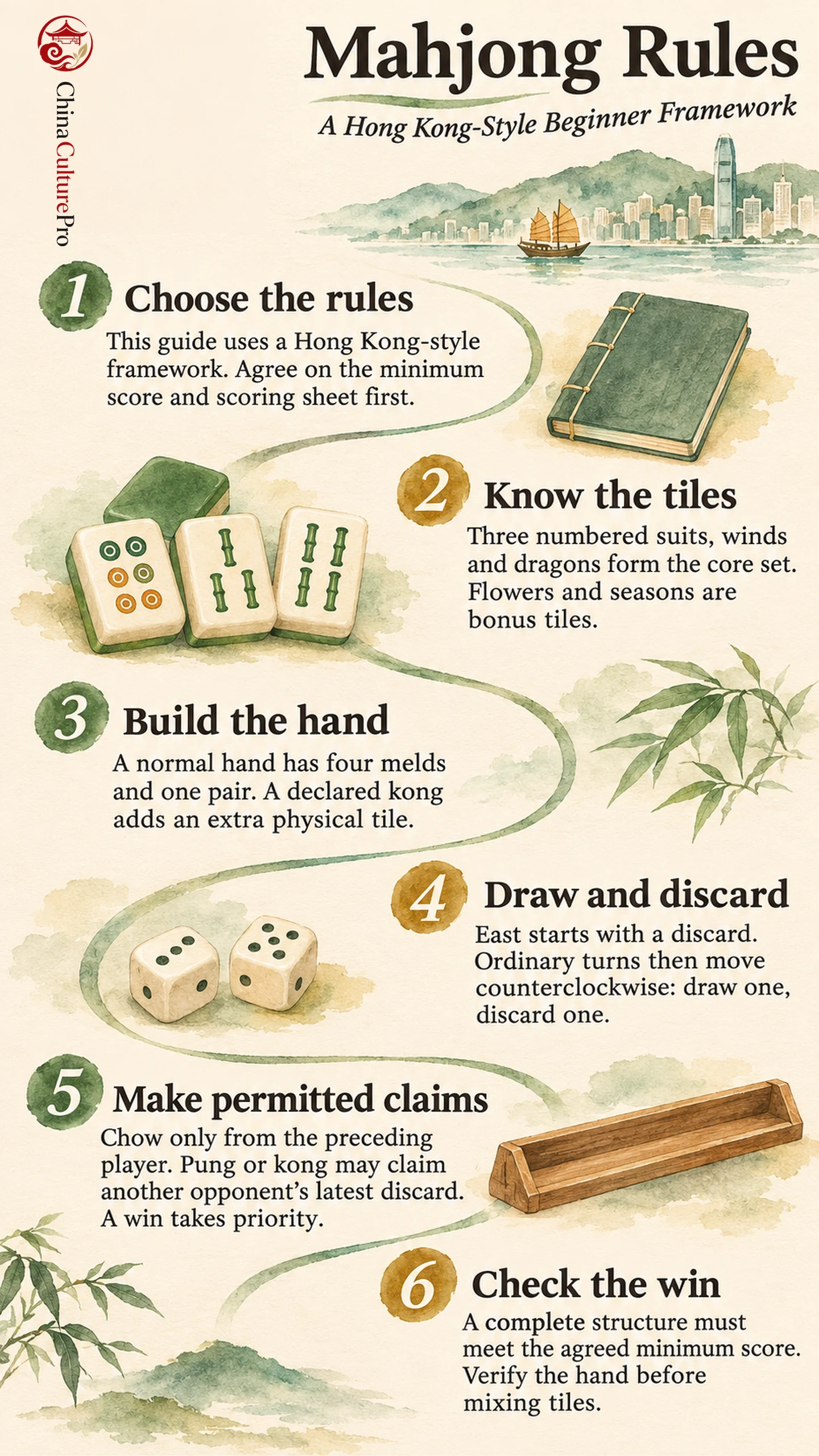
Keep a scoring sheet beside the tiles during your first session. Learning the shape of a hand and learning whether it qualifies to win are related tasks, but they are not the same task. The broader mahjong history and playing traditions explain why several rule families coexist.
Choose the Rules Before the First Hand
Confirm that everyone means the same version. For this introduction, use the Hong Kong-style structure below and agree on the minimum faan (番, fān in Mandarin), accepted special hands, treatment of bonus tiles and payment or practice-point table. Three faan is a common minimum, but lower and higher thresholds also occur.[3]
Do not substitute Chinese Official Mahjong Competition Rules simply because they are called “official.” That code has an eight-point minimum excluding flower points, with its own scoring definitions. It is a separate system.[4]
For learning, the group can use points without money and announce that the first hand is a teaching hand. If you temporarily ignore scoring to practise the draw–discard rhythm, label that as an exercise rather than a fully valid scored game. Keep Hong Kong mahjong and mahjong scoring systems available for the next layer of detail.
The Tiles: Suits, Honors and Bonuses
A common core set contains 136 tiles: four copies of each of 34 tile types. The three suits—dots, bamboo and characters—each run from one to nine, giving 108 suited tiles. Four winds and three dragons, again with four copies each, supply 28 honor tiles.[5]
Adding four flowers and four seasons produces 144 tiles. These bonus tiles are normally exposed and replaced when drawn; they do not take a place in the four-melds-and-pair structure. Their scoring depends on the selected rules.[5]
Sort your concealed tiles by suit and number so you can see possible combinations. A rank such as “three” does not make different suits interchangeable. The mahjong tile guide gives more help recognizing designs, especially when sets lack familiar Arabic numerals.
Build Four Melds and a Pair
A meld is a completed group. English spellings vary, but the underlying distinction is straightforward: a sequence, identical tiles, or four identical tiles declared as a kong. A pair is two identical tiles.[6]
| Groupe | Signification | Exemple |
|---|---|---|
| Chow, or chi (吃, chī) | Three consecutive ranks in one suit | 3, 4 and 5 bamboo |
| Pung, or peng (碰, pèng) | Three identical tiles | Three red dragons |
| Kong, or gang (杠, gàng) | Four identical tiles, declared as a kong | Four 8 dots |
| Paire | Two identical tiles | Two 2 characters |
Here is an original structural example: 1–2–3 dots; 4–5–6 dots; 2–3–4 bamboo; three red dragons; and two 9 characters. Count four melds and one pair, totaling fourteen tiles. It illustrates shape, not an automatic scoring qualification.
You cannot use one tile twice. Holding 3–4–5 bamboo plus another 5 bamboo does not let the same 5 complete a second sequence. Lay out the proposed groups separately when checking a beginner’s hand.
Some special hands follow other patterns. Which ones qualify is a rule-set question; learn the normal structure first rather than borrowing a special hand from a different game.
Set Up the Wall and Deal
Four players take seats named East, South, West and North in counterclockwise order around the table. East is the dealer; the names describe seats, not the room’s compass directions.[1]
Mix the tiles face down and build four two-high walls. With 144 tiles, each wall has eighteen stacks; with 136, each has seventeen. Dice determine the opening point according to the table’s dealing procedure. Have an experienced player demonstrate that procedure and identify the drawing end and replacement-tile area before dealing.[7]
Players take tiles in batches until they have twelve, then finish the deal so East has fourteen and everyone else thirteen. Reveal and replace any flowers or seasons under the agreed procedure. East begins by discarding, because the dealer already has the extra tile.[7]
Do not confuse turn direction with the way tiles are removed around the wall. Ask someone to point to both before starting; a short demonstration makes the two directions easier to keep separate.
The Turn: Drawing, Discarding and Claiming
An ordinary turn
After East’s opening discard, play proceeds counterclockwise. On an uninterrupted turn, draw from the live wall, assess the hand and discard one tile face up. The next player then takes a turn unless someone makes a permitted claim.[8]
Keep your concealed hand private and your discards identifiable. Calls concern the tile just discarded; an old discard cannot be retrieved because it becomes useful several turns later.[8]
Claiming the latest discard
You may claim any opponent’s latest discard to complete a pung or an eligible kong. A chow claim is restricted to the player whose turn immediately precedes yours. You may claim a discard from any opponent to complete a valid winning hand. A win outranks other claims; pung or kong outranks chow.[2]
After claiming a chow or pung, expose the completed meld and discard without first drawing a normal wall tile. Play continues from the caller, so some players’ usual turns may be skipped. Exposed melds remain fixed.[2]
If two people claim a win, stop and apply the table’s agreed rule. Do not decide priority by who shouted loudest.
Declaring a kong
A kong occupies one meld position but uses four physical tiles. Declare it, display it as your rules require and take a replacement before discarding. A declared kong remains a group; it is not a spare tile that you may later move into a chow.[6]
Turning an exposed pung into a kong requires drawing the fourth matching tile yourself, rather than taking another player’s discard to enlarge that exposed pung. Confirm the procedure for added kongs before your first one.[2]
A Complete Hand Still Needs Enough Faan
Under the illustrative three-faan minimum, four pungs and a pair qualify for the three-faan All Pungs pattern on the referenced scoring sheet. For example: three 2 dots, three 5 dots, three 7 bamboo, three 8 characters and two white dragons. There are no kongs, so the physical total is fourteen.[3]
That is a different teaching example from the earlier shape-only hand. It shows why you should identify a scoring route while building groups. Do not assume every fourteen-tile completion reaches the minimum, or add bonuses from an unrelated scoring chart.
Confirm the accepted score and use the table’s agreed settlement chart after a win. More faan and payment are related, but payout scales and responsibility for a discard win vary.
Ending the Hand and Continuing Play
A player may win on a self-drawn tile or a claimed discard if the completed hand qualifies. Announce the win, reveal the groups and let the table verify them before mixing any tiles. If the live wall is exhausted without a valid win, the hand ends in a draw.[8]
In the Hong Kong framework described here, East stays dealer after winning; otherwise, the next player becomes East, subject to the table’s draw rules. Longer sessions group hands into wind rounds. Agree whether your learning session ends after a fixed number of hands or at a set time.[2]
Do not transfer this guide’s chow permissions or dealer conventions automatically to Sichuan mahjong. Naming the version remains useful after the first lesson.
FAQs About Mahjong Rules
Do I need 136 tiles or 144?
The common core has 136 tiles. Four flowers and four seasons bring it to 144. Use the set and bonus-tile treatment specified by your chosen rules.
Can I take a discard just to make a pair?
Not as an ordinary melding call in this framework. You may claim it as the final tile of a valid winning hand, including when that tile completes the pair.
Can winds or dragons form a chow?
No. Chows use consecutive ranks in one numbered suit. Honors can form identical-tile groups or a pair, not numbered sequences.
Why can a completed hand have more than fourteen tiles?
Each declared kong adds one physical tile beyond the ordinary fourteen-tile count. Four meld positions and one pair remain the structural goal.
Is this the same as American mahjong or solitaire?
No. American mahjong uses a different rule family, while tile-matching solitaire is a separate game. Compare Chinese and American mahjong before applying one game’s instructions to the other.
Sources
[1] Mahjong Time. Hong Kong Mahjong Rules: Objective and Seats
[2] Mahjong Time. Hong Kong Mahjong Rules: Drawing Tiles and Game Play
[3] Mahjong Time. Hong Kong Mahjong Scoring
[4] World Mahjong Organization. Mahjong Competition Rules
[5] Mahjong Time. Hong Kong Mahjong Rules: The Tile Set
[6] Masters Traditional Games. The Rules of Mah Jong
[7] Mahjong Time. Hong Kong Mahjong Rules: Dealing Tiles and Breaking the Wall
[8] Connor Davis. How to Play Chinese Mahjong: A Complete Beginner’s Guide (Hong Kong Rules)