

Quick Answer: Who Was Ma Zhiyuan?
Ma Zhiyuan (马致远, Mǎ Zhìyuǎn) was a Yuan-dynasty writer whose reputation rests on both independent songs (散曲, sǎnqǔ) and variety drama (杂剧, zájù). His short autumn lyric is a good entrance, but it is only one part of his range.[1]
- For a short first reading: choose the famous lyric beginning with withered vines.
- For a broader poetic voice: try a longer suite that moves between pleasure, passing time and withdrawal.
- For theatre: choose a translated play and attend to its speaking and singing roles.
This guide selects representative works and English entry points rather than attempting a complete catalogue.
A small poem can become so famous that it hides the rest of its author. Reading Ma through more than one form changes the questions worth asking: who speaks, how long does the voice continue, and what can a scene convey before an emotion is named?
Three Works and Two Different Autumn Thoughts
Ma belongs to the literary world of the Yuan dynasty. CUHK’s author profile associates him with an unsuccessful official career, rural retirement and plays with Daoist themes. These broad coordinates are more useful than treating disputed precise life dates as a key to every line.[1]
| Work | Forme | A useful first question |
|---|---|---|
| Autumn Thoughts to Tianjingsha (天净沙·秋思, Tiānjìngshā · Qiūsī) | A short independent song. | When does the human figure enter the landscape?[2] |
| Autumn Thoughts to Yexingchuan (夜行船·秋思, Yèxíngchuán · Qiūsī) | A longer suite using successive tunes. | How does its position on worldly ambition change?[2] |
| Autumn in Han Palace (汉宫秋, Hàn Gōng Qiū) | A play available in Liu Jung-En’s translated anthology. | How does a dramatic scene distribute speech and song?[3] |
The shared English words Autumn Thoughts do not identify the same work. Match a translation with its tune name or opening, especially when an anthology uses older romanization.
How the Short Lyric Builds Its Distance
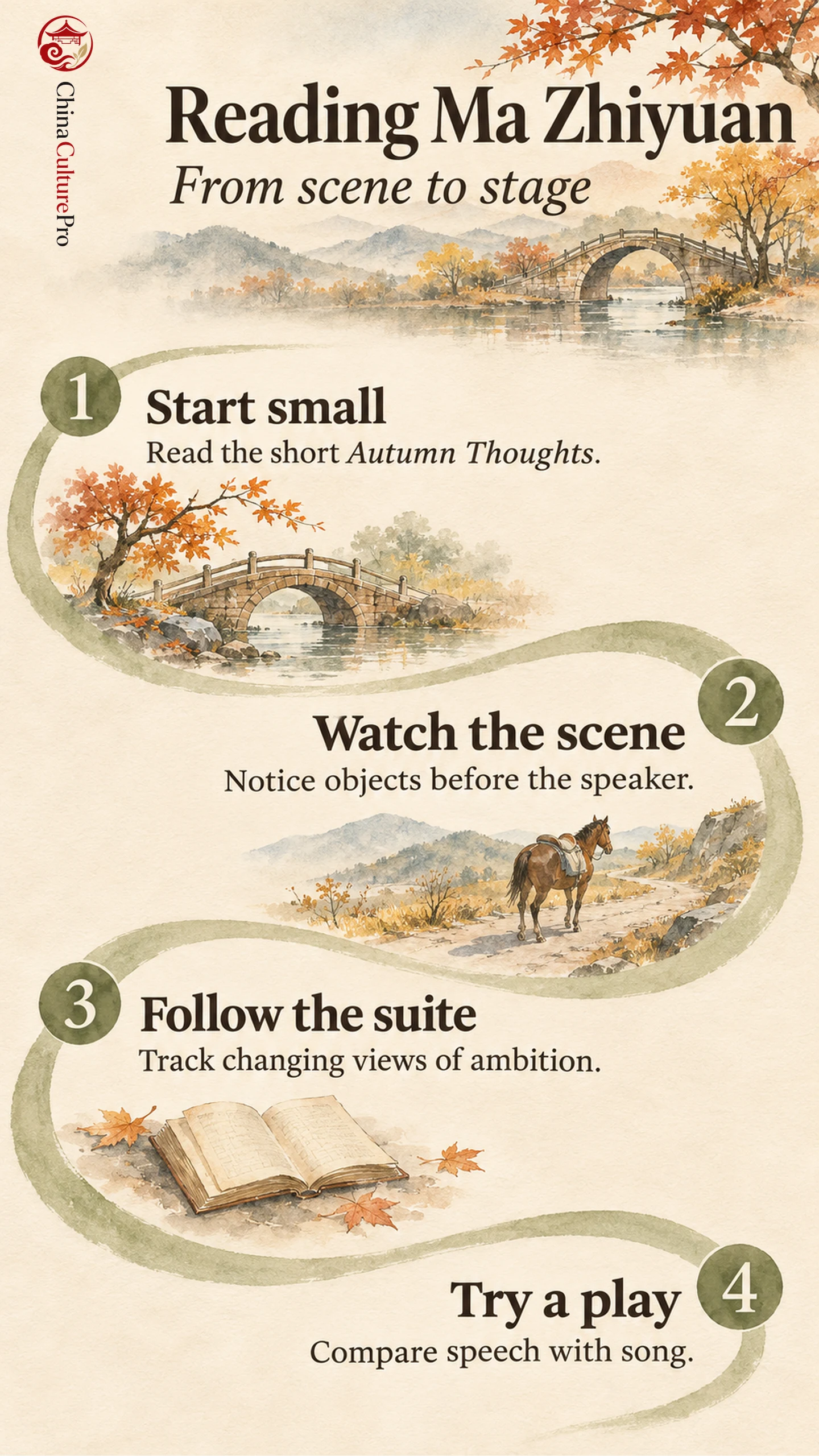
The lyric moves from vegetation and birds to inhabited waterside scenery, then a road and horse. Its suffering human figure appears last; nearby homes sharpen the feeling of distance.[2]
Try a two-pass reading. First, mark only concrete things. Then mark the words that establish age, condition, time or direction. Compare the resulting patterns before deciding on a single abstract label such as loneliness. This keeps the interpretation connected to the language rather than substituting a mood for the poem.
A Wider Range Than Autumn Melancholy
The longer suite moves from life’s brevity through ruined grandeur toward retreat. Owen also selects scenes of fishing, returning boats and temple bells: Ma’s scenery serves more than one attitude.[2]
CUHK emphasizes Ma’s dramatic reputation, particularly Autumn in Han Palace.[1]
For comparison, Guan Hanqing offers another route into Yuan performance writing; Bai Pu offers a further author comparison. Use the same questions across writers: which role carries the feeling, and what does the chosen form let that role do?
Where to Begin in English
- Poetry: Stephen Owen’s An Anthology of Chinese Literature, pages 739–743, includes the short lyric and longer suite.[2]
- Drama: Liu Jung-En’s Six Yuan Plays, published by Penguin in 1972, includes Autumn in Han Palace. The publisher lists it as one play among six, not a collection devoted entirely to Ma.[3]
When comparing translations, note whether English supplies a pronoun, a connecting verb or an explanation absent from another version. Those choices can make a compressed scene feel more like a continuous story. Keep a separate note for what the text states and what your reading supplies.
FAQs About Ma Zhiyuan
Is Tianjingsha the name of a place?
Here it names the tune pattern; Autumn Thoughts names the subject.[2]
Are the songs personal diary entries?
Not automatically. Owen emphasizes conventional song roles, which need not transparently reproduce their writer’s life.[2]
Can Autumn in Han Palace be read as historical evidence?
Use it first as drama. A play can reveal how a later literary culture reimagines a past story; specific claims about the earlier period still need historical sources. This distinction also makes room to appreciate invention rather than treating it as an error.
Sources
[1] Chinese University of Hong Kong. Ma Zhiyuan
[2] Stephen Owen, Harvard University. An Anthology of Chinese Literature, selected pages 739–743
[3] Penguin Random House. Six Yuan Plays: contents and publication details