
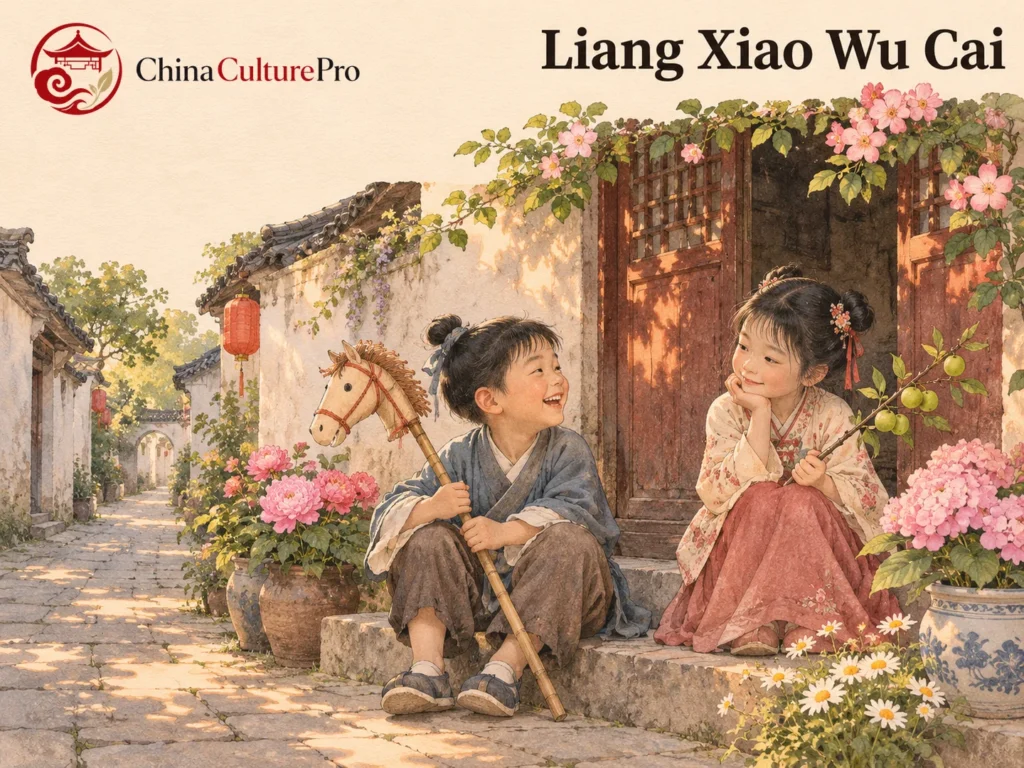

Quick Answer: What Does Liang Xiao Wu Cai Mean?
Liang Xiao Wu Cai (两小无猜, liǎng xiǎo wú cāi) describes two children who are completely at ease with each other, without suspicion or self-consciousness. The expression comes from a line in a poem by Li Bai, where a woman remembers growing up alongside the boy she later married.[1][2]
- The image: Two neighborhood children play together freely.[2]
- The emphasis: The phrase describes the ease and innocence of their relationship when they are young.[1]
- The context: In a love story, it can recall the childhood of a couple. In other contexts, the relationship may remain a friendship.[1]
The idiom describes the bond as it was in childhood.
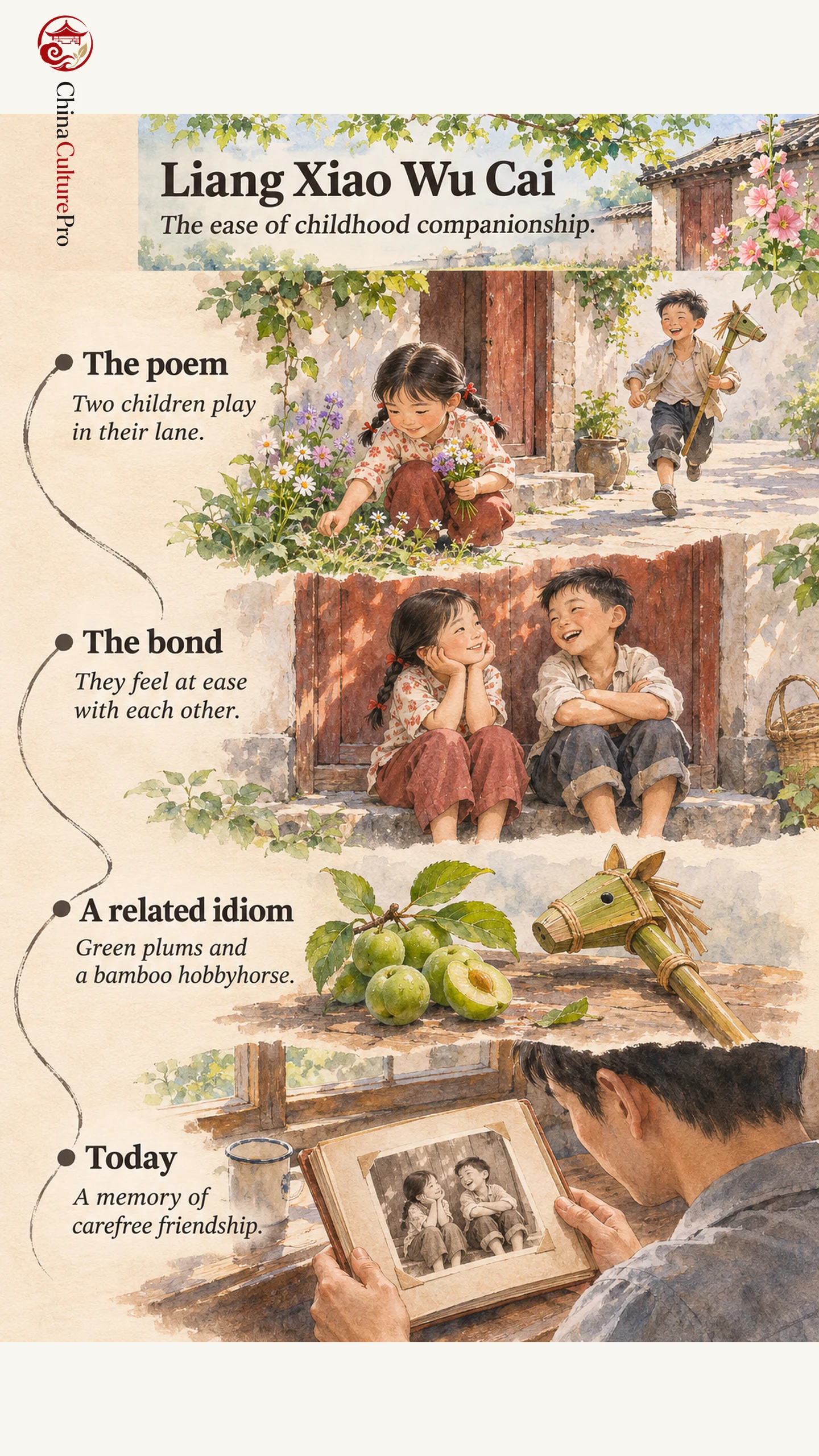
A girl picks flowers near her door, and a boy arrives riding a stick like a horse. Li Bai gives their ordinary play an extra weight through the adult speaker’s memories of marriage and separation. The idiom takes its meaning from that early scene.[2]
The Children in Li Bai’s Changgan Xing
In the first of Li Bai’s two poems titled Changgan Xing (长干行, Chánggān xíng), a wife addresses her absent husband. She remembers how they lived in the same neighborhood and played with green plums and a bamboo hobbyhorse. As the poem moves on, she recalls her early shyness after marriage and the pain of his departure.[1][2]
The childhood scene matters because the adult narrator remembers a time when the pair could spend time together without awkwardness. Her husband’s absence makes the memory of carefree companionship particularly vivid.[2]
How the Poem Became a Four-Character Idiom
The line in the poem uses five characters for the description, 兩小無嫌猜. The idiom leaves out 嫌 and retains the idea of two young children with no suspicion between them. Here, the last character has the sense of suspecting or doubting. “Innocent childhood companions” usually conveys more of the phrase than a literal rendering about guessing.[1][2]
Liang Xiao Wu Cai and Qing Mei Zhu Ma
Qing Mei Zhu Ma (青梅竹马, qīng méi zhú mǎ) takes its green plums and bamboo hobbyhorse from the nearby line of the same poem. It evokes a shared childhood through the things the children play with. Liang Xiao Wu Cai describes how freely the children relate to each other. A speaker can put the two phrases together to bring both the play and the ease of the friendship to mind.[1][2][3]
How to Use Liang Xiao Wu Cai Today
A narrator might describe two children holding hands in an old neighborhood photo as Liang Xiao Wu Cai. The expression can also sound wistful when adults remember how easily they got along before they drifted apart. In a translation, a phrase like “they played together without a trace of awkwardness” can preserve that tone.[1]
FAQs About Liang Xiao Wu Cai
Does the Idiom Always Imply Romance?
The original poem follows childhood companions into marriage, and modern stories sometimes make the same connection. The idiom can also describe childhood friends who grow apart or simply remain friends.[1][2]
What Does Cai Mean Here?
Here the character means to suspect or doubt. The whole idiom describes how unguarded the two children are with each other.[1]
Why Do the Two Idioms Often Appear Together?
Both draw on the opening of the same Li Bai poem. One names the objects in the play scene, and the other names the quality of the friendship.[1][2][3]
Sources
[1] Taiwan Ministry of Education. Dictionary of Chinese Idioms entry for Liang Xiao Wu Cai
[2] Wikisource. Li Bai’s two Changgan Xing poems
[3] Taiwan Ministry of Education. Dictionary of Chinese Idioms entry for Qing Mei Zhu Ma