
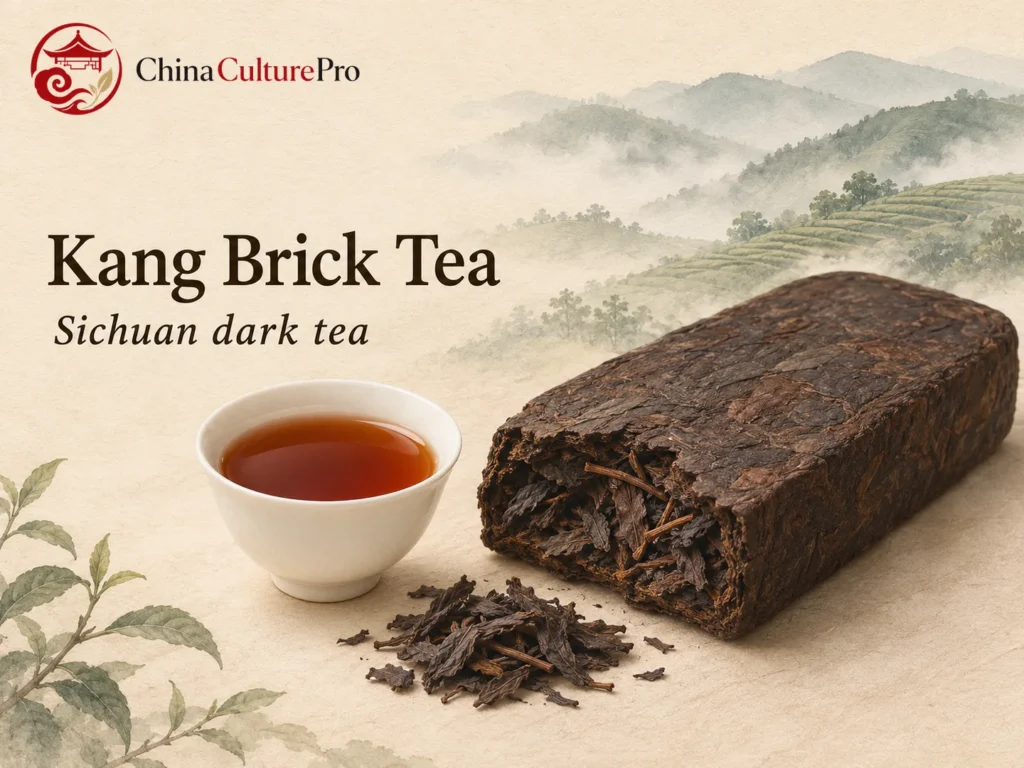

Quick Answer: What Is Kang Brick Tea?
Kang brick tea(康砖茶,kāngzhuān chá)is a compressed Sichuan tea associated with Ya’an’s southern-route border-tea tradition. It belongs to heicha(黑茶,hēichá), the dark-tea category.[1][2]
- Category: Dark-tea processing and fermentation explain the tea inside the brick.
- Form: Pressing gives prepared leaf a compact shape.
- Cup: Red-brown liquor and a mellow taste are characteristic descriptions.
- Serving: It can be drunk plain or used as a base for a prepared butter tea.
Brick shape alone does not identify Kang tea; butter is added when serving.[1][4][5]

A brick’s label, broken interior and brewed cup each reveal something different about the tea.
Sichuan Origins and the Southern-Route Tea Tradition
Nanlu Biancha(南路边茶,nánlù biānchá), southern-route border tea, is associated with Ya’an in Sichuan and supply to Tibetan communities in Tibet, Qinghai, Ganzi and Aba. The regional craft received national intangible-cultural-heritage recognition in 2008.[1]
Kang brick sits within that wider tradition. For the broader regional context, see Ya’an Tibetan tea. The name identifies a tea product as well as appearing in commercial branding: GB/T 9833.4-2013 is specifically titled “Compressed tea—Part 4: Kang zhuan tea.”[2]
Fermentation and Pressing Have Different Jobs
Wodui(渥堆,wòduī), pile fermentation, helps develop the tea’s character. A Kang-brick simulation study identified microorganisms and humid heat as major influences on the changes in the leaf. This is more than simply leaving compressed tea to grow older.[3]
Brick-making has a separate shaping stage: prepared material is sorted and blended, then weighed, steamed, pressed, cooled and dried. Steam helps the leaf take its compressed form; pressing alone does not explain its fermentation.[4]
Mechanization is also part of the history. A Kang-brick pressing production line was developed in 1988, so the heritage connection should not be read as a promise that every current brick is entirely handmade.[4]
What the Brick and the Cup Look Like
Expect compressed brown material rather than a loose collection of delicate green shoots. One aged Kang-brick product uses rougher leaf material and gives a deep brown infusion with red tones, described as mellow and thick. Those are lot-specific observations, not a fixed aroma across makers and storage histories.[5]
Other bricks have different identities. For example, Jingwei Fu tea has its own identity and production tradition. For the physical forms, compare tea cakes, tuocha and bricks.
Preparing Kang Brick Tea for Different Drinks
Both boiling and infusion are offered for one aged Kang-brick product. Neither dairy nor a single cooking method defines every packet.[5]
For a concrete boiling example, a separate 650 g aged product gives this method. It belongs to that product, rather than a rule for all Kang bricks.[7]
- Measure approximately 10 g of tea for 1 liter of water.
- Simmer for 10–15 minutes, then let it steep for 2–3 hours.
- Strain, reheat and drink.
Suyou cha(酥油茶,sūyóu chá), butter tea, combines tea liquor with butter and salt; some preparations also include ground walnut. The additions change the prepared drink, not the tea’s identity.[1]
Reading a Kang Brick Tea Label
Check the producer, product name, net weight and production information. Tea origin labels help distinguish a regional claim from a manufacturer or brand name. A standard number is another useful identifier, but it does not reveal an individual brick’s storage history.
A Ya’an factory display included 500 g Kang bricks, while a separate retail product is listed at approximately 650 g. Read the actual packet’s weight.[6][7]
For an older brick, ask about storage as well as the stated year. One aged product explicitly records storage in Guangzhou. Provenance is more informative than an automatic “older is better” assumption.[5]
FAQs About Kang Brick Tea
Is Kang Brick Tea the Same as Pu-erh?
No. Kang brick is a named product associated with Sichuan’s border-tea tradition. A compressed shape or dark liquor does not make a tea Pu-erh.
Does Kang Brick Tea Already Contain Butter or Milk?
A plain tea brick and a prepared butter tea are different products. Check the ingredients, especially when buying an instant or premixed drink.
Does Every Kang Brick Weigh 500 Grams?
No. That size is documented, but larger formats also exist. The net weight on the actual product is the useful measurement.
Sources
[1] China Intangible Cultural Heritage Network. 黑茶制作技艺(南路边茶制作技艺)
[2] National Public Service Platform for Standards Information. 紧压茶 第4部分:康砖茶
[3] Zhang Kainong, Xiao Chun and Zhang Xian. 康砖渥堆中主要成分的变化规律
[4] China Agriculture Press. 砖茶加工
[5] King Tea Mall. 90’s YaAn “Kang Zhuan” (Kang Brick—Tibetan Tea) 500g Tea, Dark Tea, Sichuan Province
[6] Song Caiwei, Chen Min and Wang Yunxi, Sichuan Agricultural University. 传承千年制茶工艺,引领茶文化新潮流
[7] Orijin Tea. 2002 Tibetan Kang Zhuan 650g