

Quick Answer: What Is Jiuniang?
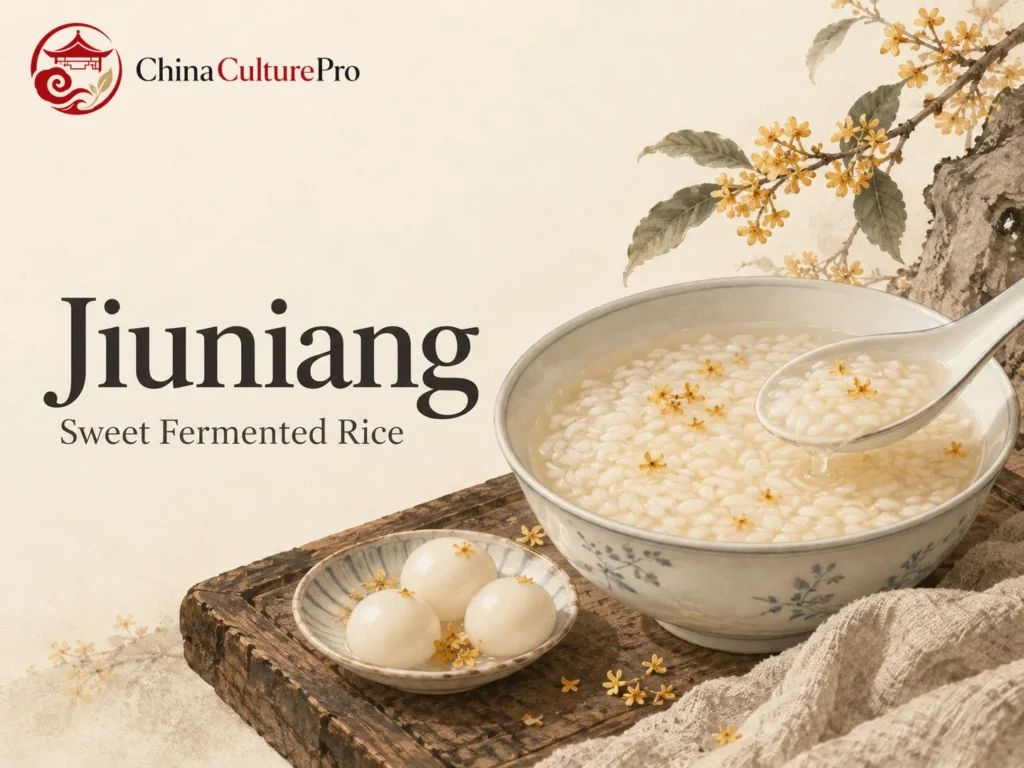
Jiuniang (酒酿, jiǔniàng) is sweet fermented rice: softened grains sit in fragrant liquid rather than being strained out. It is eaten with a spoon, added to sweet soups, or used as an ingredient in cooked dishes.
- Ingredients: Glutinous rice and a fermentation starter produce the characteristic grains and sweet liquid.
- Flavor: Sweet, gently tangy and lightly wine-like, with variation between products.
- Alcohol: Fermentation can produce alcohol; a sweet taste does not make a product alcohol-free.
Think of it as a rice ferment with culinary uses, rather than assuming every bottle labeled rice wine is interchangeable. [1]

A jar with white rice grains suspended in liquid may look more like a dessert ingredient than a drink. That appearance is useful: the grains are part of what you eat. Within Chinese drinks and sweet-food traditions, jiuniang sits at the boundary between a beverage, a spoonable food and a cooking ingredient.
How Rice Becomes Sweet and Lightly Alcoholic
The starter, jiuqu (酒曲, jiǔqū), is more than ordinary baker’s yeast. Its microorganisms and enzymes help break cooked rice starch into sugars; yeasts can then convert some of those sugars into alcohol. Sweetness and alcoholic fermentation can therefore coexist. [1]
The process begins with cooked rice that is cooled before the starter is mixed in. During fermentation, the grains soften and liquid develops. The balance depends on the rice, starter, temperature and fermentation time. A description such as “two days” is not a universal quality or safety test, and a longer ferment does not simply mean a better dessert.
This also explains why two jars can taste different without either being mislabeled. One may be thick and notably sweet; another may have more liquid or a sharper fermented aroma. Exact alcohol content belongs to the particular product, not to the English word “sweet.” A fermentation study describes change over time under its own experimental conditions, rather than establishing one alcohol percentage for every household or commercial jar. [1]
Names That Can Mislead on a Label
Laozao (醪糟, láozāo) is another common name for this grain-containing ferment. Mijiu (米酒, mǐjiǔ) is a broader label, while huangjiu (黄酒, huángjiǔ) names a different fermented grain-wine category. English translations can flatten these distinctions into “rice wine.” [2]
| Label | Éléments à observer | Why the distinction matters |
|---|---|---|
| Jiuniang or laozao | Soft rice grains with sweet fermented liquid | Suitable when a dish needs both rice texture and sweetness |
| Mijiu | Read the product description and alcohol label | The name alone does not identify a spoonable sweet ferment |
| Huangjiu | A fermented grain wine generally sold as a liquid | Not the same texture or ingredient role as dessert rice mash |
When a recipe asks for jiuniang, clear cooking wine will not supply the missing grains. A salty cooking preparation can change the dish even more. The wider Chinese rice wine family helps explain the naming overlap; huangjiu has its own serving and brewing traditions.
Traditional Ways to Serve Jiuniang
The ingredient’s appeal is the combination of tender grains, a fragrant liquid and a sweetness that can be adjusted within a dish. Three uses show how differently it can work.
- Sweet rice-ball soup: Tangyuan (汤圆, tāngyuán) can be served in a liquid containing jiuniang. Small plain rice balls make the fermented rice itself more prominent than a rich filling would.
- Egg and rice-cake preparations: Local versions combine the ferment with eggs or strips of rice cake, giving the bowl more substance.
- A spoonful in a cooked dish: The grains and liquid can contribute sweetness and fermented flavor; the amount should follow the actual recipe rather than a one-for-one cooking-wine substitution. [3][4][5]
Yuanxiao (元宵, yuánxiāo) also appears in this dessert context. A documented festival recipe pairs rice dumplings with jiuniang and serves the dish hot. The difference between tangyuan and yuanxiao concerns how the dumplings are made, not a rule that only one may meet fermented rice. [3]
Osmanthus is a familiar aromatic partner in sweet dishes. If the floral note interests you, osmanthus desserts provide the broader food context. That pairing does not turn every sweet rice ferment into a bottle of floral wine.
Regional Hospitality and Family Food
Chongming, in Shanghai, offers a specific example of jiuniang as hospitality food. Local accounts describe families preparing it around the New Year for reunions and visiting relatives, with rice-cake strips and egg preparations among the winter dishes. Chongming sweet-jiuniang making was included in Shanghai’s seventh municipal intangible-cultural-heritage list in 2024. This is a local designation, not a claim that all jiuniang nationwide follows one protected recipe. [4]
The example is useful because it shows how an everyday ferment can carry family meaning without requiring a formal ceremony. A jar may be kept for visitors, cooked into a warming bowl or associated with a particular relative’s kitchen. The region’s ingredients and methods shape its character; another family’s version may differ in sweetness, texture and occasion. [4]
Historical writing also discusses possible antecedents of sweet, grain-containing fermented foods. Those comparisons do not establish a single inventor or prove that a modern commercial jar is identical to an ancient preparation. A precise local record is stronger evidence for a specific custom than a sweeping claim that one recipe has remained unchanged for thousands of years. [2]
Choosing a Jar and Using It at Home
Start with the dish you want to make. For a spoonable dessert or rice-ball soup, check that the product actually contains rice grains. For a recipe needing a clear wine, use its specified wine instead. The distinction is especially helpful when shopping through translated product listings.
- Read the full label: Check ingredients, declared alcohol where provided, whether the product is ready to eat, and any preparation directions.
- Follow product-specific storage: An unopened shelf-stable jar and an opened refrigerated product need not have the same instructions.
- Use clean utensils: Keep the remaining jar separate from ingredients and utensils used for cooking.
- Check suitability before serving: If someone avoids alcohol, do not infer suitability from the word sweet or from gentle heating.
For a first taste, use a small amount in a familiar sweet preparation rather than replacing all the liquid at once. The grains affect texture as well as flavor. A bowl of tangyuan or another of the traditional Chinese desserts gives the ingredient a clear culinary setting.
FAQs About Jiuniang
Is jiuniang the same as rice wine?
Jiuniang belongs to the fermented-rice family, but it normally retains edible grains. “Rice wine” can also mean a clear or stronger liquid product, so the English label alone is not enough.
Can jiuniang contain alcohol even when it tastes sweet?
Yes. Starch can become sugar while some sugar becomes alcohol. Check the individual product rather than treating sweetness as an alcohol test.
Can I use rice vinegar instead?
Rice vinegar provides acidity rather than the same sweet grains and fermented-rice texture. It is not a direct substitute in a jiuniang dessert.
Sources
[1] Foods research article. Analysis of the Changes in Physicochemical Properties and Microbial Communities During Fermentation of Sweet Fermented Rice
[2] Anthony Tursi. Alcoholic Beverages in China: Terminology, History, and Cultural Significance
[3] Smithsonian Folklife Festival. Recipe from China: Rice Wine Yuanxiao
[4] Chongming District Government. 崇明甜酒酿制作技艺申遗成功——崇明的市级非物质文化遗产代表性项目达到20个
[5] Chongqing Local Chronicles Office. 巴乡清,先秦名酒