

Quick Answer: What Is Jade Rabbit?
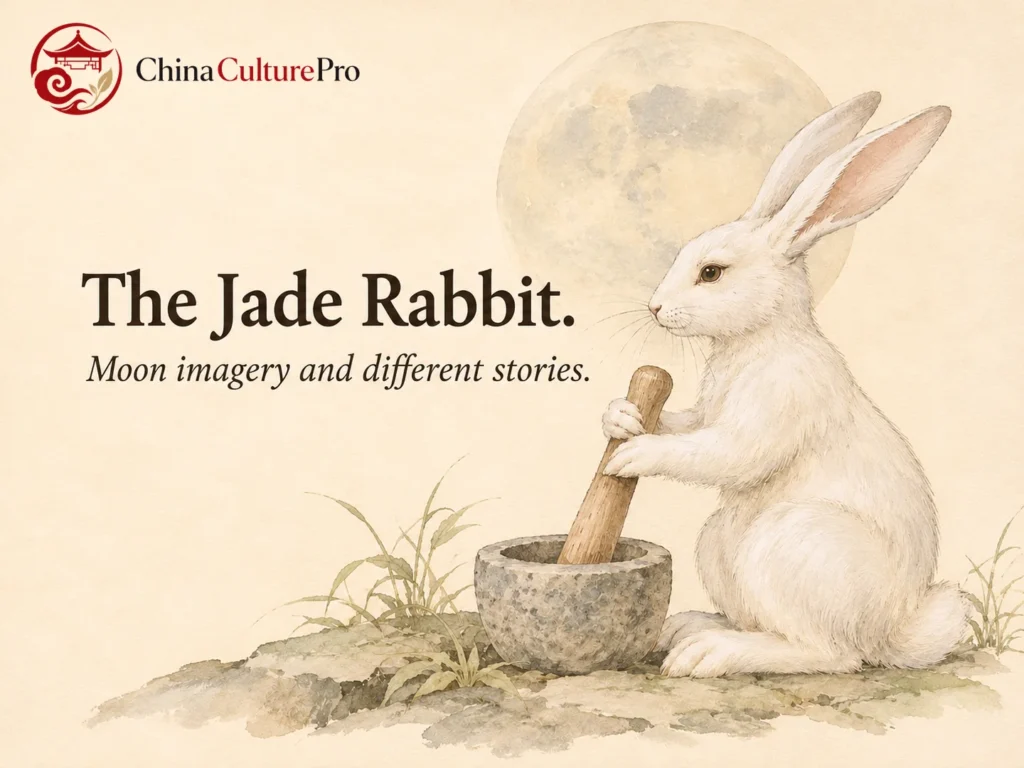
The Jade Rabbit(玉兔,Yùtù)is the moon hare of Chinese legend, commonly shown working a pestle and mortar. Its medicine-pounding image appears in early writing and later art, while other rabbit stories have different settings and purposes.[1]
- Recognizable image: A hare associated with the moon, often pounding a legendary elixir.
- Related figure: The moon goddess appears with the rabbit in Chinese imagery.
- Different stories: A Buddhist tale explains a hare’s image on the moon through generosity; Japanese images commonly show rice-cake pounding instead.
The shared lunar animal does not make these accounts one continuous story.
A rabbit holding a pestle beside a round moon is immediately recognizable in much Chinese festival imagery. A rabbit on an antique object can be harder to identify. This guide to Chinese mythology follows the written motif, an actual bronze mirror and distinct storytelling traditions to explain what the surrounding details contribute.
Early Writing and the Medicine-Pounding Hare
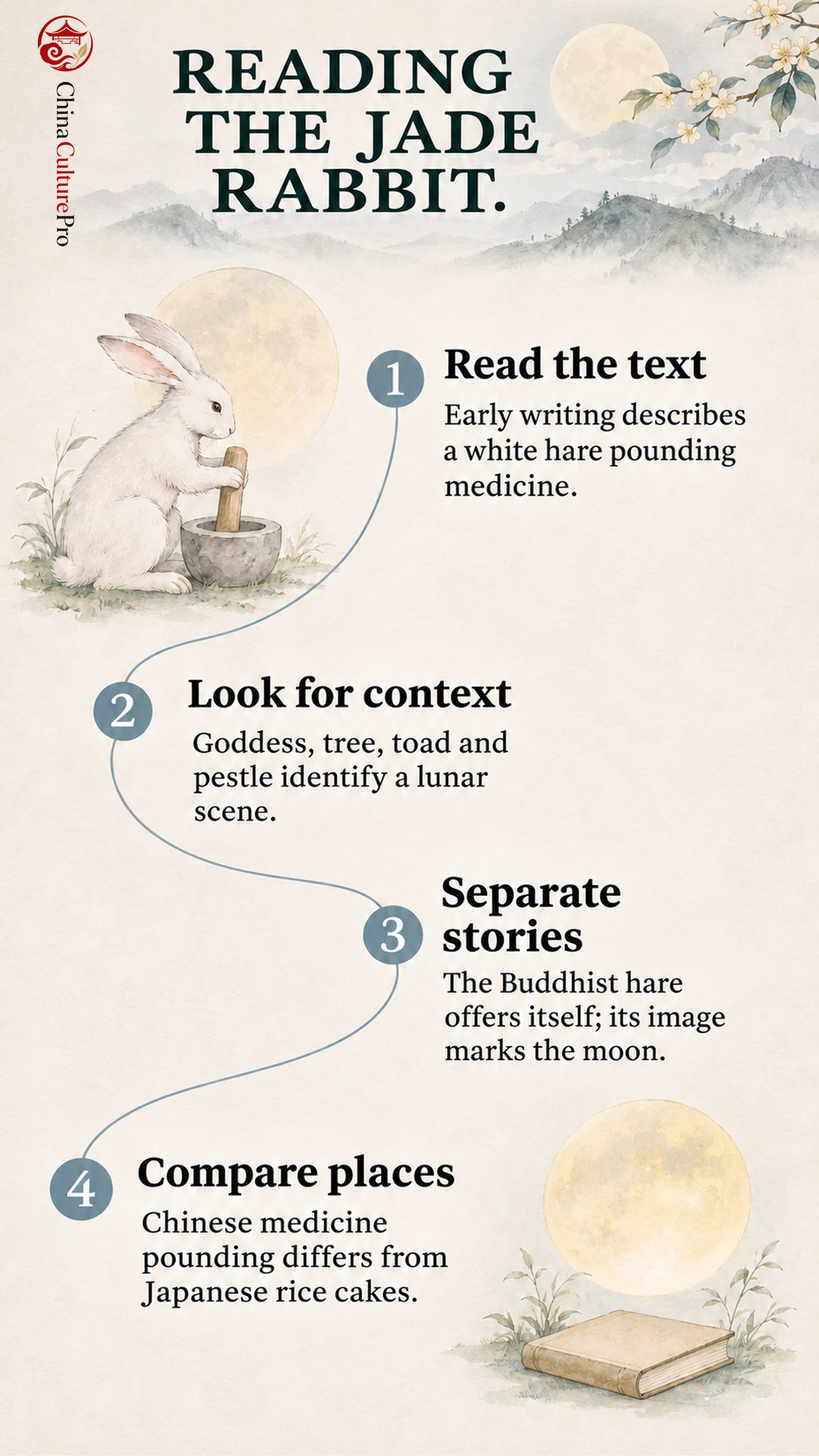
One useful early reference comes from Fu Xuan(傅玄,Fù Xuán), a third-century writer. A passage attributed to him asks what is in the moon and answers with a white hare pounding medicine. It survives as a quotation in the later encyclopedia Taiping Yulan(太平御览,Tàipíng yùlǎn).[1]
This gives us a specific action, not a complete origin adventure. The animal belongs to the moon; its work is pounding medicine. The passage does not explain how it arrived, make it a named human’s transformed pet or supply the whole cast of a modern illustrated story.
The difference between a quoted writer and the surviving compilation also matters. Fu Xuan’s lifetime and the encyclopedia’s compilation belong to different periods. Citing the passage establishes that this motif had a textual history; it does not establish an exact year when somebody first imagined the lunar hare.
Within the story world, the medicine connects the rabbit with extraordinary longevity or immortality. That association explains the mortar and pestle as meaningful attributes rather than ordinary kitchen equipment. It is a legendary function, not a description of an actual remedy.
Chang’e and the Moon Palace in Art
Chang’e(嫦娥,Cháng’é)and the rabbit can occupy the same lunar scene without every surviving story describing their relationship identically. A concrete example is the Metropolitan Museum of Art’s *Mirror with moon goddess and rabbit*, a Chinese bronze dated to the eighth–ninth century, object 25.24.[2]
On its decorated back, a tree rises through the center. The goddess occupies the left, with flowing forms around her; the rabbit stands to the right, leaning toward its working equipment. A toad appears below. The small figures are organized around the mirror’s projecting central boss rather than arranged like characters in a straight illustrated narrative.
That layout supplies an important reading lesson: the rabbit’s meaning emerges from the ensemble. Tree, goddess, toad and pounding equipment establish a lunar setting together. A lone rabbit with no such context leaves more possibilities open.
The museum explains its scene through a version in which the goddess takes her husband’s immortality elixir and flees to the moon.[2] Other Chang’e stories deserve their own treatment. The mirror demonstrates a historical visual association, rather than proving that every retelling must use this precise plot.
A Separate Buddhist Story of Generosity
The hare story in *Jataka* 316 concerns a previous life of the Buddha. A wise hare encourages its animal companions to give food to anyone in need. Having no suitable food to offer, it resolves to offer its own body. Sakka, a divine figure disguised as a religious mendicant, tests that willingness.[3]
The hare leaps into a miraculous fire, but the flames do not harm it. Sakka then marks the moon with a hare’s image and returns the animal to a grassy resting place in its forest. In this telling, the moon receives a commemorative image: the hare is neither killed by the fire nor physically installed there as a medicine maker.
Its central subject is generosity. There is no pestle, immortality potion or flight with a moon goddess. Reading this narrative alongside the Chinese lunar hare reveals a shared moon-animal image with a different moral explanation. For the wider religious setting, see Chinese Buddhism.
Festival Images and Regional Variations
Tu’er Ye(兔儿爷,Tù’eryé), often translated as Lord Rabbit, gives the lunar animal another form. A late-Qing painted-clay example in the Palace Museum wears official dress, holds a pestle and rides a deer. The museum connects these colorful Mid-Autumn toys with moon worship and a legend of the lunar rabbit making medicine for people.[4] This dressed, human-bodied figure differs from the small naturalistic hare on the Tang mirror.
Such objects belong beside Mid-Autumn festival traditions, where moon viewing and lunar imagery provide a recognizable context. They do not require every household to use the same toy or tell the same story.
Across the sea, Japanese moon rabbits commonly pound rice cakes. Researcher Daigo Shoji contrasts that activity with Chinese elixir pounding and studies changes in the depicted equipment.[5] A similar silhouette can therefore carry a different task. When comparing folk tales, identify the locality, source and action before assuming the picture preserves one unchanged story.
FAQs About Jade Rabbit
Is the Jade Rabbit made of jade?
The name identifies a legendary moon hare, not a required material. Its image can appear in bronze, clay and other media.[2][4]
Does the moon rabbit pound medicine or rice cakes?
Medicine or an immortality elixir is characteristic of Chinese imagery; rice cakes are common in Japanese versions.[1][5]
Does every rabbit image represent the Jade Rabbit?
No. Look for a lunar setting, pounding equipment or other identifying context. A rabbit motif alone is insufficient.
Sources
[1] Shidianguji. Taiping Yulan, celestial section: quotations concerning the moon
[2] Metropolitan Museum of Art. Mirror with moon goddess and rabbit, object 25.24
[3] Ancient Buddhist Texts. Jataka 316: The Birth Story about the Wise Hare
[4] Palace Museum. Painted-clay Lord Rabbit
[5] Daigo Shoji, ISAS/JAXA. Why does the rabbit on the Moon pound rice cakes?