

Quick Answer: How Do You Read a Chinese Museum Label?
Start with the object title and the date, then use the object number to find the full record. If a label gives both a dynasty and a century, the century often narrows the longer dynastic period.[1]
- Object title. Look for the form or function and any romanized Chinese name.[1]
- Period and date. Write both down and preserve words like “about” or “probably.”
- Object number. Copy every digit and separator, along with the museum name.[1]
A credit line acknowledges an acquisition. The full catalog may also show earlier ownership and images of details.[1]

If you want to find a Chinese object again after leaving the gallery, a photograph without the label may be difficult to match to a catalog record. Many objects are cataloged as bowls, jars or ritual vessels. A note that keeps the title, date and museum identifier together gives you a much better starting point.
Start With a Real Object Label
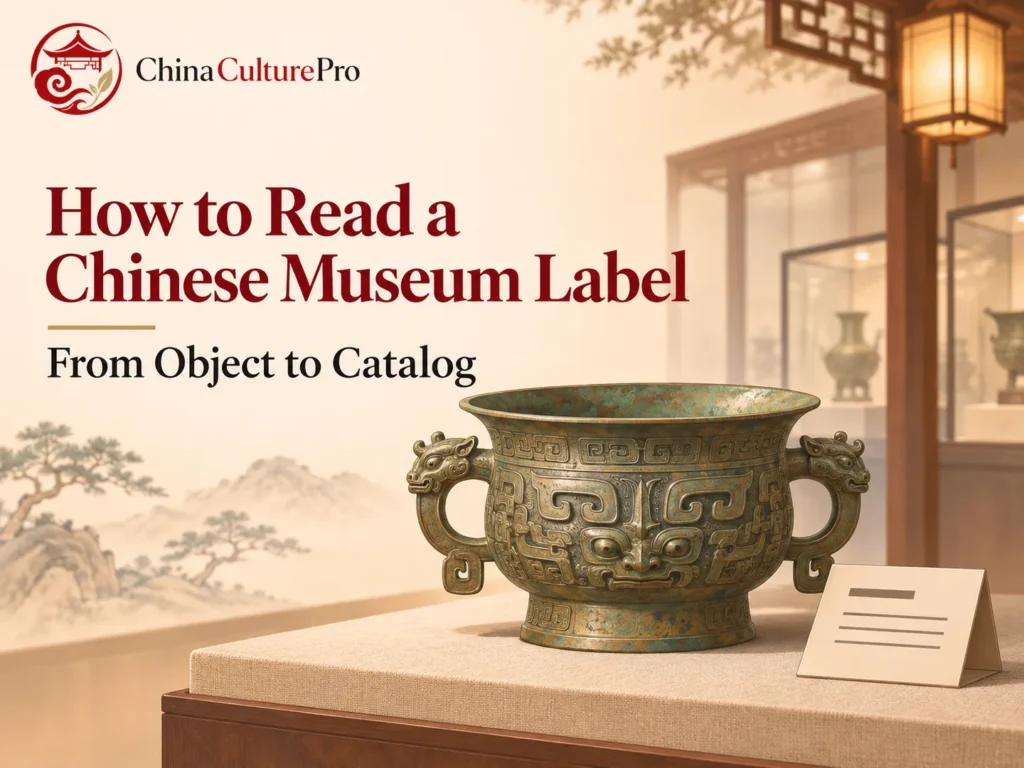
A Western Zhou bronze in the Metropolitan Museum of Art’s online catalog is called a grain serving vessel, or gui (簋, guǐ). The title tells you about the form and conventional use of the vessel. The photograph can help you see why the rim diameter is smaller than the vessel’s width from handle to handle.[1]
| Champ | What to record from this example | Ce qu’elle indique |
|---|---|---|
| Object title | Grain serving vessel (Gui) | The cataloged object type and the form name. |
| Période | Western Zhou, 1046–771 BCE | The larger historical period. |
| Date | 11th–10th century BCE | The catalog’s narrower dating of this piece. |
| Support | Bronze | The material category. |
| Object number | 1978.526.2 | The identifier for this record at this museum. |
| Credit line | Gift, 1978 | How the acquisition is acknowledged and dated. |
Here the period spans roughly three centuries, but the object date places the work nearer the beginning. The year 1978 in the credit line relates to the gift. Even though the identifier begins with the same digits, copy the identifier as a complete unit. Its remaining segments matter when recovering the exact record.[1]
The guide to Chinese museum collections explains the relationship between the display label, object record and provenance. For the photograph in front of you, the first goal is to preserve enough information to retrieve that record.
Read a Museum Label in Four Steps
- Match the title to the object. Compare the stated form and material with the thing on display. In a crowded case, check whether the label applies to one piece, a lid and its vessel, or a group.
- Keep the date fields separate. Copy the dynasty, the narrower date, and any qualifying words as they appear. Give inscription dates and acquisition dates separate places in your notes.
- Save the museum and object number. Record the full identifier. Search for it with the museum’s name, then compare the online image and dimensions with the label you saw.
- Open the full catalog entry. Check which details the record actually supplies. Look for images of the base or interior, object history, and any explanation of an attribution.
For a bronze, an exterior photograph may show handle shape and ornament while leaving the interior out of view. If the record identifies text on the inside, use the museum’s transcription or translation as a separate piece of evidence. A guide to reading Chinese bronze inscriptions explains what that text may contribute.
If a gallery label identifies the exhibited piece as a replica, record that word. A date printed next to a replica can refer to the historical model. The distinction matters when comparing museum replicas and historical objects.
When the Mark and the Date Tell Different Stories
A catalog description of an early fifteenth-century dragon jar uses “Xuande mark and period.” The jar bears a reign inscription on its shoulder, and the catalog assigns the object to the Xuande reign, 1426–35. Here the wording describes agreement between the inscription and the museum’s dating.[2]
Other objects bear an earlier reign name even though they were made later. Potters in the Qing Kangxi reign copied marks from the Ming Chenghua reign, for example. When a record distinguishes the mark from the assigned period, write down both. For dates on Chinese antiques, this is often the most useful distinction to preserve.[3]
A label is a brief curatorial statement. If the name describes a vessel form, compare the rim, body and foot using the guide to Chinese porcelain shapes. When you compare Chinese porcelain marks, pay attention to whether the writer is describing the characters on the object, giving a date for the object, or doing both in separate fields.
FAQs About Chinese Museum Labels
Is the number on the label the date of the object?
An object number identifies a catalog record at that museum. The object’s date is usually given separately, sometimes alongside the dynasty. In the bronze example, the 1978 gift and the 11th–10th century BCE object date refer to different events.[1]
What if two museums use different English titles?
Compare the Chinese form name if one is given, along with the image, material, dimensions and date. Similar titles may describe different objects, and museums can use different English wording for the same form. Include the museum name and its identifier in your notes.
Is a credit line the same as provenance?
A credit line acknowledges a gift, purchase fund, lender or other contribution. Provenance concerns where an object was and who owned or held it over time. The full record may give only part of that history.[1][4]
Sources
[1] The Metropolitan Museum of Art. Grain serving vessel (Gui), object 1978.526.2
[2] The Metropolitan Museum of Art. Jar with dragon, object 37.191.1
[3] Asian Ceramics. Reign marks on Chinese ceramics
[4] Taipei Art Anthology. Reading a wall label