


Quick Answer: What Are Henan Carp Noodles?
Henan carp noodles usually means liyu beimian(鲤鱼焙面,lǐyú bèimiàn), a Kaifeng dish combining sweet-and-sour carp with very fine crisp noodles.
- Fish: Carp forms the substantial center of the dish.
- Noodles: Fine strands provide a contrasting texture.
- Serving: The two components meet on a shared plate rather than in a noodle-soup bowl.[1]
The English word “baked” sometimes appears in the name, but it does not adequately explain how the noodles are prepared.
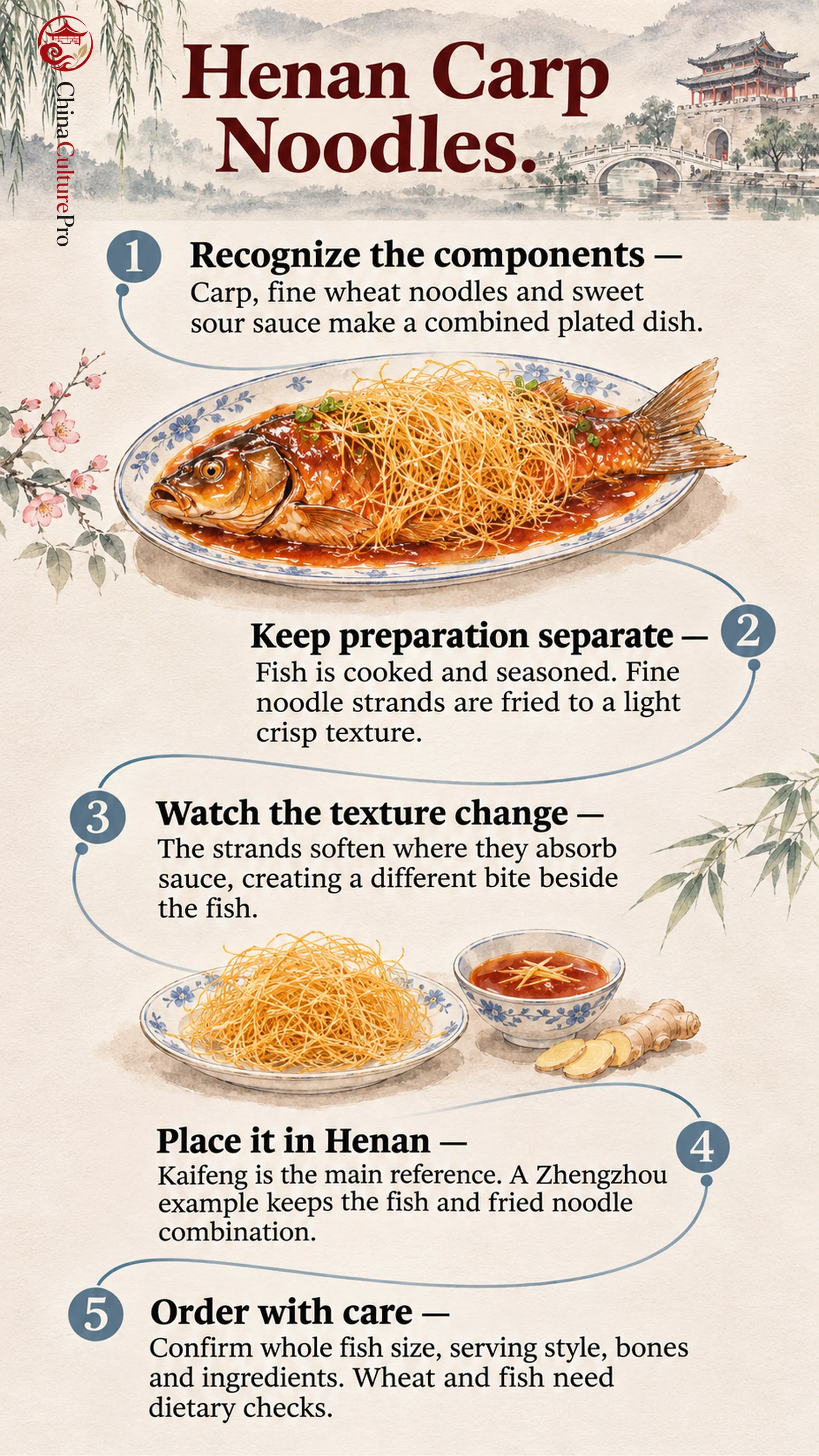
A whole fish sits beneath a loose tangle of pale golden threads, with glossy sweet-sour sauce around it. The platter brings together fish and a separately prepared noodle component. That combination makes this Henan cuisine specialty different from a bowl of boiled noodles, while giving diners both fish and a sauce-absorbing accompaniment.
Carp, Fine Wheat Noodles and Sweet-Sour Sauce
The traditional association is with Yellow River carp. The fish is cleaned, cut to help preparation and seasoning, and fried before the sauced finish. Sugar and vinegar build the sweet-sour balance; ginger, salt and cooking wine appear in a documented preparation. Starch helps give the sauce a coating consistency. The resulting flavor is more specific than simply “sweet fish”: acidity and savory seasoning remain part of the dish.[2]
The noodle component is associated with longxu mian(龙须面,lóngxū miàn), literally dragon-whisker noodles. Here the important qualities are very fine strands and a light, brittle fried texture. These are wheat noodles rather than rice vermicelli; their slender form distinguishes them from thicker noodle cakes.[3]
The flour-based noodles remain a Chinese noodle preparation even though the presentation is a fish course. They are not rice vermicelli, shredded vegetables or a garnish that must be left uneaten.
Why the Fish and Noodles Are Prepared Separately
Skilled pulling turns wheat dough into fine threads, which are then oil-fried until golden and airy. The two components need different treatment. Fish must become a cooked, seasoned centerpiece; the noodle threads need to retain their fine structure during frying. Combining them only for serving allows crisp strands and moist fish to coexist. Sauce then changes the noodles as diners eat, softening the portions it reaches.[3]
A Zhengzhou description similarly pairs deep-fried carp with stock-enhanced seasoning and separately fried fine noodles. This reinforces the central process distinction: the strands are prepared as their own component before meeting the fish. The finished plate is not made by boiling an ordinary portion of noodles underneath raw carp.[4]
The amount of sauce contact determines how much of that initial crispness remains at each bite.
Kaifeng Identity and the Zhengzhou Version
Kaifeng is the main cultural reference for this combined dish. Its presence in provincial food presentations places it among Henan’s recognized local specialties. Henan also has flour-based soup noodles, including huimian, but that shared use of wheat does not make the dishes interchangeable.[1]
The Zhengzhou example shows the dish beyond Kaifeng while retaining carp, fine fried noodles and a sauced finish. It does not establish a separate standardized school of carp noodles. For a particular order, confirm the presentation, seasoning and whether the noodles arrive separately.[4]
A verifiable modern record is the publication of Kaifeng local standard DB4102/T 044-2023 on December 12, 2023, with an implementation date of January 12, 2024. That dated record should not be confused with proof of the dish’s invention or a rule binding every restaurant worldwide.[5]
Ordering and Sharing a Whole-Fish Dish
Ask whether the order is a whole fish, how many people the portion suits and whether the noodles arrive over the fish or alongside it. As a shared banquet dish, it needs serving space and attention to bones. Taking small portions makes it easier to separate edible flesh from the skeleton without scattering the entire noodle topping.
Fish and wheat are central ingredient checks. Soy-containing seasonings, cooking wine or a particular frying oil need separate confirmation. For allergies, ask about the sauce and shared equipment as well as visible ingredients; removing noodles afterward cannot establish that the fish is free from wheat contact.[6]
FAQs About Henan Carp Noodles
Are the noodles baked in an oven?
The characteristic fine strands are oil-fried until crisp. “Baked noodles” is a menu translation that can obscure this important detail.[3]
Is this the same as Henan huimian?
No. Huimian is a broth-based noodle dish; carp noodles combines a fish course with fine crisp noodles.[1]
Can the dish be gluten-free?
The usual wheat noodles contain gluten. An adapted order would also require checks of sauces and cross-contact.
Sources
[1] China Cultural Centre Kuala Lumpur. Discover Henan, A Home in My Heart
[2] Henan Tourism. Sweet-and-sour carp with fine noodles
[3] CCTV. Kaifeng: Central Plains food
[4] Zhengzhou Culture, Radio, Television and Tourism Bureau. Yellow River carp with fine noodles
[5] National Public Service Platform for Standards Information. DB4102/T 044-2023 record
[6] US Food and Drug Administration. Food Allergies: What You Need to Know