

Quick Answer: Who Is Han Shaogong?
Han Shaogong (韩少功, Hán Shàogōng; born 1953) is a Chinese novelist, short-fiction writer, essayist and translator whose writing makes ordinary language an instrument of uncertainty. Rural Hunan and the experience of being sent to work in the countryside inform his fiction.[1]
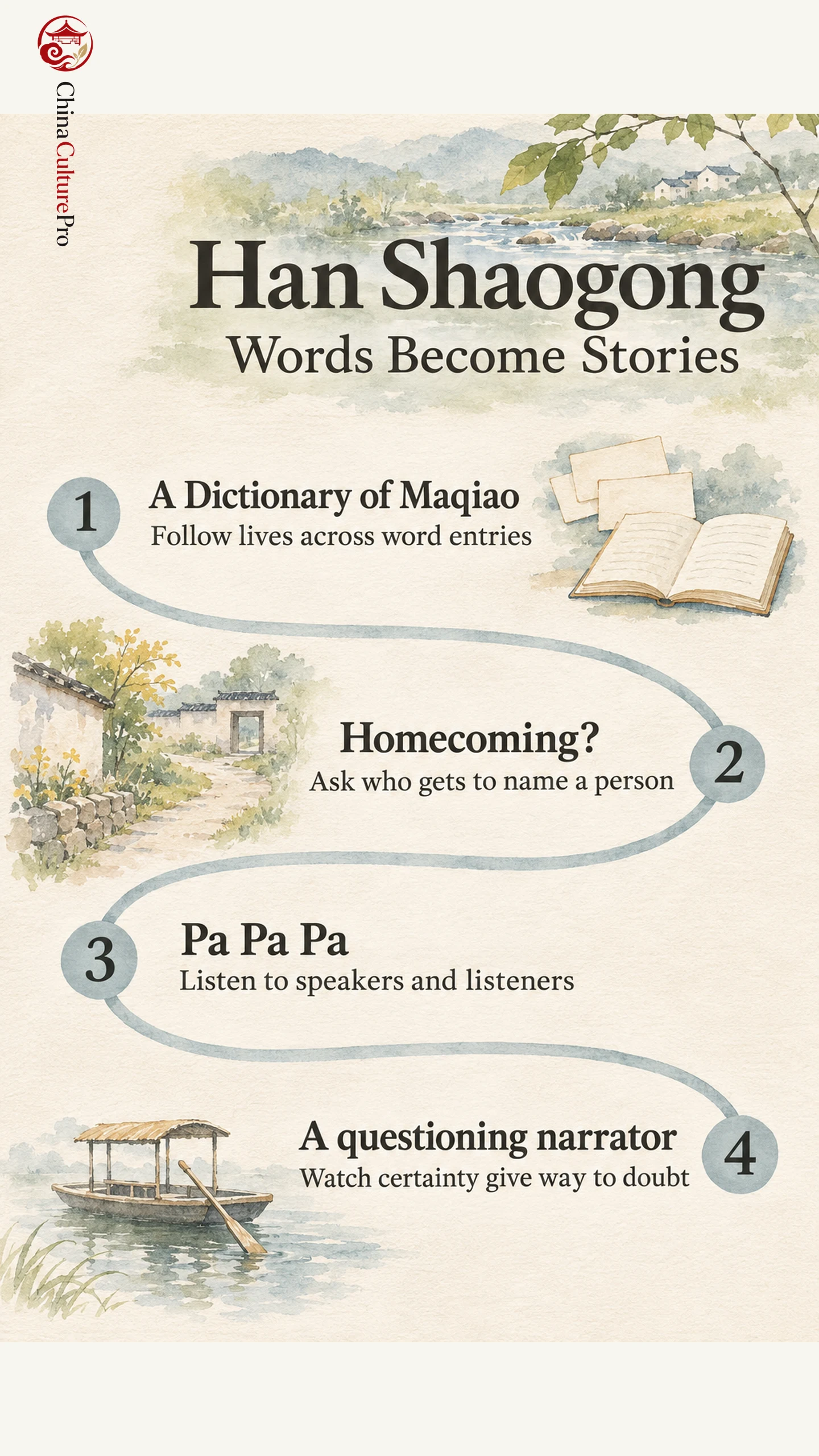
- Begin with A Dictionary of Maqiao (马桥词典, Mǎqiáo Cídiǎn) for linked stories organized as word entries.
- Choose the collection Homecoming? and Other Stories, including Homecoming? (归去来, Guī Qù Lái), for shorter fiction in Martha Cheung’s translation.
- Read his interest in cultural roots as a critical, creative inquiry into inherited ways of thinking.[2]
The Maqiao novel is imaginative literature, not a dependable phrasebook or an ethnographic inventory of all Hunan communities.[9]
A familiar word can become unfamiliar when somebody else uses it. Han’s fiction asks readers to stay with that discomfort: who gets to name a place, define a person or decide which explanation counts? His work belongs in modern and contemporary Chinese literature, where experiments with storytelling accompany arguments about history and cultural inheritance.
A Rural Experience and the Search for Roots
Han went to farm in Miluo, Hunan, in 1968, moved to the county cultural centre in 1974 and entered Hunan Normal College in 1978. These dates give the rural years a concrete setting within the Cultural Revolution; they do not make every fictional episode a documented incident from his life.[1]
He became a leading advocate of roots-seeking literature (寻根文学, Xúngēn Wénxué), notably through the 1985 essay The Roots of Literature (文学的根, Wénxué de Gēn). In a 2018 interview, he explained that this meant examining and creatively using local cultural resources while developing dialogue with the West. It did not mean restoring the past unchanged.[2]
Folklore, speech and inherited habits can therefore provide both imaginative resources and objects of criticism. An old custom appearing in a story is an invitation to examine its effects, not automatic evidence of the author’s approval.
Three Works to Begin With
| Work | What it offers | A useful question |
|---|---|---|
| A Dictionary of Maqiao, 1996. | A novel in which an urban youth’s encounters with a village emerge through interconnected word entries. | When does defining a word turn into telling somebody’s history? [3][4] |
| Homecoming?, 1985. | A story of a visitor whose identity becomes entangled with somebody the villagers remember. | Who controls the narrator’s identity: himself or the people addressing him? [6] |
| Pa Pa Pa (爸爸爸, Bà Bà Bà). | A novella whose opening presents a child with two recurrent utterances and adults who react to them. | How much meaning comes from the speaker, and how much from listeners? [8] |
The first work suits readers who enjoy a novel assembled from smaller units. The other two are included in Cheung’s Homecoming? and Other Stories, together with The Blue Bottle-cap and Woman Woman Woman, giving a compact introduction to Han’s shorter fiction.[7]
For Homecoming?, scholar Lee Hyun Jeong emphasizes mistaken identity: Huang Zhixian is taken for Ma Yanjing, a former sent-down youth, and becomes entangled with Ma’s obligations and guilt. This is a useful interpretive starting point for the story’s unsettled relation between memory, belonging and responsibility.[6]
What a Dictionary Entry Can Do to a Story
The opening River entry makes the newcomer’s ear part of the plot. A tonal distinction in local speech separates waterways of different sizes; the narrator follows directions expecting a substantial river and finds a small brook. The mistake puts his assumptions, rather than merely the villagers’ vocabulary, on display.[5]
Luo River then moves from geography into an embarrassing memory. The educated youths evade a ferryman’s fare while imagining themselves as resistance heroes. His persistence defeats their cleverness, and they pay. The episode turns a place-name into a test of the narrator’s self-importance.[5]
The narrator’s uncertainty matters. In the River entry, his misunderstanding is visible to the reader; in Luo River, his youthful certainty about his own cleverness becomes embarrassing. Keep that gap between experience and retrospective explanation in view.[5]
Paola Iovene notes that the Chinese edition’s index uses character-stroke order, while the entries themselves follow an arrangement selected for reading. Begin in the printed sequence and follow recurring people and memories rather than treating every entry as an isolated explanation.[4]
English Editions and a Useful Reading Approach
Julia Lovell translated A Dictionary of Maqiao for Columbia University Press in 2003. The Dial Press paperback appeared in 2005; this is another edition of Lovell’s translation, not evidence that the Chinese novel was first written then.[3][10]
Martha Cheung’s Homecoming? and Other Stories was published by Renditions in 1992. The question mark is part of the English collection’s title; its four-story contents make the edition useful for comparing forms.[7]
Read an entry once for events, then return to its heading. Ask whether the story confirms the apparent definition or makes it harder to sustain. For shorter fiction, track who speaks a name, who accepts it and who resists. These questions keep form and human consequences together without forcing every strange event into a single symbolic code.
Han received the 2011 Newman Prize for Chinese Literature. In his acceptance speech, he described the Maqiao book as fiction that protects variation, individuality and the right to doubt authoritative explanations—a helpful statement of its ambitions.[9]
FAQs About Han Shaogong
Is A Dictionary of Maqiao a language reference book?
No. It is a novel using dictionary entries as a storytelling form. Han himself stressed that it does not promise authoritative, universal definitions.[9]
Does roots-seeking mean simply celebrating tradition?
No. Han’s account includes examining and transforming local cultural resources. Stories may expose the costs of inherited beliefs as well as their imaginative possibilities.[2]
Do you need to read his books chronologically?
No. Start with the Maqiao novel for extended experiments in language, or the Homecoming? collection for a shorter introduction. Returning to the wider career afterward helps place these different forms together.
Sources
[1] China Writers Association. Han Shaogong: member biography
[2] Wen Hui. Interview with Han Shaogong, 15 July 2018
[3] Columbia University Press. A Dictionary of Maqiao
[4] Paola Iovene. Authenticity, Postmodernity, and Translation: The Debates around Han Shaogong’s Dictionary of Maqiao
[5] Han Shaogong, translated by Julia Lovell. A Dictionary of Maqiao: authorized excerpt
[6] Lee Hyun Jeong. Research abstract on Homecoming, sent-down memory and cultural roots, 2009
[7] Research Centre for Translation, CUHK. Homecoming? and Other Stories: publication details and contents
[8] China Youth Press book excerpt, indexed by MegBook. Chinese Good Fiction: Han Shaogong, Pa Pa Pa opening
[9] Han Shaogong, translated by Ning Yu and Jonathan Stalling. The 2011 Newman Prize Lecture
[10] Penguin Random House. A Dictionary of Maqiao: Dial Press edition details